
Pulp Fiction, 1929 · page 42 of 97
Air Wonder Stories, December 1929 — page 42: what you’re looking at
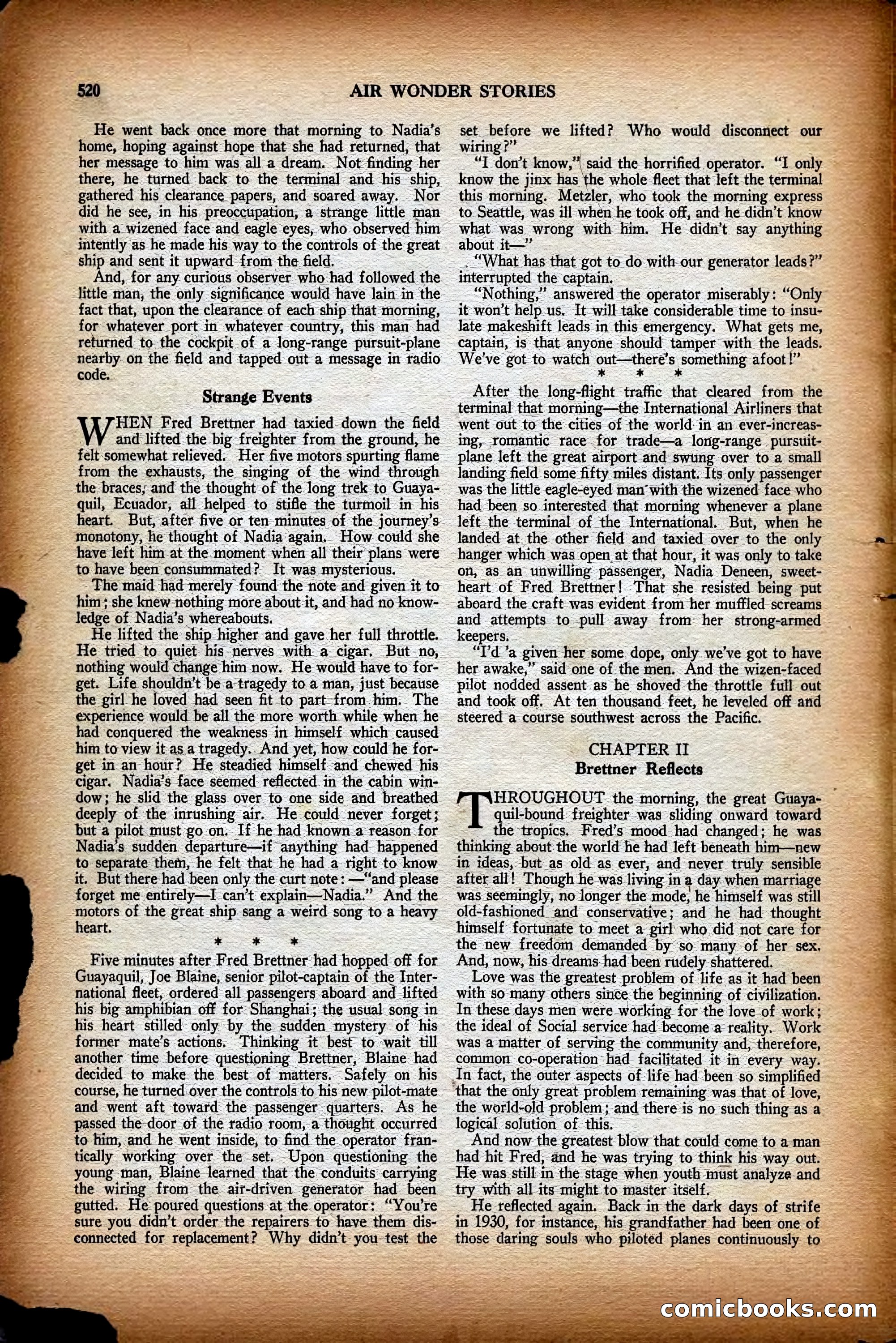
A restored page from Pulp Fiction, 1929. Page through the whole issue in the reader above.
📄 Transcribed text from this page (OCR, searchable)
Machine-transcribed from the original scan — historical spelling and the odd misread are preserved.
520 AIR WONDER STORIES He went back once more that morning to Nadia’s home, hoping against hope that she had returned, that her. message to him was all a dream. Not finding her there, he. turned back to the terminal: and his ship, gathered his clearance papers, and soared away. Nor did he see, in his. preoccupation, a strange little man with a wizened face-and eagle eyes, who observed him intently as he made his way to the controls of the great ship and sent it upward from the field. And, for any curious observer ‘who:had followed the little man, the only significance would have lain in the fact that, upon the clearance.of each ship that morning, for whatever port in whatever country, this man had returned to the cockpit of a long-range pursuit-plane nearby. on the field and tapped out a message in tadio code. Strange Events HEN Fred Brettner had taxied down the field and lifted the big freighter from the ground, he felt:somewhat relieved. Her five motors spurting flame from the exhausts, the singing of the wind through the braces;-and the thought of the long trek to Guaya- quil, Ecuador, all helped to stifle the turmoil in his heart. But, after five or ten minutes of the journey’s monotony, he thought of Nadia again. How could she have Jeft him at the-moment when-all their plans were to have been consummated:?. It. was mysterious. The maid:had merely found:the note and given it to him+-she knew nothing more about-it, and had no know- ledge of Nadia’s whereabouts. He lifted the ship higher and gave her full throttle. He tried to quiet his nerves with a cigar, But-no, nothing would change him now. He would have to for- get. Life shouldn't be a:tragedy to a man, just because the girl he loved had seen fit to part from-him. The experience would be all the more worth while when he had conquered the weakness in himself which caused him to view it as.a tragedy. And yet, how could he for- get in-an- hour? He steadied himself and chewed: his cigar. Nadia’s face seemed: reflected in the cabin win- dow; he slid the glass over to one side and breathed deeply of the inrushing-air. He could never forget; but-a pilot must go on:. If he-had-known a reason-for Nadia's sudden departure—if anything had- happened to separate then, he felt that he had a right:to know it. But there had been only.the curt note: —“and please forget me entirely—I can’t explain—Nadia.” And the motors of the great ship sang a weird song to.a heavy heart. (a Five minutes after Fred Brettner had hopped off: for Guayaquil, Joe Blaine, senior pilot-captain of the Inter- national fleet, ordered all passengers.aboard and lifted his big amphibian off for:Shanghai; the usual: song in his heart stilled- only by the sudden mystery of ‘his former mate’s actions. Thinking it best to wait. till another time before questioning Brettner, Blaine had decided to make: the best: of matters. Safely on his course, he turned over the controls to his new pilot-mate and went aft toward the passenger quarters. As he passed the door of the radio room, a thought occurred to him, and he went inside, to find the operator fran- tically working over the set. Upon questioning the young man, Blaine learned that the conduits carrying the wiring from the: air-driven generator had been gutted. He poured questions at the operator: ‘You're sure you didn’t order the repairers to have them: dis- connected for replacement? Why didn’t- you-test the a aan Sets set. before we lifted? Who would disconnect our wiring?” “T_ don’t know,” said the-horrified operator. “I only know the jinx has the whole fleet that left the terminal this morning. Metzler, who took the morning express to. Seattle, was ill when he took-off, and he-didn’t know what was wrong with him. He didn’t say anything about it—”’ . ‘What has-that got to do with our generator leads?” interrupted the captain. “Nothing,” answered the operator miserably: “Only it-won’t help-us. It-will take considerable time to insu- late makeshift leads in this emergency. What gets me, captain, is that anyone should tamper with the leads. We've got to watch outshone =: somethiais afoot !” After the long-flight traffic that cleared from the terminal that morning—the International Airliners that went out to the cities of the world:in an ever-increas- ing, romantic race for trade—a long-range. pursuit- plane left the great airport and swung over to a small landing field some fifty miles distant. Its only passenger was the little eagle-eyed man‘with the wizened face who had-been so interested that morning whenever a plane left_the terminal of the International. But, when he landed at. the other field and taxied over to the only hanger which was open at that hour, it was only to take on, as an unwilling passenger, Nadia Deneen, sweet- heart of Fred Brettner!.-That she resisted being put aboard the craft was evident from her muffled-screams and attempts to pull away from: her strong-armed keepers. “T'd.’a given her some dope, only we've got to have her awake,” said one of the men.-And the wizen-faced pilot nodded assent as he shoved the throttle full out and took off. At ten thousand feet, he leveled off and steered a course southwest across the Pacific. CHAPTER II Brettner Reflects quil-bound freighter was sliding onward toward the tropics. Fred’s mood had changed; he was thinking about:the world he had left beneath him—new in ideas, but as old as ever, and never truly sensible after all! Though he-was living-in a day when marriage was seemingly, no longer the mode, he himself was still old-fashioned and conservative; and he had thought himself fortunate to meet a girl who did not care for the new freedom demanded by so: many of her sex, And, now, his dreams-had been rudely-shattered. Love was the greatest problem of life as it had been with so-many others since the beginning of civilization. In these days men were-working for the love of work; the ideal of Social service had become a reality. Work was amatter of serving the community and, therefore, common co-operation had- facilitated it in every way. EP csomnt Sets the -moming, the great Guaya- An fact, the outer aspects of life had been so simplified that the only great- problem remaining was that of love, the world-old problem; and there is no such thing as a logical solution of this. And now the greatest blow that could come to a-man had hit Fred, and he was trying to think his way out. He was still:in the stage when youth must analyze and try with all its might to master itself. He teflected again. Back in the dark days of strife in 1930, for instance, his grandfather had been one of those daring souls who piloted planes continuously. to = S comicbooks.com —