
Pulp Fiction, 1929 · page 37 of 97
Air Wonder Stories, December 1929 — page 37: what you’re looking at
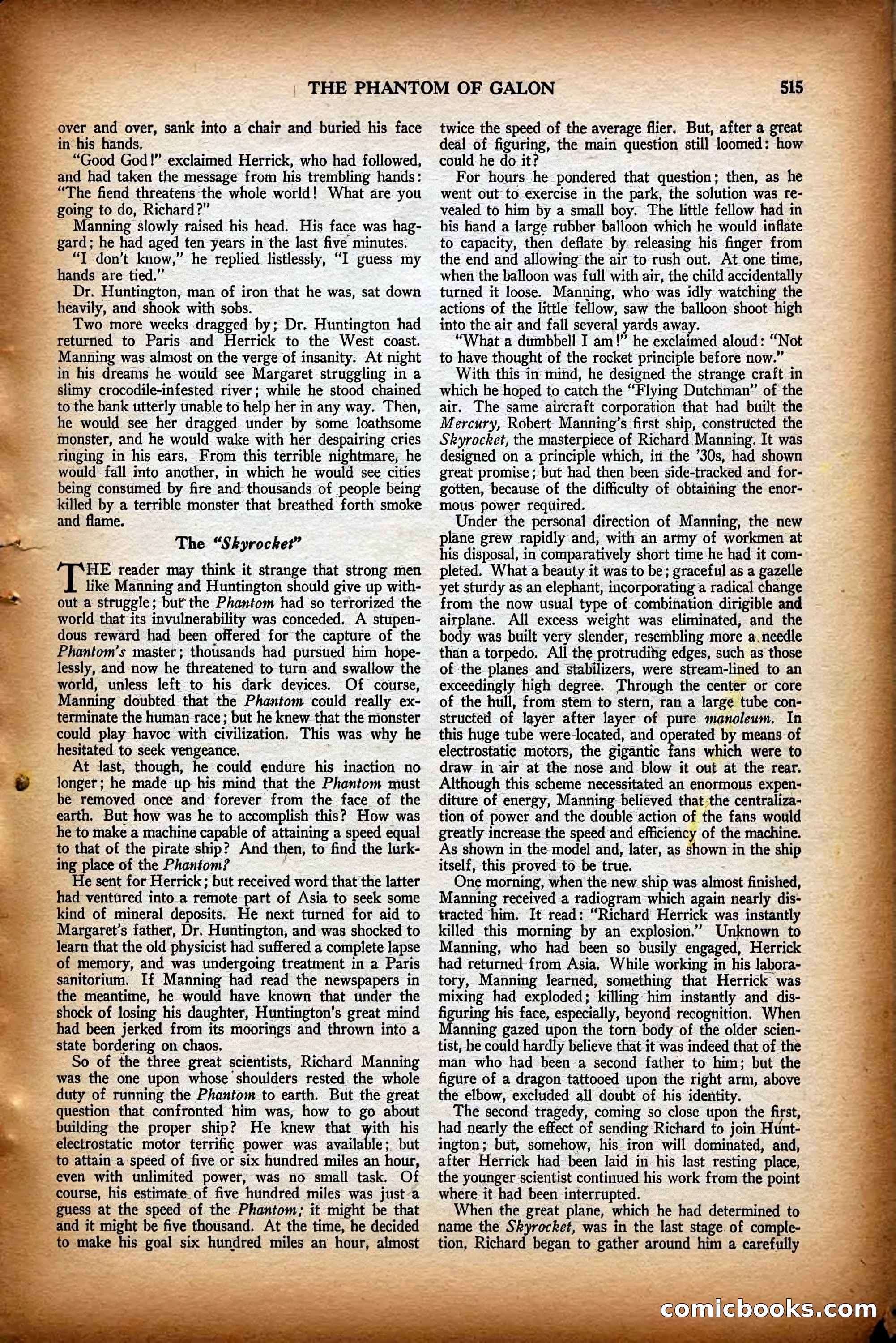
A restored page from Pulp Fiction, 1929. Page through the whole issue in the reader above.
📄 Transcribed text from this page (OCR, searchable)
Machine-transcribed from the original scan — historical spelling and the odd misread are preserved.
_— - 7 - = — ~ _ a on Ne a Ne ee ee | THE PHANTOM OF GALON over and over, sank into a chair and buried his face in his hands, “Good God!” exclaimed Herrick, who had. followed, and had taken the message from his trembling hands: “The fiend threatens the whole world! What are you going to do, Richard?” Manning slowly raised his head. His face was hag- gard; he had aged ten years in the last five minutes. “I don’t know,” he replied listlessly, “I guess my hands are tied.” Dr. Huntington, man of iron that he was, sat down heavily, and shook with sobs. Two more weeks dragged by; Dr. Huntington had returned to Paris and Herrick to the West coast. Manning was almost on the verge of insanity. At night in his dreams he would see Margaret struggling in a slimy crocodile-infested river; while he stood chained to the bank utterly unable-to help her in any way. Then, he would see her dragged under by some loathsome monster, and he would wake with her despairing cries ringing in his ears, From this terrible nightmare, he would fall into another, in which he would see cities being consumed by fire and thousands of people being killed by a terrible monster that breathed forth smoke and flame. The “Skyrocket” | ie reader may think it strange that strong men like Manning and Huntington should give up with- out a struggle; but the Phantom had so terrorized the world that its invulnerability was conceded. A stupen- dous reward had been offered for the capture of the Phantom’s master; thousands had pursued him hope- lessly, and now he threatened to turn-and swallow the world, unless left to his dark devices. Of course, Manning doubted that the Phantom could really ex- terminate the human race ; but he knew that the monster could play havoe with civilization. This was why he hesitated to seek vengeance, At fast, though, he could endure his inaction no longer; he made up his mind that the Phantom must be removed once and forever from the face of the earth, But how was he to accomplish this? How was he to make a machine capable of attaining a speed equal to that of the pirate ship? And then, to find the lurk- ing place of the Phantom? He sent for Herrick ; but received word thatthe latter had ventured into a remote part of Asia to seek some kind of mineral deposits. He next turned for aid to Margaret’s father, Dr. Huntington, and-was shocked to learn that the old physicist had suffered a complete lapse of memory, and was undergoing treatment in a Paris sanitorium. If Manning had read the newspapers in the meantime, he would have known that under the shock of losing his daughter, Huntington's great mind had been jerked from its moorings and thrown into a state bordering on chaos, So of the three great scientists, Richard Manning was the one upon whose shoulders rested the whole duty of running the Phantom to earth. But the great question that confronted him was, how to go about building the proper ship? He knew that with his electrostatic motor terrific power was available; but to attain a speed of five or six hundred. miles an hour, even with unlimited power, was no small task. Of course, his estimate of five hundred miles was just-a guess at the speed of the Phantom; it might be that and it might be five thousand. At the time, he decided to make his goal six hundred miles an hour, almost Pe Le - — Yo 515 twice the speed of the average flier. But, after a great deal of figuring, the main question still loomed: how could he do it? For hours he pondered that question; then, as he wert out to-exercise in the park, the solution was re- vealed to him by a small boy. The little fellow had in his hand a large rubber balloon which he would inflate to capacity, then deflate by releasing his finger from the end and allowing the air to rush out. At one time, when the balloon was full with air, the child accidentally turned it loose. Manning, who was idly watching the actions of the little fellow, saw the balloon shoot high into the air and fall several yards away. “What a dumbbell I am!” he exclaimed aloud: “Not to have thought of the rocket principle before now.” With this in mind, he designed the strange craft in which he hoped to catch the “Flying Dutchman” of the air. The same aircraft corporation that had built the Mercury, Robert Manning’s first ship, constructed the Skyrocket, the masterpiece of Richard Manning. It was designed on a principle which, iri the ’30s, had shown great promise; but had then been side-tracked-and for- gotten, because of the difficulty of obtaining the enor- mous power required. Under the personal direction of Manning, the new plane grew rapidly and, with an army of workmen at his disposal, in comparatively short time he had it com- pleted. What a beauty it was to be; graceful as a gazelle yet sturdy as an elephant, incorporating a radical change from the now usual type of combination dirigible and airplane. All excess weight was eliminated, and the body: was built very slender, resembling more a, needle than a torpedo. All the protruditg edges, such as those of the planes and stabilizers, were stream-lined to an exceedingly high degree. Through the center or core of the hull, from stem to stern, ran a large tube con- structed of layer after layer of pute manoleum. In this huge tube were-located, and operated by means of electrostatic motors, the gigantic fans which were to draw in air at the nose and blow it out at the rear. Although this ‘scheme necessitated an enormous expen- diture of energy, Manning believed that-the centraliza- tion of power and the double action of the fans would greatly increase the speed’and efficiency of the machine. As shown in the model and, later, as shown in the ship itself, this proved to be true. One morning, when the new ship was almost finished, Manning received a radiogram which again nearly dis- tracted him. It read: “Richard Herrick was instantly killed this morning by an explosion.”’ Unknown to Manning, who had been so busily engaged, Herrick had returned from Asia, While working in his labora- tory, Manning learned, something that Herrick was mixing had exploded; killing him instantly and dis- figuring his face, especially, beyond recognition. When Manning gazed upon the torn body of the older scien- tist, he could hardly believe that it was indeed that of the man who had been-a second father to him; but the figure of a dragon tattooed upon the right arm, above the elbow, excluded: all doubt of his identity. The second tragedy, coming so close upon the first, had nearly the effect of sending Richard to join Hunt- ington; but, somehow, his iron will dominated, and, after Herrick had been laid in his last resting place, the younger scientist continued his work from the point where it had been interrupted. When the great plane, which he had determined to name the Skyrocket, was in the last stage. of comple- tion, Richard began to gather around him a carefully —— comicbooks . ) . . | | | . . . | | CT es RE EE et a a a er ry et -cO %,