
Pulp Fiction, 1929 · page 33 of 97
Air Wonder Stories, December 1929 — page 33: what you’re looking at
A restored page from Pulp Fiction, 1929. Page through the whole issue in the reader above.
📄 Transcribed text from this page (OCR, searchable)
Machine-transcribed from the original scan — historical spelling and the odd misread are preserved.
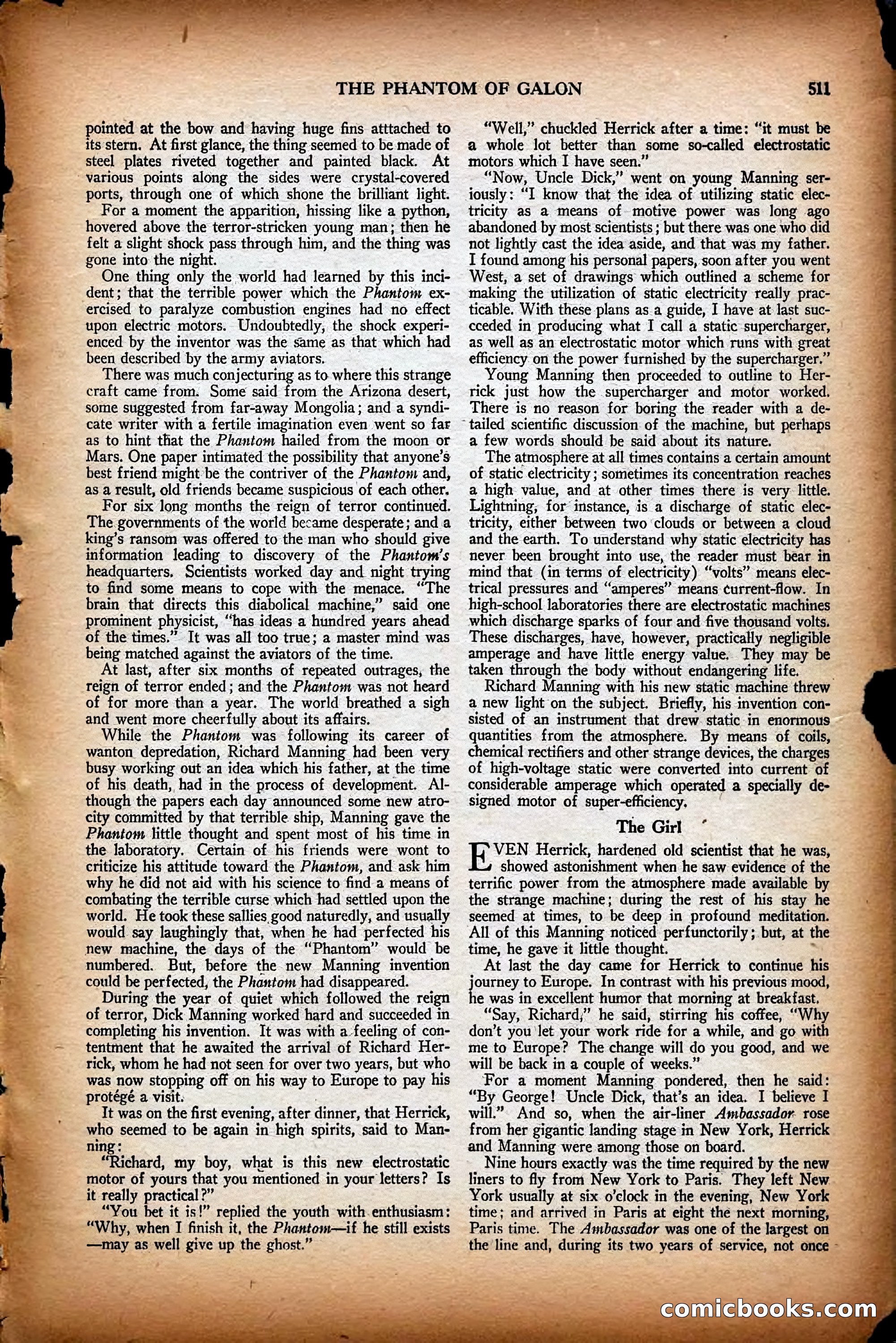
pointed at the bow and’ having huge fins atttached to its‘stern. At first glance, the thing seemed to be made of steel plates riveted together and painted black. At various points along the sides were crystal-covered ports, through one of which shone the brilliant light. For a moment the apparition, hissing like a python, hovered above the terror-stricken young man; then he felt a slight shock pass through him, and the thing was gone into the night. One thing only the world had learned by this inci- dent; that the terrible power which the Phantom ex- ercised to paralyze combustion engines had no effect upon electric motors. Undoubtedly, the shock experi- enced by the inventor was the same as that which had been described by the army aviators. There was much conjecturing as to where this strange craft came from. Some said from the Arizona desert, some suggested from far-away Mongolia; and a syndi- cate writer with a fertile imagination even went so far as to hint that the Phantom hailed from the moon or Mars. One paper intimated the possibility that anyone’s best friend mightbe the contriver of the Phantom and, as a result, old friends became suspicious of each other. For six long months the reign of terror continued. The governments of the world became desperate; anda king’s ransom was offered to the man who should give information leading to discovery of the Phantom’s headquarters, Scientists worked day and night trying to find some means to cope with the menace. “The brain that directs this diabolical machine,” said one prominent physicist, “has ideas a hundred years ahead of the times.” It was all too true; a master mind was being matched against the aviators of the time. At last, after six months of repeated outrages, the reign of terror ended; and the Phantom was not heard of for more than a year. The world breathed a sigh and went more cheerfully about its affairs. While the Phantom was following its career of wanton depredation, Richard Manning had been very busy working out an idea which his father, at the time of his death, had in the process of development. Al- though the papers each day annotnced some new atro- city committed by that terrible ship, Manning gave the Phantom little thought and spent most of his time in the laboratory. Certain of his friends were wont to criticize his attitude toward the Phantom, and ask him why he did not aid with his science to find a means of combating the terrible curse which had settled upon the world. He took these sallies good naturedly, and usually would say laughingly that, when he had perfected his new machine, the days of the “Phantom” would be numbered. But, before the new Manning invention could be perfected, the Phantom had disappeared. During the year of quiet which followed the reign of terror, Dick Manning worked hard and succeeded in completing his invention. It was with a feeling of con- tentment that he awaited the arrival of Richard Her- rick, whom he had not-seen for over two years, but who was now stopping off on his way to Europe to pay his protégé a visit: It was on the first evening, after dinner, that. Herrick, who seemed to be again in high spirits, said to Man- ning: “Richard, my boy, what is this new electrostatic motor of yours that you mentioned in your letters? Is it really practical?” “You het it is!” replied the youth with. enthusiasm: “Why, when I finish it, the Phantom—if he still exists —may as well give up the ghost.” THE PHANTOM OF GALON “Well,” chuckled Herrick after a time: “it must be a whole lot better than some so-called electrostatic motors which I have seen.” “Now, Uncle Dick,” went on young Manning ser- iously: “I know that the idea of utilizing static elec- tricity as a means of motive power was long ago abandoned by most scientists ; but there was one who did not lightly cast the idea aside, and that was my father. I found among his personal papers, soon after you went West, a set of drawings which outlined a scheme for making the utilization of static electricity really prac- ticable. With these plans as.a guide, I have at last suc- cceded in producing what I call a static-supercharger, as well as an electrostatic motor which runs with great efficiency. on the power furnished by the supercharger.” Young Manning then proceeded to outline to Her- rick just how the supercharger and motor worked. There is no reason for boring the reader with a de- “tailed scientific discussion: of the machine, but perhaps a few. words should be said about its nature. The atmosphere at all times contains a certain amount of static electricity ; sometimes its concentration reaches a high value, and at other times there is very: little. Lightning; for’ instance, is a discharge of static elec- tricity, either between two ‘clouds or between a cloud and the earth. To understand why static electricity has never been brought into use, the reader must bear in mind that (in terms of electricity) “volts” means elec- trical pressures and “amperes” means current-Alow. In high-school laboratories there are electrostatic machines which discharge sparks of four and five thousand volts. These discharges, have, however, practically negligible amperage and have little energy value, They may be taken through the body without endangering life. ‘ Richard Manning with his new static machine threw a new light on the subject. Briefly, his inverition con- sisted of an instrument that drew. static in enormous quantities from the atmosphere. By means of coils, chemical rectifiers and other strange devices, the charges of high-voltage static were converted into current. of considerable amperage which operated a specially de- signed motor of super-efficiency, The Girl * VEN Herrick, hardened old scientist that he was, showed astonishment when he saw evidence of the terrific power from the atmosphere made available by the strange machine; during the rest of his stay he seemed at times, to be deep in profound meditation. ‘All of this Manning noticed perfunctorily ; but, at th time, he gave it little thought. : At last the day came for Herrick to continue his ourney to Europe. In contrast with his previous mood, e was in excellent humor that morning at breakfast. “Say, Richard,” he said, stirring his coffee, “Why don’t you ‘let your work ride for a while, and go with me to Europe? The change will do you good, and we will be back in a couple of weeks.” ‘For a moment Manning pondered, then he said: “By George! Uncle Dick, that’s an idea. I believe I will.” And so, when the air-liner Ambassador. rose from her gigantic landing stage in New York, Herrick and Manning were among those on board. Nine hours exactly was the time required by the new liners to fly from New York to Paris. They left New York usually at six. o'clock in the evening, New York time; and arrived in Paris at eight the next morning, Paris time. The Ambassador was one of the largest on the’ line and, during its two years of service, not once - : 7 ~ e€omicbooks.com a