
Pulp Fiction, 1929 · page 13 of 97
Air Wonder Stories, December 1929 — page 13: what you’re looking at
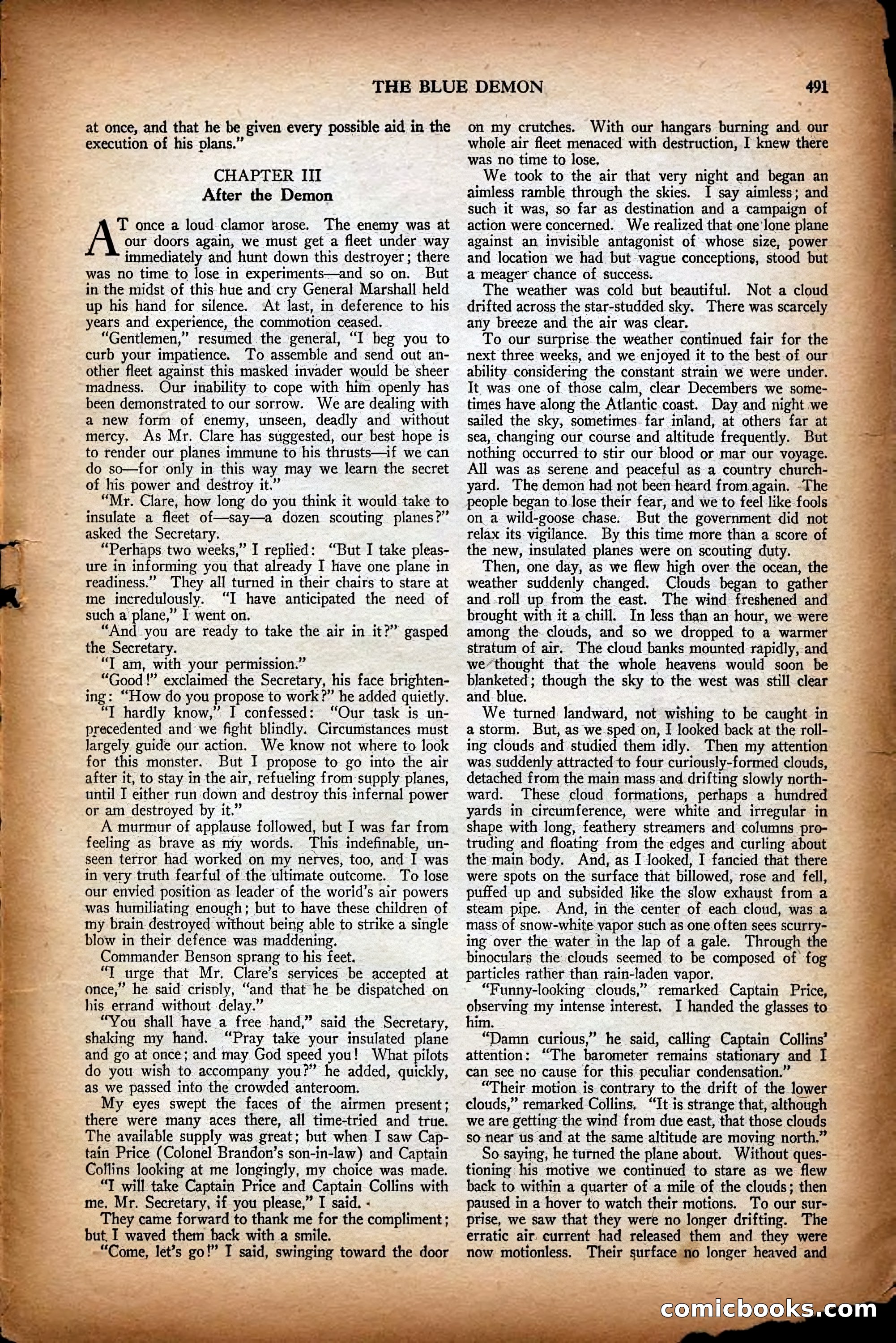
A restored page from Pulp Fiction, 1929. Page through the whole issue in the reader above.
📄 Transcribed text from this page (OCR, searchable)
Machine-transcribed from the original scan — historical spelling and the odd misread are preserved.
te ae * xe at once, and that he be given every possible aid in the execution of his plans.” CHAPTER III After the Demon T once a loud clamor arose. The enemy was at A our doors again, we must get a fleet under way immediately and hunt down this destroyer; there was no time to lose in experiments—and so on. But in the midst of this hue and cry General Marshall held up his hand for silence. At last, in deference to his years and experience, the commotion ceased. “Gentlemen,” resumed the general, “I beg you to curb your impatience. To assemble and send out an- other fleet against this masked invader would be sheer madness. Our inability to cope with him openly has been demonstrated to our sorrow. We are dealing with a new form of enemy, unseen, deadly and without mercy, As Mr. Clare has suggested, our best hope is to render our planes immune to his thrusts—if we can do so—for only in this way may we learn the secret of his power and destroy it.” “Mr. Clare, how long do you think it would take to insulate a fleet of—say—a dozen scouting planes?” asked the Secretary. “Perhaps two weeks,” I replied: “But I take pleas- ure in informing you that already I have one plane in readiness.” They all turned in their chairs to stare at me incredulously. “I have anticipated the need of such a plane,” I went on, “And you are ready to take the air in it?” gasped the Secretaty. ““T am, with your permission.” “Good!” exclaimed the Secretary, his face brighten- ing: “How do you propose to work?” he added quietly. “T hardly know,” I confessed: “Our task is un- precedented and we fight blindly. Circumstances must largely guide our action. We know not where to look for this monster. But I propose to go into the air after it, to stay in the air, refueling from-supply planes, until I either run down and destroy this infernal power or am destroyed by it.” A murmur of applause followed, but I was far from feeling as brave as niy words. This indefinable, un- seen terror had worked on my nerves, too, and I was in very truth fearful of the ultimate outcome. To lose our envied position as leader of the worid’s air powers was humiliating enough; but to have these children of my brain destroyed without being able to strike a single blow in their defence was maddening. Commander Benson sprang to his feet. “T_ urge that Mr. Clare’s services be accepted at once,” he said crisply, “and that he be dispatched: on his errand without delay.” “You shall have a free hand,” said the Secretary, shaking my hand. “Pray take your insulated plane and go at once; and may God speed you! What pilots do you wish to. accompany you?” he added, quickly, as we passed into the crowded anteroom. My eyes swept the faces of the airmen present; there were many aces there, all time-tried and true. The available supply was great; but when I saw Cap- tain Price (Colonel Brandon’s son-in-law) and Captain Collins looking at me longingly, my choice was. made. “J will take Captain Price and Captain Collins with me. Mr. Secretary, if you please,” I said, < They came forward to thank me for the compliment ; but I waved them back with a smile. -“Come, let’s go!” T said, swinging toward the door THE BLUE DEMON on my crutches. With our hangars burning and our whole air fleet menaced with destruction, I knew there was no time to lose, ) We took to the air that very night and began an aimless ramble through the skies. I say aimless; and such it was, so far as destination and a campaign of action were concerned. We realized that one'lone plane against an invisible antagonist of whose size, power and location we had but vague conceptions, stood but a meager chance of success. The weather was cold but beautiful. Not a cloud drifted across the star-studded sky, There was scarcely any breeze and the air was clear. To our surprise the weather continued fair for the next three weeks, and we enjoyed it to the best of our ability considering the constant strain we were under. It. was one. of those calm, clear Decembers we some- times have along the Atlantic coast. Day and night we sailed the sky, sometimes far inland, at others far at sea, changing our course and altitude frequently. But nothing occurred to stir our blood or mar our voyage. All was as serene and peaceful as a country church- yard. The demon had not been heard from.again. The people began to lose their fear, and we to feel like fools on a wild-goose chase: But the government did not relax its vigilance. By this time more than a score of the new, insulated planes were on scouting duty. Then, one day, as we flew high over the ocean, the weather suddenly changed. Clouds began to gather and roll up from the east. The wind freshened and brought with it a chill. In less than an hour, we were among the. clouds, and so we dropped to a warmer stratum of air. The cloud banks mounted rapidly, and we’thought that the whole heavens would soon be blanketed; though the sky to the west was still clear and. blue. We turned landward, not: wishing to be caught. in a storm. But, as we-sped on, I looked back at the roll- ing clouds and studied them idly. Then my attention was suddenly attracted to four curiously-formed clouds, detached from the main mass and drifting slowly north- ward. These cloud formations, perhaps a hundred yards in circumference, were white and irregular in shape with long, feathery streamers and columns pro- truding and floating from the edges and curling about the main body. And, as I looked, I fancied that there were spots on the surface that billowed, rose and fell, puffed up and subsided like the slow exhaust from a steam pipe. And, in the center of each cloud, was a mass of snow-white vapor such as one often sees scurry- ing over the water in the lap of a gale. Through the binoculars the clouds seemed to be composed of fog particles rather than rain-laden vapor. “Funny-looking clouds,” remarked Captain Price, shecrving my intense interest. I handed the glasses to “Damn curious,” he said, calling Captain Collins’ attention: “The barometer remains stationary and I can see no cause for this peculiar condensation.” “Their motion. is contrary to the drift of the lower clouds,” remarked Collins. “It is strange that, although we are getting the wind from due east, that those clouds so near us and at the same altitude are moving north,” So saying, he turned the plane about. Without ques- tioning his motive we continted to stare as we flew back to within a quarter of a mile of the clouds; then paused in a hover to watch their motions. To our sur- prise, we saw that they were no longer drifting. The erratic air. current had released them and they were now motionless. Their surface no longer heaved and Pa _ “¢€omicbooks.com