
Pulp Fiction, 1929 · page 67 of 95
Air Wonder Stories, August 1929 — page 67: what you’re looking at
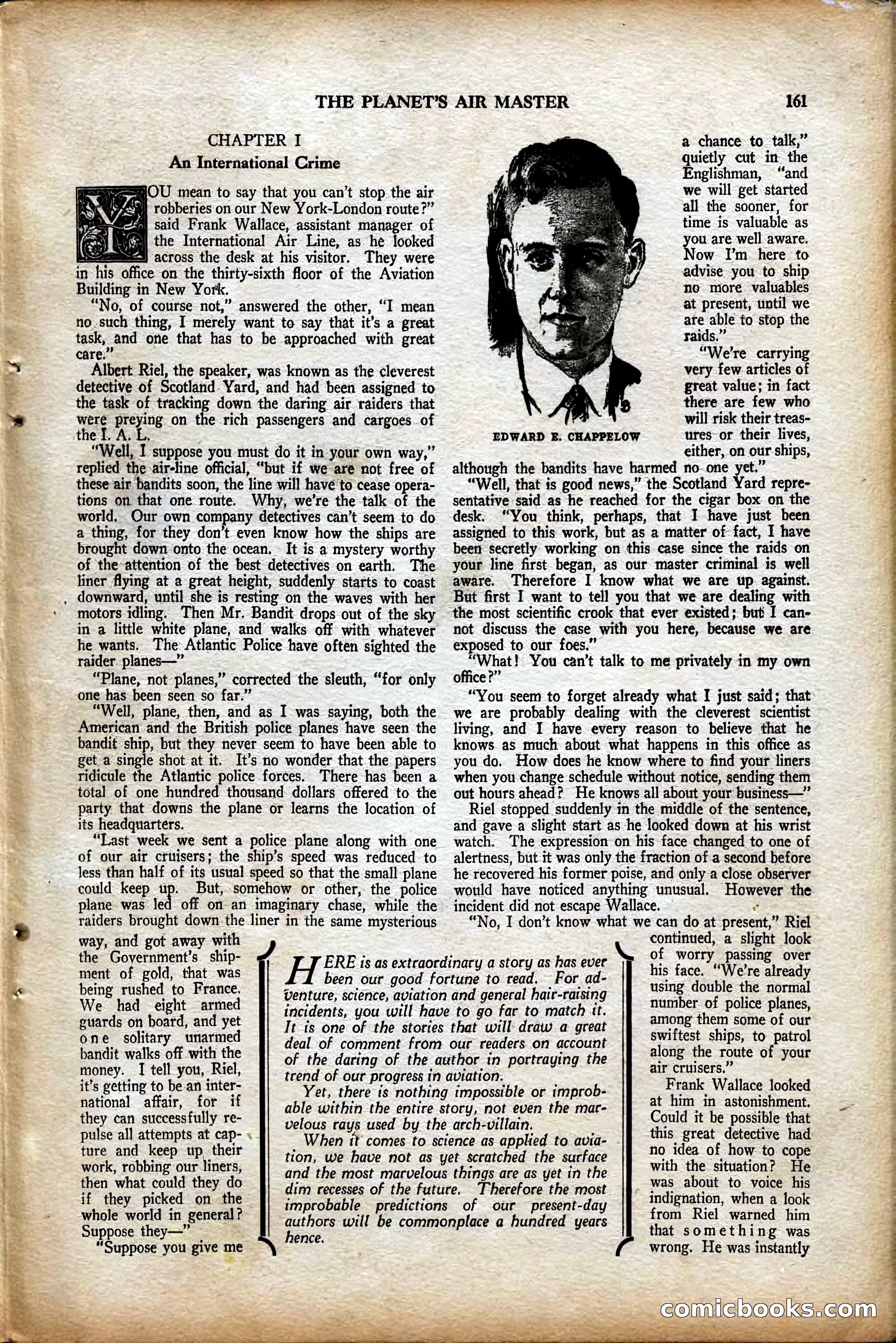
A restored page from Pulp Fiction, 1929. Page through the whole issue in the reader above.
📄 Transcribed text from this page (OCR, searchable)
Machine-transcribed from the original scan — historical spelling and the odd misread are preserved.
THE PLANET'S AIR MASTER 161 CHAPTER I An International Crime z——aU mean to say that you can’t stop. the air robberies on-our New York-London route?” said Frank Wallace, assistant manager of mai the International Air Line, as he looked Eze # across the desk at his visitor. They were in his office on the thirty-sixth floor of the Aviation Building in New York, “No, of course not,” answered the other, “I mean no. such thing, I merely want to say that it’s a great task, and ofie that has to be approached with great care,” Albert Riel, the speaker, was known as the cleverest detective of Scotland: Yard, and had been assigned to the task of tracking down the daring air raiders that were preying on the rich passengers and cargoes. of the lL. A. L. : “Well, I suppose you must do it in your own way,” replied the air-line official, “but if we are not free of these air bandits soon, the line will have to cease opera- tions on that one route. Why, we’re the talk of the world. Our-own company detectives can’t seem to do a thing, for they don’t even know how the ships are brought down onto the ocean. It is a mystery worthy of the-attention of the best detectives on earth. The liner flying at @ great height, suddenly starts to coast , downward, until-she is resting on the waves with her motors-idling. Then Mr. Bandit drops out of the sky ina little white plane, and walks off with whatever he wants. The:Atlantic Police have often sighted the raider. planes—” “Plane, not-planes,” corrected the sleuth, “for only one has been:seen so far.” “Well, plane, then, and as I was saying, both the American and the British police planes have seen the bandi€ ship, but they never seem to have been able to get.a single shot at it. It’s no wonder that.the papers ridicule the Atlantic police forces. There has been a total of one hundred thousand: dollars offered to the party that downs the plane or learns the location of its headquarters. “Last week we sent a police plane along with one of our air critisers; the ship’s speed was reduced: to less than half of its usual speed so that the small-plane could keep 2 But, somehow or other, the police plane was led off onan imaginary chase, while the raiders brought down. the liner in the same mysterious way, and got away with the Goyernment’s. ship- ment of gold, that was being rushed to France. We had eight armed guards on board, and yet one solitary unarmed bandit ies eu seul of the daring of the author in portcaying the pices ye 1 Cel vee trend of our progress in aviation. it’s getting to bean inter- 7 3 national affair, for if they can successfully re- pulse all attempts at cap- ture and keep up, their work, robbing our liners, then what could they do if they picked on the whole world in general ? Suppose they—” “Suppose you give me 4 hence. ERE ts as extraordinary a story as has ever been our good fortune to tead. d Venture, science, aviation and general hatr-ratsing incidents, you will have to go far to match tt. It is one of the stories that will: draw a great deal of comment from our readers.on account Yet, there is nothing impossible or improb- able within the entire story, not even the marc- velous rays used by the arch-villain. When it comes to sctence as applied to avia- - tion, we have not as yet scratched the surface and the most marvelous things are as yet in the dim recesses of the future. improbable predictions of our present-day authors will be commonplace a hundred years a chance: to_ talk,” quietly cut in the Englishman, “and we will get:started all-the sooner, for time is valuable as ou are well aware. ow I’m here to advise you to ship no more valuables at present, until we ate able to stop the Taids,” “We're carrying very few articles of great value; in fact there are few who will risk their treas- ures-or their lives, either, on our ships, although the bandits have harmed no-one yet.” “Well, that is good news,” the Scotland Yard repre- sentative said as he reached for the cigar box on the desk. “You think, perhaps, that I have just been assigned to this work, but as a matter of- fact, I have been Secretly working on this case since the raids on your line first began, as our master criminal is well aware. Therefore I know what we are up. against. But first I want to tell you that we are dealing with the most scientific crook that ever existed; but I can- not discuss the case with you here, because we are exposed to our foes.” “What! You can’t talk to me privately in my own office?” “You seem to forget already what I just said; that we ate probably dealing with the cleverest scientist living, and I have every reason to believe that he knows. as much about what happens in this office as you do. How does he know where to find your liners when you:change schedule without notice, sending them out hours ahead? He knows all about your business—” Riel stopped suddenly in the middle of the sentence, and gave a slight start as -he looked down at his wrist watch, The expression on his face changed to one of alertness, but-it was only the fraction of a second before he recovered his-former poise, and only a close observer would have noticed anything unusual. However the incident did not escape Wallace. . “No, I don’t know what we can do at present,” Riel continued, a slight look of worry passing over his face. “We're already using double the normal number. of police planes, among them some of our swiftest ships, to patrol along the route of your air’ cruisers,” Frank Wallace looked at him in astonishment. Could it be possible that this -great detective had no idea of how to cope with the situation? He was about to voice his indignation, when a look from Riel warned him that something- was wrong. He was instantly EDWARD E. CHAPPELOW For. ad- Therefore. the most