
Pulp Fiction, 1929 · page 62 of 95
Air Wonder Stories, August 1929 — page 62: what you’re looking at
A restored page from Pulp Fiction, 1929. Page through the whole issue in the reader above.
📄 Transcribed text from this page (OCR, searchable)
Machine-transcribed from the original scan — historical spelling and the odd misread are preserved.
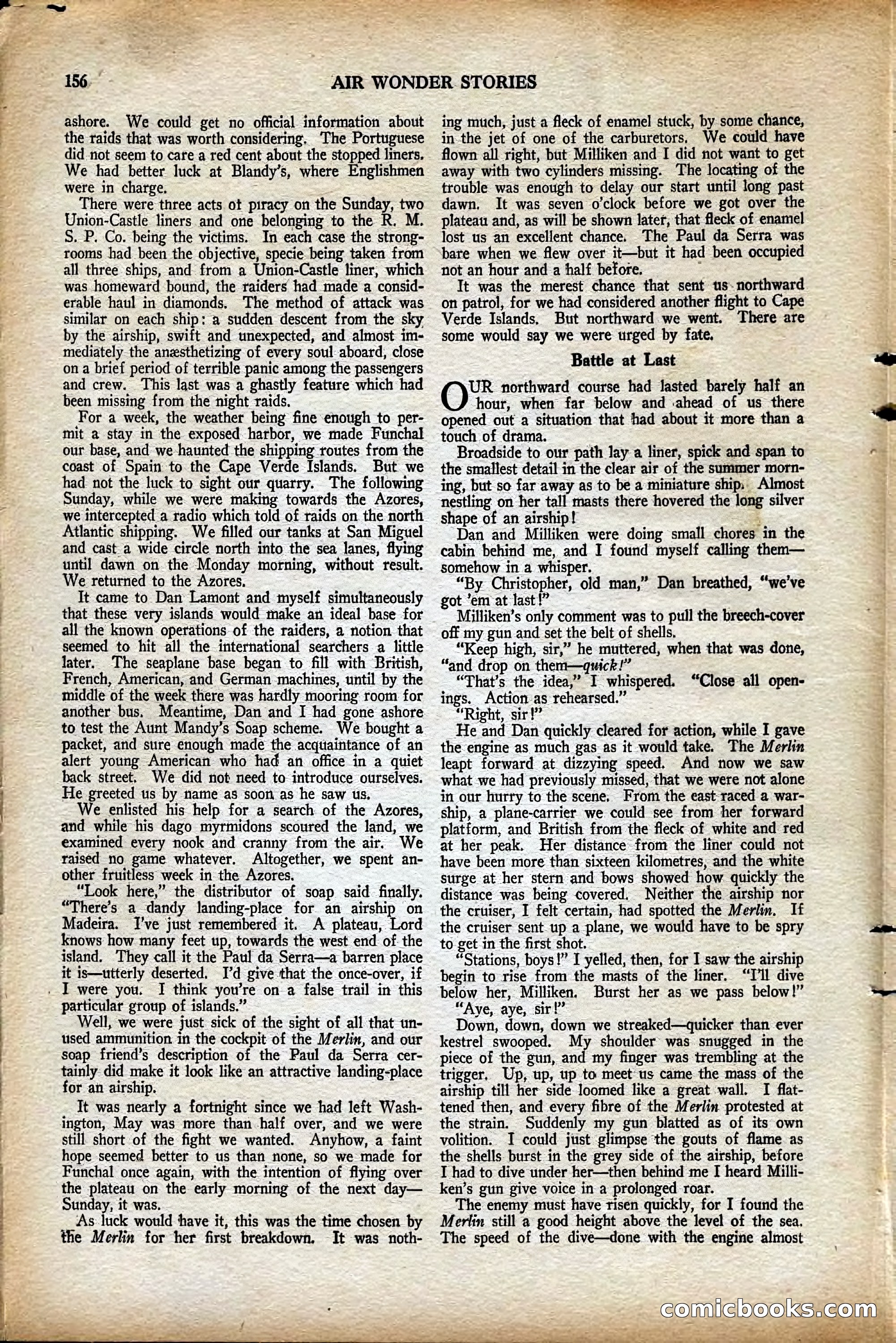
“3°. ) .. = OF =e e 156. AIR WONDER STORIES ashore. We could get no official information about the raids that was worth considering. The Portuguese did not seem to care a red cent about the stopped liners. We had better luck at Blandy’s, where Englishmen were in charge. There were three acts. ot piracy on the Sunday, two Union-Castle liners and one belonging to the R. M. S.P. Co. being the victims. In each case the strong- rooms had been the objective, specie being taken from all three ships, and from a Union-Castle liner, which was homeward bound, the raiders had made a consid- erable haul in diamonds, The method of attack was similar on each ship: a sudden descent from the sky by the airship, swift and unexpected, and almost im- mediately.the anesthetizing of every soul-aboard, close on a brief period of terrible panic among the passengers and crew. This last was a ghastly feature which had been missing from the night raids. For a week, the weather being fine enough to per- mit a stay in the exposed harbor, we made Funchal our base, and we haunted the shipping routes from the coast of Spain to the Cape Verde Islands. But we had not the luck to sight our quarry. The following Sunday, while we. were making towards the Azores, we intercepted a radio which told of raids on the north Atlantic shipping. We filled our tanks at San Miguel and cast.a wide circle north into the sea lanes, flying until dawn on the Monday morning, without result. We returned to the Azores, It came to Dan Lamont and myself simultaneously that these very islands would make an ideal base for all the known operations of the raiders, a notion that seemed to hit all the international searchers a little later. The seaplane base began to fill with British, French, American, and German machines, until by the middle of the week there was hardly mooring room for another bus. Meantime, Dan and I had gone ashore to test the Aunt Mandy’s Soap scheme. We bought a packet, and stire enough made the acqttaintance of an alert young American who had an office in a quiet back street. We did not need to introduce ourselves. He greeted us by name as soon as he saw us, We enlisted his help for a search of the Azores, and while his dago myrmidons scoured the land, we examined every nook and cranny from the air. We raised no game whatever. Altogether, we spent an- other fruitless week in the Azores. “Look here,” the distributor of soap said finally. “There’s a dandy landing-place for an airship on Madeira. I’ve just remembered it. A plateau, Lord knows how many feet up, towards the west end: of. the island. They call it the Paul da Serra—a barren place it is—utterly deserted. I’d give that the once-over, if . I were you. I think you're ona false trail in this particular group of islands.” Well, we were just sick of the sight of all that un- tused ammunition in the cockpit of the Merlin, and our soap friend’s description of the Paul da Serra cer- tainly: did make it look like an attractive landing-place for an airship. Tt was nearly a fortnight since we had left Wash- ington, May was more than half over, and we were still short of the fight we wanted. Anyhow, a faint hope seemed better to us than none, so we made for Funchal once again, with the intention of flying over the plateau on the early morning of the next day— Sunday, it was. As: luck would ‘have it, this was the time chosen by the Merlin for her first breakdown. It was noth- ing much, just a fleck of enamel stuck, by.some chance, in-the jet of one of the carburetors, We could have flown all right, but: Milliken and I did not want to get away with two cylinders missing. The locating of the trouble was enough to delay our start until long past dawn. It was seven o'clock before we got over the plateau and, as will be shown later; that fleck of enamel lost us an excellent chance. The Paul da Serra was bare when we flew over it—but it had been occupied not an hour and a half before. : It was the merest chance that sent ts-northward on patrol, for we had considered another flight to Cape Verde Islands, But northward.we went. There are some would say we were urged by fate, Battle at Last UR northward course had fasted barely half an hour, when far below and ‘ahead of us there opened out a situation that had about it more than a touch of drama. Broadside to our path Jay a liner, spick and span to the smatflest detail in the clear air of the summer morn- ing, but so far away as to be a miniature ship; Almost nestling on her tall masts there hovered the long silver shape of an airship! 5 Dan and Milliken were doing small chores in the cabin behind me, and I found myself calling them— somehow in a whisper. “By Christopher, old man,” Dan breathed, “we've got ‘em at last!” Milliken’s only comment was to pull the breech-cover off my gun and set the belt of shells, “Keep high, sir,” he muttered, when that was done, “and drop on them—quick!” “That’s the idea,” I whispered. “Close all open- ings. Action-as rehearsed.” “Right, sir!” He and Dan quickly cleared for action, while I gave the engine as much pas as it would take. The Merlin leapt forward at dizzying speed. And now we saw what we had previously missed, that we were not alone in our hurry to the scene, From the east-raced a war- ship, a plane-carrier we could see from her forward platform, and British from the fleck of white and red at her peak. Her distance-from the liner could not have been more than sixteen kilometres, and the white surge at her stern and bows showed how quickly the distance was being covered, Neither the airship nor the cruiser, I felt certain, had spotted the Merlin. If the cruiser sent.up a-plane, we would have to be spry to get in the first shot. “Stations, boys!” I yelled, then, for I-saw the airship begin to rise from the masts of the liner. “I'll dive below her, Milliken, Burst her as we pass below!” “Aye, aye, sir!” Down, down, down we streaked—quicker than ever kestrel swooped. My shoulder was snugged in the piece of the gun, and my finger was trembling at the trigger, Up, up, up to meet ts came the mass of the airship till her side loomed like a great wall. I flat- tened then, and every fibre of the Merlin protested at the strain. Suddenly my gun blatted as of its own volition. I could just glimpse the gouts of flame as the shells burst in the grey side of the airship, before T had to dive under her—then behind me I heard Milli- ken’s gun give voice in a prolonged roar. The enemy must have risen quickly, for I found the Merlin still a good height above the level of the sea, The speed of the dive—done with the engine almost comilcbooks:com|© i a aceon pee aE SEES OP OURO A el a