
Pulp Fiction, 1929 · page 13 of 95
Air Wonder Stories, August 1929 — page 13: what you’re looking at
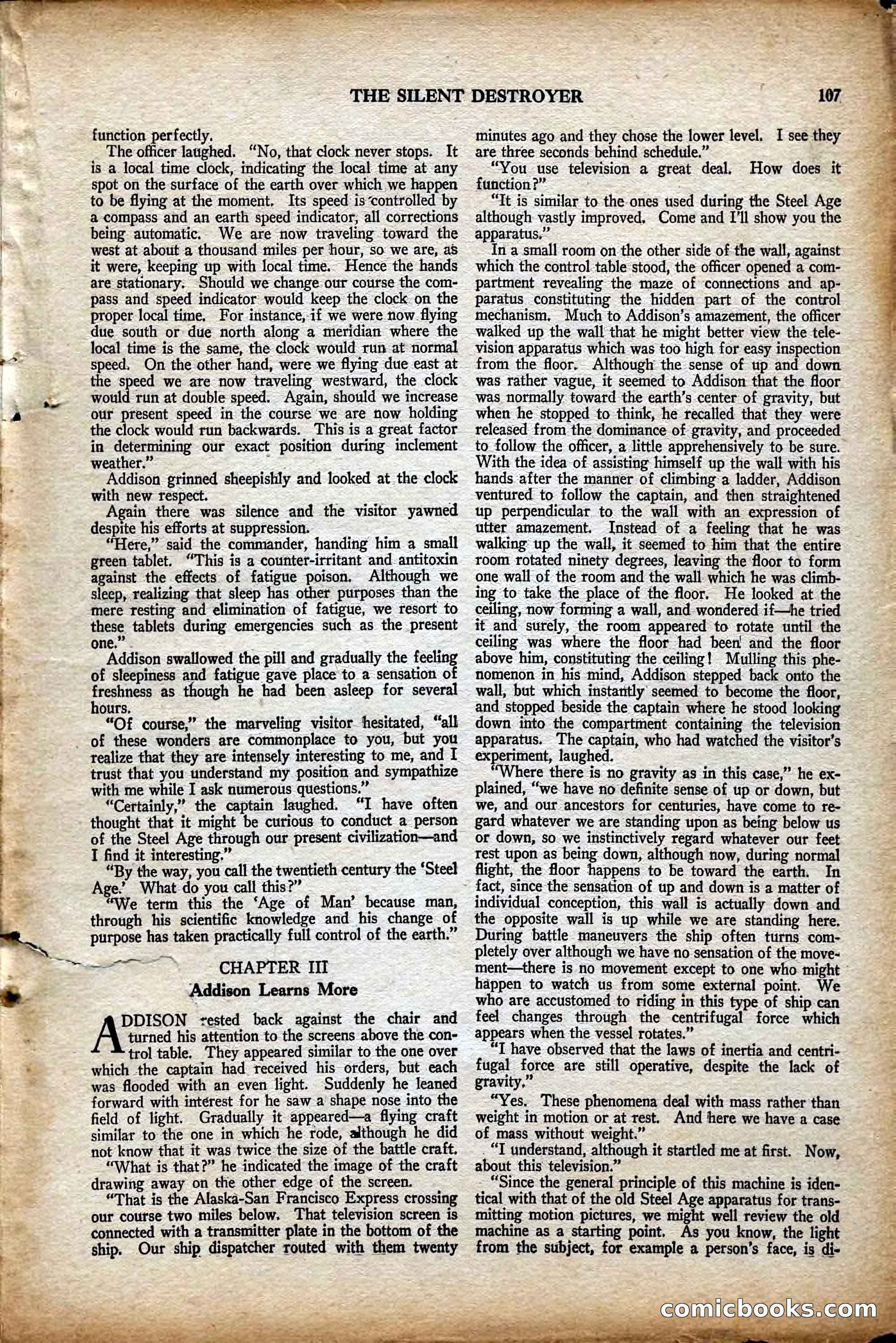
A restored page from Pulp Fiction, 1929. Page through the whole issue in the reader above.
📄 Transcribed text from this page (OCR, searchable)
Machine-transcribed from the original scan — historical spelling and the odd misread are preserved.
im ~~ THE SILENT DESTROYER 107 function perfectly. The officer laughed. “No, that clock never stops. It is a local time clock, indicating the local time at any spot on the surface of the earth over which we happen to be flying at the moment, Its speed is“controlled by a compass and an earth speed indicator, all corrections being. automatic. We are now traveling toward the west at about-a thousand miles per hour, So: we are, a& it were, keeping up with local time. Hence the hands ate stationary: Should we change: our course the com- pass and speed indicator: would keep the clock. on the proper local time, For instancé,if we were now- flying due south or-due north along a meridian where the local time is the same, the:clock would: run at: normal speed, On the other hand, were we flying due east at the speed we ate now traveling westward, the clock would run at double speed. Again, should we increase our present speed in the course we are now. holding the dock would run backwards. This is a great factor in determining our exact position during inclement weather.” Be Addison grinned sheepishly and looked at the clock with new respect. 2 ; Again there was silence and the visitor yawned despite his efforts at suppression. “Here,” said the commander, handing him a small green tablet. “This is a countet-irritant and-antitoxin against the effects. of fatigue poison. Although we sleep, realizing that sleep has other purposes than the mere resting and elimination of fatigue, we resort to these tablets during emergencies such as the present one,” - Addison swallowed the pill and gradually the feeling of sleepiness-and fatigue gave place to_a sensation of freshness as though he had been asleep for several hours, “Of course,’ the marveling visitor. hesitated, “all _ of these wonders are comimonplace to you, but you realize that they are intensely interesting to me, and I trust that you understand my position and sympathize with me while I ask numerous questions.” “Certainly,” the captain laughed. “I have often thought that it might be curious to conduct a person of the Steel Age through our present civilization—and I find it interesting.” : : “By the way, you call the twentieth century the ‘Steel Age?” What-do you call this?” “We term this the ‘Age of Man’ because man, through his scientific knowledge and his change: of purpose has taken practically full control of the earth.” © it a CHAPTER III Addison Learns More DDISON ‘ested back against the chair and turned his attention to the screens above.the con- trol table. They appeared similar to the one over which the captain had received his orders, but each was flooded with an even light. Suddenly he leaned forward with interest for he saw a’ shape nose into the field of light. Gradually it appeared—a flying craft similar to the one in which he rode, although he did not know that it was twice -the size of the battle craft. “What is that?” he indicated the image of the craft drawing away on the other edge of the screen. “That is the Alaska-San Francisco Express crossing our coutse two miles below. That television screen is connected with a transmitter plate in the bottom of the ship. Our ship dispatcher routed with them twenty ~ oo aS ee mintites ago and they chose the lower level. I see they are three seconds behind schedule.” “You use television a great deal, How does it function?” “Tt is similar to the-ones used during the Steel Age although vastly improved. Come and I'll show you the apparatus,” In a small room onthe other side of the wall, against which the control-table stood, the officer opened a com- partment revealing the maze of connections and ap- paratus constituting the hidden part of the control mechanism, Much to Addison’s amazement, the officer walked up the wallthat he might better view the tele- vision apparatus which was too high for easy inspection from the floor. Although the:sense of tip and down was tather vague, it seemed to Addison that the floor was normally: towatd the earth’s center of gravity, but when he stopped to think, he recalled that they were released from the dominance of gravity, and proceeded to follow the officer, a little apprehensively to be sure. With the idea of assisting himself up the wall with his hands after the manner of climbing’a ladder, Addison ventured to follow the captain, and then straightened up perpendicular to the wall with an expression of utter amazement. Instead of a feeling that he was walking: up the wall, it seemed to him that the entire toom rotated ninety degrees, leaving the floor to form one wall of the room and the wall which he was climb- ing ‘to take the place of the floor. He looked at the ceiling, now forming a wall, and-wondered:if—he tried it and surely, the room appeared: to rotate until the ceiling was where the floor had been! and the floor above him, constituting the ceiling! Mulling this phe- nomenon in his mind, Addison stepped: back onto the wall, but which instatitly seemed to become the floor, and stopped beside the captain where he stood looking down into the compartment containing the television apparatus. The captain, who had watched the visitor’s experiment, laughed. “Where there is no gravity asin this case,” he ex- plained, “we have no definite sense of up or down, but we, and our ancestors for centuries, have come to re- gard whatever we are standing upon as being below us or down, so. we instinctively regard whatever our feet Test upon as being down, although now, during normal flight, the floor happens to be toward the earth, In ~ fact, since the sensation of up and down is a matter of individual conception, this wall is actually down and the opposite wall is up while we are standing here, ing battle maneuvers the ship often turns com- pletely over although we have no sensation of the move- ment—there is no movement except to one who might ° happen to watch us from some external point, We who are accustomed to riding in this type of ship:can feel changes through the centrifugal force which appears when the vessel rotates.” “I have observed that the laws of inertia and centri- fugal force are still operative, despite the lack of gravity,” “Yes. These phenomena deal with mass rather than weight in motion or at rest. And there we have a case of mass without weight.” . “I understand, although it startled me at first. Now, about this television.” - “Since the general principle of this machine is iden- tical with that of the old Steel Age apparatus for trans- mitting motion pictures, we might well review the old machine as a starting point. you know, the light from the subject, for example a person’s face, is di-