
Pulp Fiction, 1929 · page 76 of 100
Air Wonder Stories, July 1929 — page 76: what you’re looking at
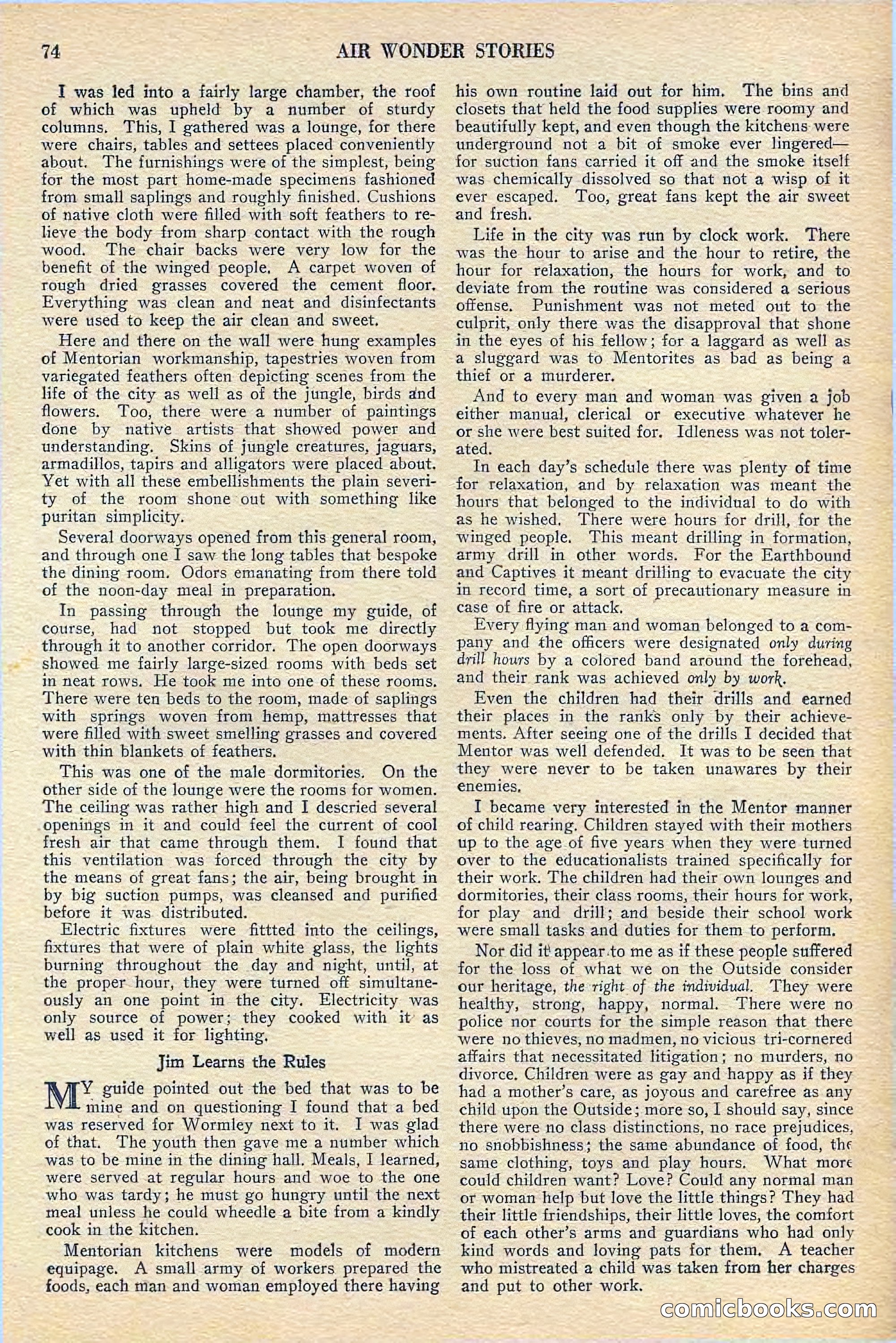
A restored page from Pulp Fiction, 1929. Page through the whole issue in the reader above.
📄 Transcribed text from this page (OCR, searchable)
Machine-transcribed from the original scan — historical spelling and the odd misread are preserved.
74 I was led into a fairly large chamber, the roof of which was upheld by a number of sturdy columns, This, I gathered was a lounge, for there were chairs, tables and settees placed conveniently about. The furnishings were of the simplest, being for the most part home-made specimens fashioned from small saplings and roughly finished. Cushions of native cloth were filled with soft feathers to re- lieve the body from sharp contact with the rough wood. The chair backs were very low for the benefit of the winged people, A carpet woven of trough dried grasses covered the cement floor, Everything was clean and neat and disinfectants were used to keep the air clean and sweet. Here and there on the wall were hung examples of Mentorian workmanship, tapestries woven from variegated feathers often depicting scenes from the life of the city as well as of the jtmgle, birds and flowers. Too, there were a number of paintings done by native artists that showed power and understanding. Skins of jungle creatures, jaguars, armadillos, tapirs and alligators were placed about. Yet with all these embellishments the plain severi- ty of the room shone ont with something like puritan simplicity. Several doorways opened from this general room, and through one I saw the long tables that bespoke the dining room. Odors emanating from there told of the noon-day meal in preparation. In passing through the lounge my guide, of course, had not stopped but took me directly through it to another corridor. The open doorways showed me fairly large-sized rooms with beds set in neat rows. He took me into one of these rooms. There were ten beds to the toom, made of saplings with springs woven from hemp, mattresses that were filled with sweet smelling grasses and covered with thin blankets of feathers. This was one of the male dormitories. On the other side of the lounge were the rooms for women. The ceiling was rather high and I descried several openings in it and could feel the current of cool fresh air that came through them. I found that this ventilation was forced through the city by the means of great fans; the air, being brought in by big suction pumps, was cleansed and purified before it was distributed. Electric fixtures were fittted into the ceilings, fixtures that were of plain white glass, the lights burning throughout the day and night, until, at the proper hour, they were turned off simultane- ously an one point in the city. Electricity was only source of power; they cooked with it as well as used it for lighting, Jim Learns the Rules M* guide pointed out the bed that was to be mine and on questioning I found that a bed was reserved for Wormley next to it. I was glad of that. The youth then gave me a number which was to be mine in the dining hall. Meals, I learned, were served at regular hours and woe to the one who was tardy; he must go hungry until the next meal unless he could wheedle a bite from a kindly cook in the kitchen. Mentorian kitchens were models of modern equipage. A small army of workers prepared the foods, each man and woman employed there haying ATR WONDER STORIES his own routine laid out for him. The bins and closets that held the food supplies were roomy and beautifully kept, and even though the kitchens were underground not a bit of smoke ever lingered— for suction fans carried it off and the smoke itself was chemically dissolved so that not a wisp of it ever escaped. Too, great fans kept the air sweet and fresh. Life in the city was run by clock work. There was the hour to arise and the hour to retire, the hour for relaxation, the hours for work, and to deviate from the routine was considered a serious offense. Punishment was not meted out to the culprit, only there was the disapproval that shone in the eyes of his fellow; for a laggard as well as a sluggard was to Mentorites as bad as being a thief or a murderer. And to every man and woman was given a job either manual, clerical or executive whatever he or she were best suited for. Idleness was not toler- ated. In each day’s schedule there was plenty of time for relaxation, and by relaxation was imeant the hours that belonged to the individnal to do with as he wished, There were hours for drill, for the winged people. This meant drilling in formation, army drill in other words. For the Earthbound and Captives it meant drilling to evacuate the city in record time, a sort of precatitionary measure in case of fire or attack, Every flying man and woman belonged to a com- pany and the officers were designated only during drill hours by a colored band around the forehead, and their rank was achieved only by work. Even the children had their drills and earned their places in the ranks only by their achieve- ments. After seeing one of the drills I decided that Mentor was well defended. It was to be seen that they were never to be taken unawares by their enemies, I became very interested in the Mentor manner of child rearing, Children stayed with their mothers up to the age of five years when they were turned over to the educationalists trained specifically for their work. The children had their own lounges and dormitories, their class rooms, their hours for work, for play and drill; and beside their school work were small tasks and duties for them to perform. Nor did it appear.to me as if these people suffered for the loss of what we on the Outside consider our heritage, the right of the individual. They were healthy, strong, happy, normal. There were no police nor courts for the simple reason that there were no thieves, no madmen, no vicious tri-cornered affairs that necessitated htigation; no murders, no divorce. Children were as gay and happy as if they had a mother’s care, as joyous and carefree as any child upon the Outside; more so, I should say, since there were no class distinctions, no race prejudices, no snobbishness+ the same abundance of food, the same clothing, toys and play hours. What more could children want? Love? Could any normal man or woman help but love the little things? They had their little friendships, their little loves, the comfort of each other’s arms and guardians who had only kind words and loving pats for them, A teacher who mistreated a child was taken from her charges and put to other work. comniclooolks.cotn