
Pulp Fiction, 1929 · page 24 of 100
Air Wonder Stories, July 1929 — page 24: what you’re looking at
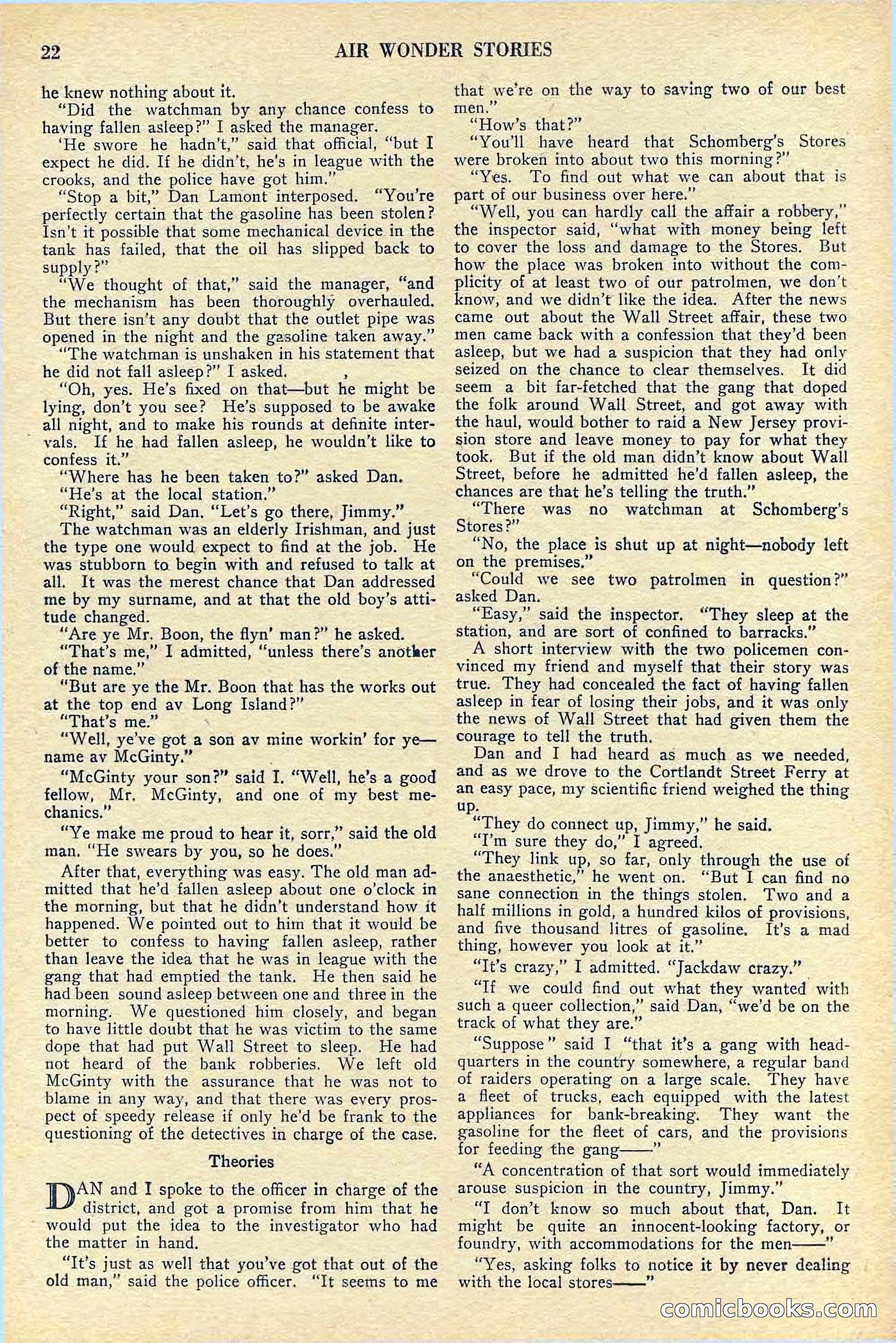
A restored page from Pulp Fiction, 1929. Page through the whole issue in the reader above.
📄 Transcribed text from this page (OCR, searchable)
Machine-transcribed from the original scan — historical spelling and the odd misread are preserved.
22 AIR WONDER STORIES he knew nothing about it. “Did the watchman by any chance confess to having fallen asleep?” I asked the manager. ‘He swore he hadn't,” said that official, “but I expect he did. If he didn’t, he’s in league with the crooks, and the police have got him.” “Stop a bit,” Dan Lamont interposed. “You're perfectly certain that the gasoline has been stolen? Isn’t it possible that some mechanical device in the tank has failed, that the oil has slipped back to supply?” “We thought of that,” said the manager, “and the mechanism has been thoroughly overhauled. But there isn't any doubt that the outlet pipe was opened in the night and the gasoline taken away.” “The watchman is unshaken in his statement that he did not fall asleep?” I asked. : “Oh, yes. He’s fixed on that—but he might be lying, don’t you see? He's supposed to be awake all night, and to make his rounds at definite inter- - vals, If he had fallen asleep, he wouldn't like to confess it.” ‘Where has he been taken to?” asked Dan. “He’s at the local station.” “Right,” said Dan, ‘“Let’s go there, Jimmy.” The watchman was an elderly Irishman, and just the type one would expect to find at the job. He was stubborn to begin with and refused to talk at all. It was the merest chance that Dan addressed me by my surname, and at that the old boy’s atti- tude changed. “Are ye Mr. Boon, the flyn’ man?” he asked. “That’s me,” I admitted, “unless there’s another of the name,” “But are ye the Mr. Boon that has the works out at the top end av Long Island?” “That’s me.” “Well, ye’ve got a son av mine workin’ for ye— name avy McGinty.” ; “McGinty your son?” said I. “Well, he’s a good fellow, Mr, McGinty, and one of my best me- chanics,” “Ye make me proud to hear it, sorr,” said the old man. ‘He swears by you, so he does.” After that, everything was easy. The old man ad- mitted that he’d fallen asleep about one o’clock in the morning, but that he didn’t understand how it happened. We pointed out to him that it would be better to confess to having fallen asleep, rather than leave the idea that he was in league with the gang that had emptied the tank. He then said he had been sound asleep between one and three in the morning. We questioned him closely, and began to have little doubt that he was victim to the same dope that had put Wall Street to sleep. He had not heard of the bank robberies. We left old McGinty with the assurance that he was not to blame in any way, and that there was every pros- pect of speedy release if only he'd be frank to the questioning of the detectives in charge of the case. Theories DA and I spoke to the officer in charge of the district, and got a promise from him that he would put the idea to the investigator who had the matter in hand. “It’s just as well that you’ve got that out of the old man,” said the police officer. ‘It seems to me that we're on the way to saving two of our best men,” “Flow’s that?” “You'll have heard that Schomberg’s Stores were broken into about two this morning?” “Yes. To find out what we can about that is part of our business over here.” “Well, you can hardly call the affair a robbery,” the inspector said, “what with money being left to cover the loss and damage to the Stores. But how the place was broken into without the com- plicity of at least two of our patrolmen, we don’t know, and we didn’t like the idea. After the news came out about the Wall Street affair, these two men came back with a confession that they’d been asleep, but we had a suspicion that they had only seized on the chance to clear themselves. It did seem a bit far-fetched that the gang that doped the folk around Wall Street, and got away with the haul, would bother to raid a New Jetsey provi- sion store and leave money to pay for what they took. But if the old man didn’t know about Wall Street, before he admitted he’d fallen asleep, the chances are that he’s telling the truth.” “There was no watchman at Schomberg’s Stores?” “No, the place is shut up at night—nobody left on the premises,” “Could we see two patrolmen in question?” asked Dan. “Easy,” said the inspector. “They sleep at the station, and are sort of confined to barracks.” A short interview with the two policemen con- vinced my friend and myself that their story was true. They had concealed the fact of having fallen asleep in fear of losing their jobs, and it was only the news of Wall Street that had given them the courage to tell the truth, Dan and I had heard as much as we needed, and as we drove to the Cortlandt Street Ferry at an easy pace, my scientific friend weighed the thing up. “They do connect up, Jimmy,” he said. “T’m sure they do,” I agreed. “They link up, so far, only through the use of the anaesthetic,” he went on. “But I can find no sane connection in the things stolen. Two and a half millions in gold, a hundred kilos of provisions, and five thousand litres of gasoline, It’s a mad thing, however you look at it.” “It’s crazy,” I admitted. “Jackdaw crazy.” “Tf we could find out what they wanted with such a queer collection,” said Dan, “we'd be on the track of what they are.” “Suppose” said I “that it’s a gang with head- quarters in the country somewhere, a regular band of raiders operating on a large scale. They have a fleet of trucks, each equipped with the latest appliances for bank-breaking. They want the gasoline for the fleet of cars, and the provisions for feeding the gang——” “A concentration of that sort would immediately arouse suspicion in the country, Jimmy.” “TY don’t know so much about that, Dan. It might be quite an innocent-looking factory, or foundry, with accommodations for the men “Yes, asking folks to notice it by never dealing with the local stores——” comnliiclooolks.com