
Pulp Fiction, 1929 · page 21 of 100
Air Wonder Stories, July 1929 — page 21: what you’re looking at
A restored page from Pulp Fiction, 1929. Page through the whole issue in the reader above.
📄 Transcribed text from this page (OCR, searchable)
Machine-transcribed from the original scan — historical spelling and the odd misread are preserved.
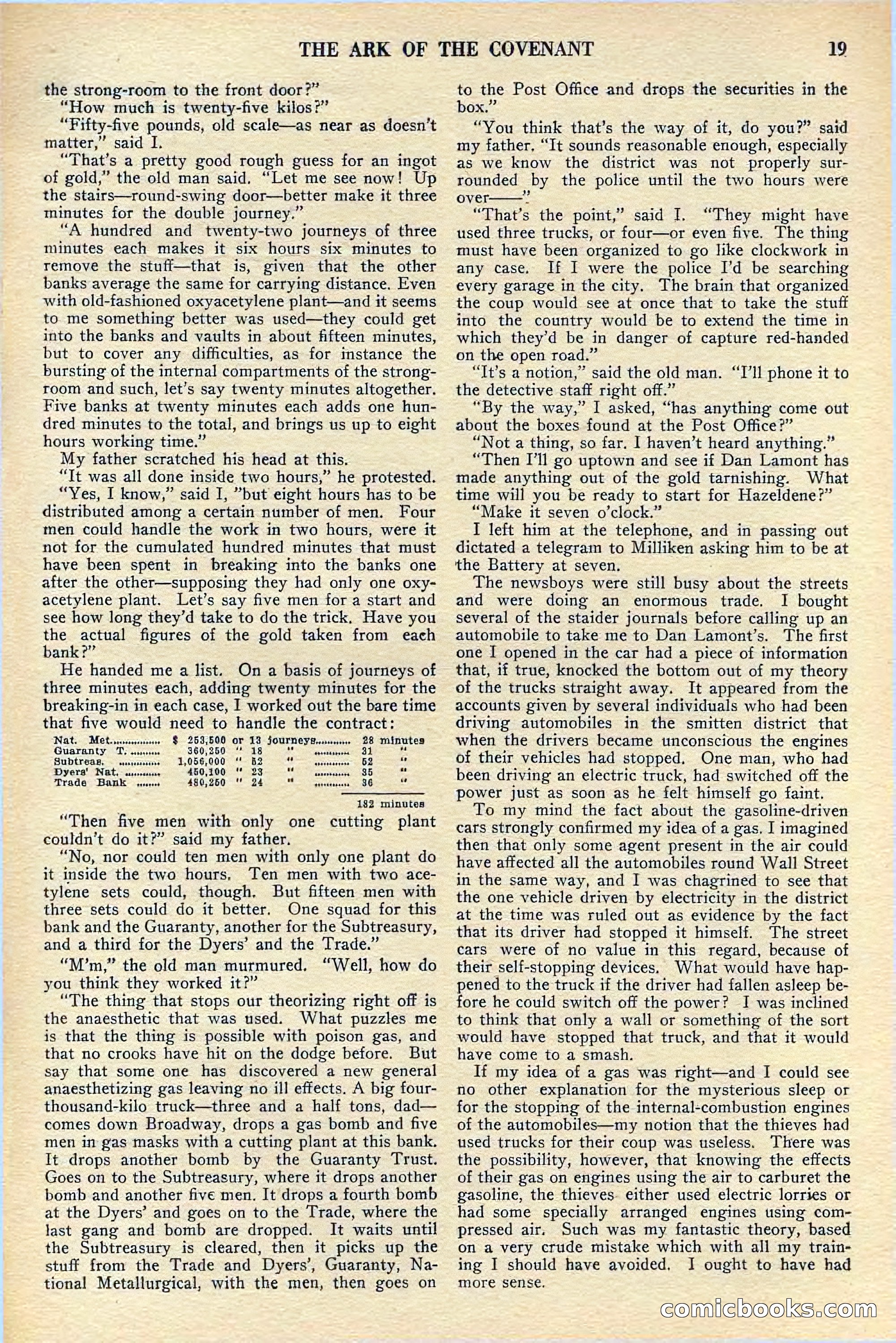
THE ARK OF THE COVENANT the strong-room to the front door?” “How much is twenty-five kilos?” “Fifty-five pounds, old scale—as near as doesn’t matter,” said I. “That’s a pretty good rough guess for an ingot of gold,” the old man said. “Let me see now! Up the stairs—round-swing door—better make it three minutes for the double journey.” “A hundred and twenty-two journeys of three minutes each makes it six hours six minutes to remove the stuffi—that is, given that the other banks average the same for carrying distance. Even with old-fashioned oxyacetylene plant—and it seems to me something better was used—they could get into the banks and vaults in about fifteen minutes, but to cover any difficulties, as for instance the bursting of the internal compartments of the strong- room and such, let’s say twenty minutes altogether. Five banks at twenty minutes each adds one hun- dred minutes to the total, and brings us up to eight hours working time.” My father scratched his head at this. “It was all done inside two hours,” he protested. “Yes, I know,” said I, but eight hours has to be distributed among a certain number of men. Four men could handle the work in two hours, were it not for the cumulated hundred minutes that must have been spent in breaking into the banks one after the other—supposing they had only one oxy- acetylene plant. Let’s say five men for a start and see how long they’d take to do the trick. Have you the actual figures of the gold taken from each bank?” He handed me a list. On a basis of journeys of three minutes each, adding twenty minutes for the breaking-in in each case, I worked out the bare time that five would need to handle the contract: Nat. Met... . §$ 263,500 or 13 journeys, . 28 minutes Guaranty T, 360,250 “ 18 “ 31 S Subtreap, a. 1,056,000 ‘ B2 a) 62 oi Dyers’ Nat. 450,100 " 23 a we 95 = Trade Bank srs 480,260 '" 24 os » 36 = 192 minutes “Then five men with only one cutting plant couldn’t do it?’ said my father. “No, nor could ten men with only one plant do it inside the two hours, Ten men with two ace- tylene sets could, though, But fifteen men with three sets could do it better. One squad for this bank and the Guaranty, another for the Subtreasury, and a third for the Dyers’ and the Trade.” “M’m,” the old man murmured. “Well, how do you think they worked it?” “The thing that stops our theorizing right off is the anaesthetic that was used. What puzzles me is that the thing is possible with poison gas, and that no crooks have hit on the dodge before. But say that some one has discovered a new general anaesthetizing gas leaving no ill effects. A big four- thousand-kilo truck—three and a half tons, dad— comes down Broadway, drops a gas bomb and five men in gas masks with a cutting plant at this bank. It drops another bomb by the Guaranty Trust. Goes on to the Subtreasury, where it drops another bomb and another five men. It drops a fourth bomb at the Dyers’ and goes on to the Trade, where the last gang and bomb are dropped. It waits until the Subtreasury is cleared, then it picks up the stuff from the Trade and Dyers’, Guaranty, Na- tional Metallurgical, with the men, then goes on 19 to the Post Office and drops the securities in the box.” “You think that’s the way of it, do you?” said my father, “It sounds reasonable enough, especially as we know the district was not properly sur- rounded by the police until the two hours were over——" “That’s the point,” said I. “They might have used three trucks, or four—or even five. The thing must have been organized to go like clockwork in any case. If I were the police I’d be searching every garage in the city. The brain that organized the coup would see at once that to take the stuff into the country would be to extend the time in which they'd be in danger of capture red-handed on the open road.” “Tt’s a notion,” said the old man. “TI’ll phone it to the detective staff right off.” “By the way,” I asked, “has anything come out about the boxes found at the Post Office?” “Not a thing, so far. I haven’t heard anything.” “Then I'll go uptown and see if Dan Lamont has made anything out of the gold tarnishing. What time will you be ready to start for Hazeldene?” “Make it seven o’clock.” I left him at the telephone, and in passing out dictated a telegram to Milliken asking him to be at the Battery at seven. The newsboys were still busy about the streets and were doing an enormous trade. I bought several of the staider journals before calling up an automobile to take me to Dan Lamont’s. The first one I opened in the car had a piece of information that, if true, knocked the bottom out of my theory of the trucks straight away. It appeared from the accounts given by several individuals who had been driving automobiles in the smitten district that when the drivers became unconscious the engines of their vehicles had stopped. One man, who had been driving an electric truck, had switched off the power just as soon as he felt himself go faint. To my mind the fact about the gasoline-driven cars strongly confirmed my idea of a gas. I imagined then that only some agent present in the air could have affected all the automobiles round Wall Street in the same way, and I was chagrined to see that the one vehicle driven by electricity in the district at the time was ruled out as evidence by the fact that its driver had stopped it himself. The street cars were of no value in this regard, because of their self-stopping devices. What would have hap- pened to the truck if the driver had fallen asleep be- fore he could switch off the power? I was inclined to think that only a wall or something of the sort would have stopped that truck, and that it would have come to a smash. If my idea of a gas was right—and I could see no other explanation for the mysterious sleep or for the stopping of the internal-combustion engines of the automobiles—my notion that the thieves had used trucks for their coup was useless. There was the possibility, however, that knowing the effects of their gas on engines using the air to carburet the gasoline, the thieves. either used electric lorries or had some specially arranged engines using com- pressed air. Such was my fantastic theory, based on a very crude mistake which with all my train- ing I should have avoided. I ought to have had more sense. comnlicloooks.com