
Pulp Fiction, 1929 · page 18 of 100
Air Wonder Stories, July 1929 — page 18: what you’re looking at
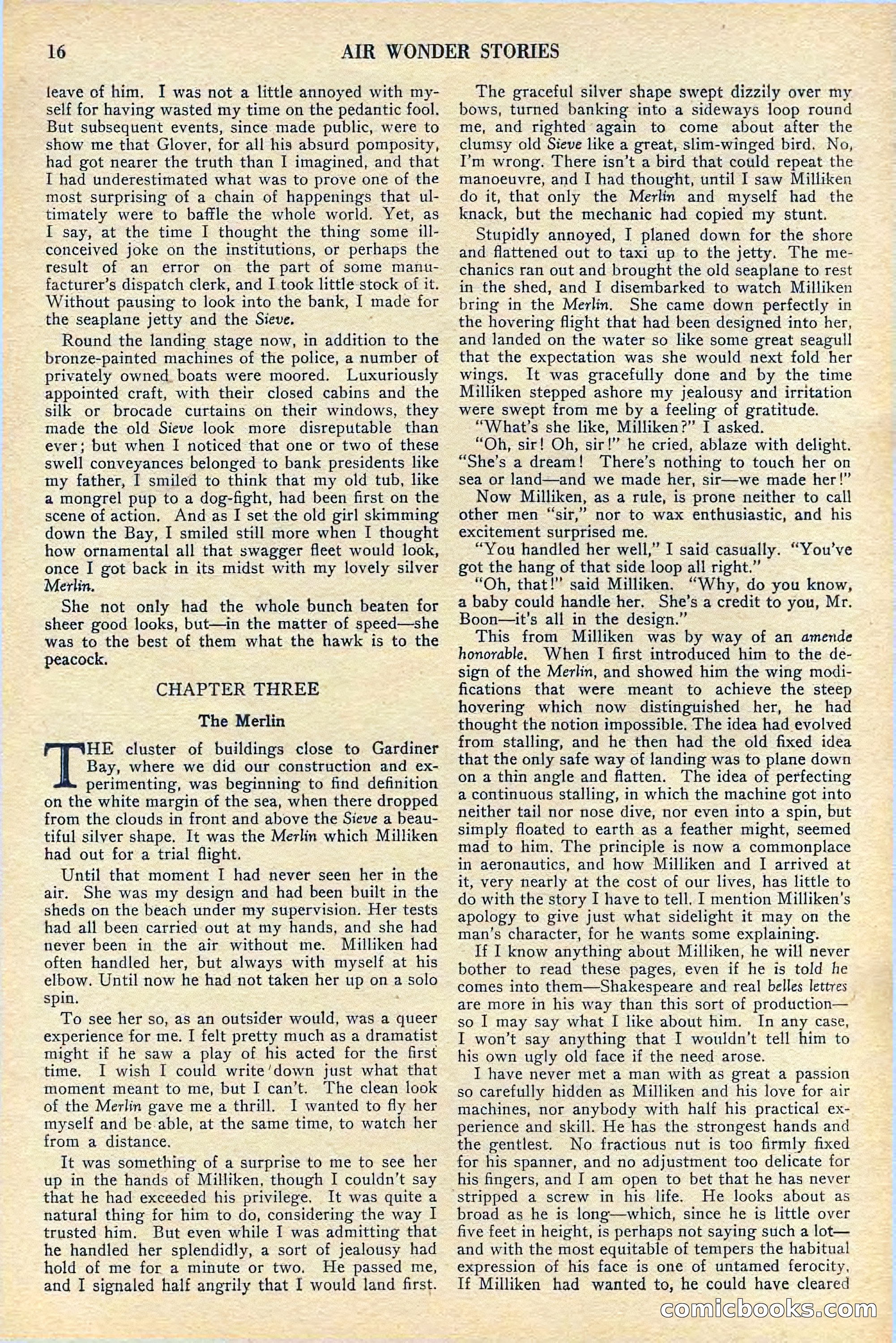
A restored page from Pulp Fiction, 1929. Page through the whole issue in the reader above.
📄 Transcribed text from this page (OCR, searchable)
Machine-transcribed from the original scan — historical spelling and the odd misread are preserved.
16 AIR WONDER STORIES feave of him, I was not a little annoyed with my- self for having wasted my time on the pedantic fool. But subsequent events, since made public, were to show me that Glover, for all his absurd pomposity, had got nearer the truth than I imagined, and that I had underestimated what was to prove one of the most surprising of a chain of happenings that ul- timately were to baffle the whole world. Yet, as I say, at the time I thought the thing some ill- conceived joke on the institutions, or perhaps the result of an error on the part of some manu- facturer’s dispatch clerk, and I took little-stock of it. Without pausing to look into the bank, I made for the seaplane jetty and the Sieve, Round the landing stage now, in addition to the bronze-painted machines of the police, a number of privately owned. boats were moored. Luxuriously appointed craft, with their closed cabins and the silk or brocade curtains on their windows, they made the old Sieve look more disreputable than ever; but when I noticed that one or two of these swell conveyances belonged to bank presidents like my father, | smiled to think that my old tub, like a mongrel pup to a dog-fight, had been first on the scene of action, And as I set the old girl skimming down the Bay, I smiled still more when I thought how ornamental all that swagger fleet would look, once I got back in its midst with my lovely silver Merlin. She not only had the whole bunch beaten for sheer good looks, but—in the matter of speed—she was to the best of them what the hawk is to the peacock. CHAPTER THREE The Merlin Te cluster of buildings close to Gardiner Bay, where we did our construction and ex- perimenting, was beginning to find definition on the white margin of the sea, when there dropped from the clouds in front and above the Sieve a beau- tiful silver shape. It was the Merlin which Milliken had out for a trial flight. Until that moment I had never seen her in the air. She was my design and had been built in the sheds on the beach under my supervision. Her tests had all been catried out at my hands, and she had never been in the air without me. Milliken had often handled her, but always with myself at his elbow. Until now he had not taken her up on a solo spin. To see her so, as an outsider would, was a queer experience for me. I felt pretty much as a dramatist might if he saw a play of his acted for the first time, I wish I could write’down just what that moment meant to me, but I can’t. The clean look of the Merlin gave me a thrill. I wanted to fly her myself and be.able, at the same time, to watch her from a distance. It was something of a surprise to me to see her up in the hands of Milliken, though I couldn’t say that he had exceeded his privilege. It was quite a natural thing for him to do, considering the way I trusted him. But even while I was admitting that he handled her splendidly, a sort of jealousy had hold of me for a minute or two. He passed me, and I signaled half angrily that I would land first. ‘stripped a screw in his life, The graceful silver shape swept dizzily over my bows, turned banking into a sideways loop round me, and righted again to come about after the clumsy old Sieve like a great, slim-winged bird. No, I’m wrong. There isn’t a bird that could repeat the manoeuvre, and I had thought, until I saw Milliken do it, that only the Merlin and myself had the Imack, but the mechanic had copied my stunt. Stupidly annoyed, I planed down for the shore and flattened out to taxi up to the jetty. The me- chanics ran out and brought the old seaplane to rest in the shed, and I disembarked to watch Milliken bring in the Merlin. She came down perfectly in the hovering flight that had been designed into her, and landed on the water so like some great seagull that the expectation was she would next fold her wings. It was gracefully done and by the time Milliken stepped ashore my jealousy and irritation were swept from me by a feeling of gratitude. “What's she like, Milliken?” I asked. “Oh, sir! Oh, sir!” he cried, ablaze with delight. “She’s a dream! There’s nothing to touch her on sea or land—and we made her, sir—we made her!” Now Milliken, as a rule, is prone neither to call other men “sir,” nor to wax enthusiastic, and his excitement surprised me. “You handled her well,” I said casually. “You’ve got the hang of that side loop all right.” “Oh, that!” said Milliken, “Why, do you know, a baby could handle her. She’s a credit to you, Mr. Boon—it’s all in the design.” This from Milliken was by way of an amende honorable. When I first introduced him to the de- sign of the Merlin, and showed him the wing modi- fications that were meant to achieve the steep hovering which now distinguished her, he had thought the notion impossible. The idea had evolved from stalling, and he then had the old fixed idea that the only safe way of landing was to plane down on a thin angle and flatten. The idea of perfecting a continuous stalling, in which the machine got into neither tail nor nose dive, nor even into a spin, but simply floated to earth as a feather might, seemed mad to him, The principle is now a commonplace in aeronautics, and how Milliken and I arrived at it, very nearly at the cost of our lives, has little to do with the story I have to tell. I mention Milliken’s apology to give just what sidelight it may on the man’s character, for he wants some explaining. If I know anything about Milliken, he will never bother to read these pages, even if he is told he comes into them—Shakespeare and real belles lettres are more in his way than this sort of production— so I may say what I like about him. In any case, I won’t say anything that I wouldn’t tell him to his own ugly old face if the need arose. I have never met a man with as great a passion so carefully hidden as Milliken and his love for air machines, nor anybody with half his practical ex- perience and skill. He has the strongest hands and the gentlest. No fractious nut is too firmly fixed for his spanner, and no adjustment too delicate for his fingers, and I am open to bet that he has never He looks about as broad as he is long—which, since he is little over five feet in height, is perhaps not saying such a lot— and with the most equitable of tempers the habitual expression of his face is one of untamed ferocity, If Milliken had wanted to, he could have cleared comnliclooolks.com