
Pulp Fiction, 1929 · page 13 of 100
Air Wonder Stories, July 1929 — page 13: what you’re looking at
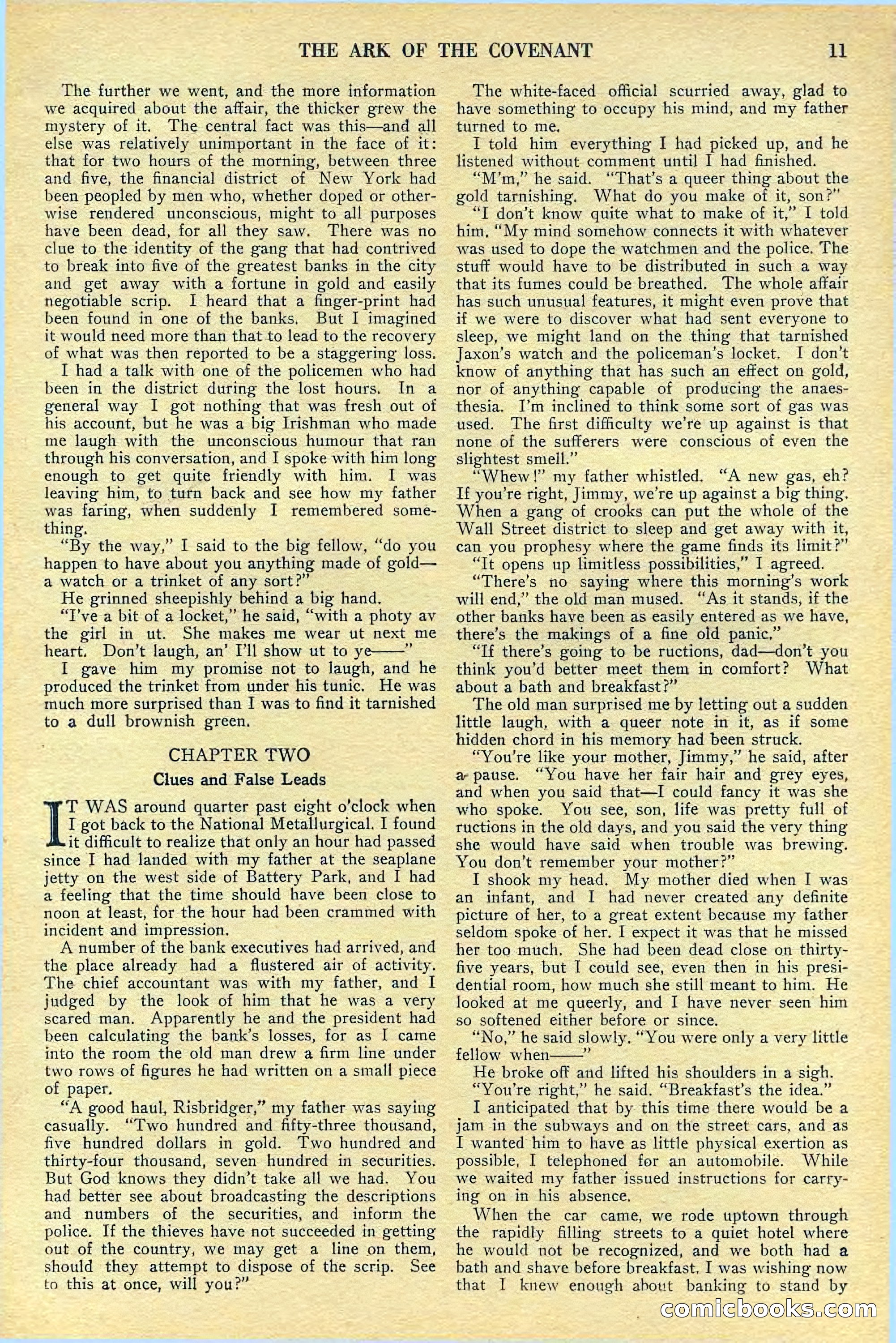
A restored page from Pulp Fiction, 1929. Page through the whole issue in the reader above.
📄 Transcribed text from this page (OCR, searchable)
Machine-transcribed from the original scan — historical spelling and the odd misread are preserved.
THE ARK OF THE COVENANT The further we went, and the more information we acquired about the affair, the thicker grew the mystery of it. The central fact was this—and all else was relatively unimportant in the face of it: that for two hours of the morning, between three and five, the financial district of New York had been peopled by men who, whether doped or other- wise rendered unconscious, might to all purposes have been dead, for all they saw. There was no clue to the identity of the gang that had contrived to break into five of the greatest banks in the city and get away with a fortune in gold and easily negotiable scrip. I heard that a finger-print had been fotind in one of the banks, But I imagined it would need more than that to lead to the recovery of what was then reported to be a staggering loss. I had a talk with one of the policemen who had been in the district during the lost hours, In a general way I got nothing that was fresh out of his account, but he was a big Irishman who made me laugh with the unconscious humour that ran through his conversation, and I spoke with him long enough to get quite friendly with him. I was leaving him, to tutn back and see how my father was faring, when suddenly I remembered some- thing, “By the way,” I said to the big fellow, “do you happen to have about you anything made of gold— a watch or a trinket of any sort?” He grinned sheepishly behind a big hand. “T’ve a bit of a locket,” he said, “with a photy av the girl in ut. She makes me wear ut next me heart. Don’t laugh, an’ Pll show ut ta ye—’ I gave him my promise not to laugh, and he produced the trinket from under his tunic. He was much more surprised than I was to find it tarnished to a dull brownish green, CHAPTER TWO Clues and False Leads T WAS around quarter past eight o’clock when [: got back to the National Metallurgical. I found it difficult to realize that only an hour had passed since I had landed with my father at the seaplane jetty on the west side of Battery Park, and I had a feeling that the time should have been close to noon at least, for the hour had been crammed with incident and impression. A number of the bank executives had arrived, and the place already had a flustered air of activity. The chief accountant was with my father, and I judged by the look of him that he was a very scared man. Apparently he and the president had been calculating the bank’s losses, for as J came into the room the old man drew a firm line under two rows of figures he had written on a small piece of paper. “A good haul, Risbridger,” my father was saying casually. “Two hundred and fifty-three thousand, five hundred dollars in gold. Two hundred and thirty-four thousand, seven hundred in securities. But God knows they didn’t take all we had. You had better see about broadcasting the descriptions and numbers of the securities, and inform the police. If the thieves have not succeeded in getting out of the country, we may get a line on them, should they attempt to dispose of the scrip. See to this at once, will you?” il The white-faced official scurried away, glad to have something to occupy his mind, and my father turned to me. T told him everything I had picked up, and he listened without comment until I had finished. “M'm,” he said. “That’s a queer thing about the gold tarnishing. What do you make of it, son?” “T don’t know quite what to make of it,” I told him, “My mind somehow connects it with whatever was used to dope the watchmen and the police. The stuff would have to be distributed in such a way that its fumes could be breathed. The whole affair has such unusual features, it might even prove that if we were to discover what had sent everyone to sleep, we might land on the thing that tarnished Jaxon’s watch and the policeman’s locket. I don’t know of anything that has such an effect on gold, nor of anything capable of producing the anaes- thesia, I’m inclined to think some sort of gas was used. The first difficulty we're up against is that none of the sufferers were conscious of even the slightest smell.” “Whew!” my father whistled. “A new gas, eh? If you're right, Jimmy, we’re up against a big thing. When a gang of crooks can put the whole of the Wall Street district to sleep and get away with it, can you prophesy where the game finds its limit?” “Tt opens up limitless possibilities,” I agreed. “There’s no saying where this morning’s work will end,” the old man mused. ‘As it stands, if the other banks have been as easily entered as we have, there’s the makings of a fine old panic,” “Tf there’s going to be ructions, dad—don’t you think you’d better meet them in comfort? What about a bath and breakfast?” The old man surprised me by letting out a sudden little laugh, with a queer note in it, as if some hidden chord in his memory had been struck. “You're like your mother, Jimmy,” he said, after a pause. “You have her fair hair and grey eyes, and when you said that—I could fancy it was she who spoke. You see, son, life was pretty full of ructions in the old days, and you said the very thing she would have said when trouble was brewing. You don’t remember your mother?” I shook my head. My mother died when I was an infant, and I had never created any definite picture of her, to a great extent because my father seldom spoke of her. I expect it was that he missed her too much, She had been dead close on thirty- five years, but I could see, even then in his presi- dential room, how much she still meant to him. He looked at me queerly, and I have never seen him so softened either before or since. “No,” he said slowly. “You were only a very little fellow when 2 He broke off and lifted his shoulders in a sigh. “You're right,” he said. “Breakfast’s the idea.” I anticipated that by this time there would be a jam in the subways and on the street cars, and as I wanted him to have as little physical exertion as possible, I telephoned for an automobile. While we waited my father issued instructions for carry- ing on in his absence, When the car came, we rode uptown through the rapidly filling streets to a quiet hotel where he would not be recognized, and we both had a bath and shave before breakfast, I was wishing now that I knew enough about banking to stand by comniclooolks.comn