
Pulp Fiction, 1946 · page 175 of 204
Avon Murder Mystery Monthly No. 41 — page 175: what you’re looking at
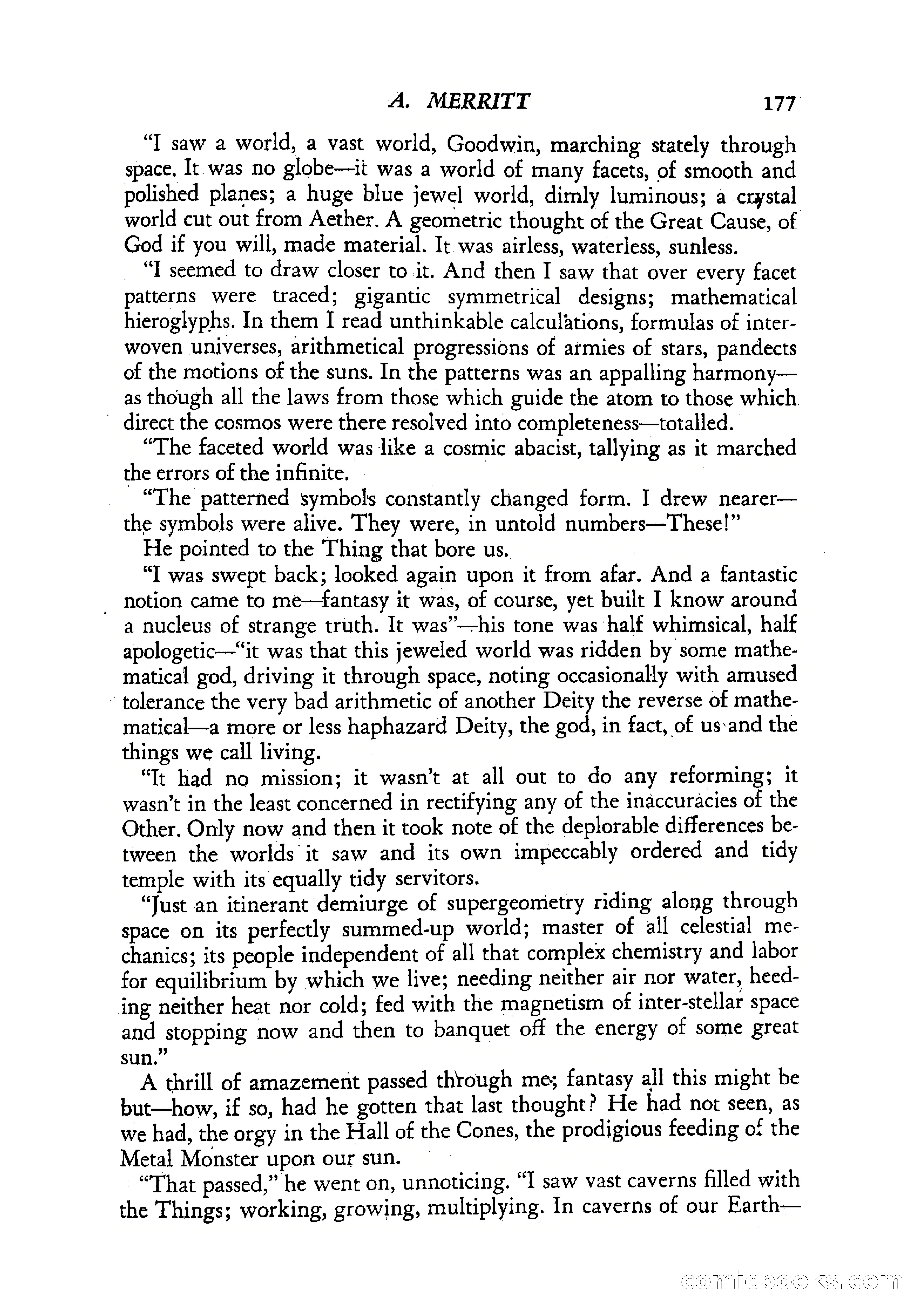
A restored page from Pulp Fiction, 1946. Page through the whole issue in the reader above.
📄 Transcribed text from this page (OCR, searchable)
Machine-transcribed from the original scan — historical spelling and the odd misread are preserved.
A, MERRITT 177 “I saw a world, a vast world, Goodwin, marching stately through space, It was no globe—it was a world of many facets, of smooth and polished planes; a huge blue jewel world, dimly luminous; a crystal world cut out from Aether. A geometric thought of the Great Cause, of God if you will, made material. It was airless, waterless, sunless. — “T seemed to draw closer to it. And then I saw that over every facet patterns were traced; gigantic symmetrical designs; mathematical hieroglyphs. In them I read unthinkable calculations, formulas of inter- woven universes, arithmetical progressions of armies of stars, pandects of the motions of the suns. In the patterns was an appalling harmony— as though all the laws from those which guide the atom to those which direct the cosmos were there resolved into completeness—totalled. “The faceted world was like a cosmic abacist, tallying as it marched the errors of the infinite. | | | “The patterned symbols constantly changed form. I drew nearer— the symbols were alive. They were, in untold numbers—These!” He pointed to the Thing that bore us. | “I was swept back; looked again upon it from afar. And a fantastic notion came to me—fantasy it was, of course, yet built I know around a nucleus of strange truth. It was”--his tone was ‘half whimsical, half apologetic—“it was that this jeweled world was ridden by some mathe- matical god, driving it through space, noting occasionally with amused - tolerance the very bad arithmetic of another Deity the reverse of mathe- matical—a more or less haphazard Deity, the god, in fact, of us-and the things we call living. “Tt had no mission; it wasn’t at all out to do any reforming; it wasn’t in the least concerned in rectifying any of the inaccuracies of the Other. Only now and then it took note of the deplorable differences be- tween the worlds it saw and its own impeccably ordered and tidy temple with its equally tidy servitors. “Just an itinerant demiurge of supergeomietry riding along through space on its perfectly summed-up world; master of all celestial me- chanics; its people independent of all that complex chemistry and labor for equilibrium by which we live; needing neither air nor water, heed- ing neither heat nor cold; fed with the magnetism of inter-stellar space and stopping now and then to banquet off the energy of some great sun.” A thrill of amazement passed through me; fantasy all this might be but—how, if so, had he gotten that last thought? He had not seen, as we had, the orgy in the Hall of the Cones, the prodigious feeding of the Metal Monster upon our sun. “That passed,” he went on, unnoticing. “I saw vast caverns filled with the Things; working, growing, multiplying. In caverns of our Earth— ECOMC OOO (GO)