
Pulp Fiction, 1947 · page 93 of 132
Avon Modern Short Story Monthly #36 — page 93: what you’re looking at
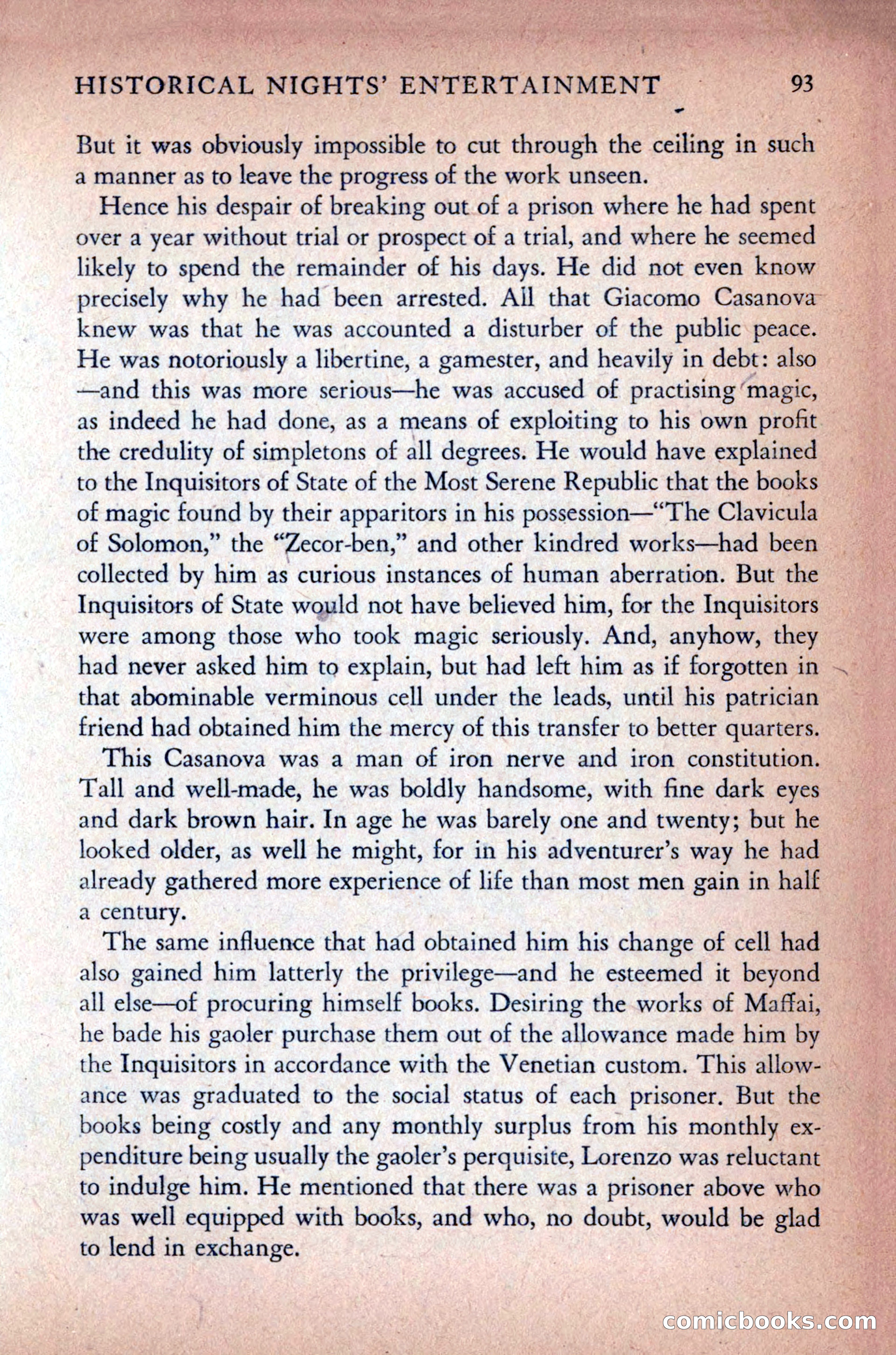
A restored page from Pulp Fiction, 1947. Page through the whole issue in the reader above.
📄 Transcribed text from this page (OCR, searchable)
Machine-transcribed from the original scan — historical spelling and the odd misread are preserved.
Sg OLA ATE LL Mars ES We ory xe - ’ y= “> be ia ii 7 * 4 ’ eas We eet « rat . ; HISTORICAL NIGHTS’ ENTERTAINMENT - But it was obviously impossible to cut through the ceiling in such a manner as to leave the progress of the work unseen. Hence his despair of breaking out of a prison where he had spent over a year without trial or prospect of a trial, and where he seemed likely to spend the remainder of his days. He did not even know precisely why he had been arrested. Ail that Giacomo Casanova knew was that he was accounted a disturber of the public peace. He was notoriously a libertine, a gamester, and heavily in debt: also —and this was more serious—he was accused of practising ‘magic, as indeed he had done, as a means of exploiting to his own profit the credulity of simpletons of all degrees. He would have explained to the Inquisitors of State of the Most Serene Republic that the books of magic found by their apparitors in his possession—“The Clavicula of Solomon,” the “Zecor-ben,” and other kindred works—had been collected by him as curious instances of human aberration. But the Inquisitors of State would not have believed him, for the Inquisitors were among those who took magic seriously. And, anyhow, they had never asked him to explain, but had left him as if forgotten in that abominable verminous cell under the leads, until his patrician friend had obtained him the mercy of this transfer to better quarters. This Casanova was a man of iron nerve and iron constitution. Tall and well-made, he was boldly handsome, with fine dark eyes and dark brown hair. In age he was barely one and twenty; but he looked older, as well he might, for in his adventurer’s way he had already gathered more experience of life than most men gain in half a century. The same influence that had obtained him his change of cell had also gained him latterly the privilege—and he esteemed it beyond all else—of procuring himself books. Desiring the works of Maffai, he bade his gaoler purchase them out of the allowance made him by the Inquisitors in accordance with the Venetian custom. This allow- ance was graduated to the social status of each prisoner. But the books being costly and any monthly surplus from his monthly ex- penditure being usually the gaoler’s perquisite, Lorenzo was reluctant to indulge him. He mentioned that there was a prisoner above who was well equipped with books, and who, no doubt, would be glad to lend in exchange. Gomichbooks com