
Pulp Fiction, 1950 · page 42 of 132
Avon Fantasy Reader No. 14 — page 42: what you’re looking at
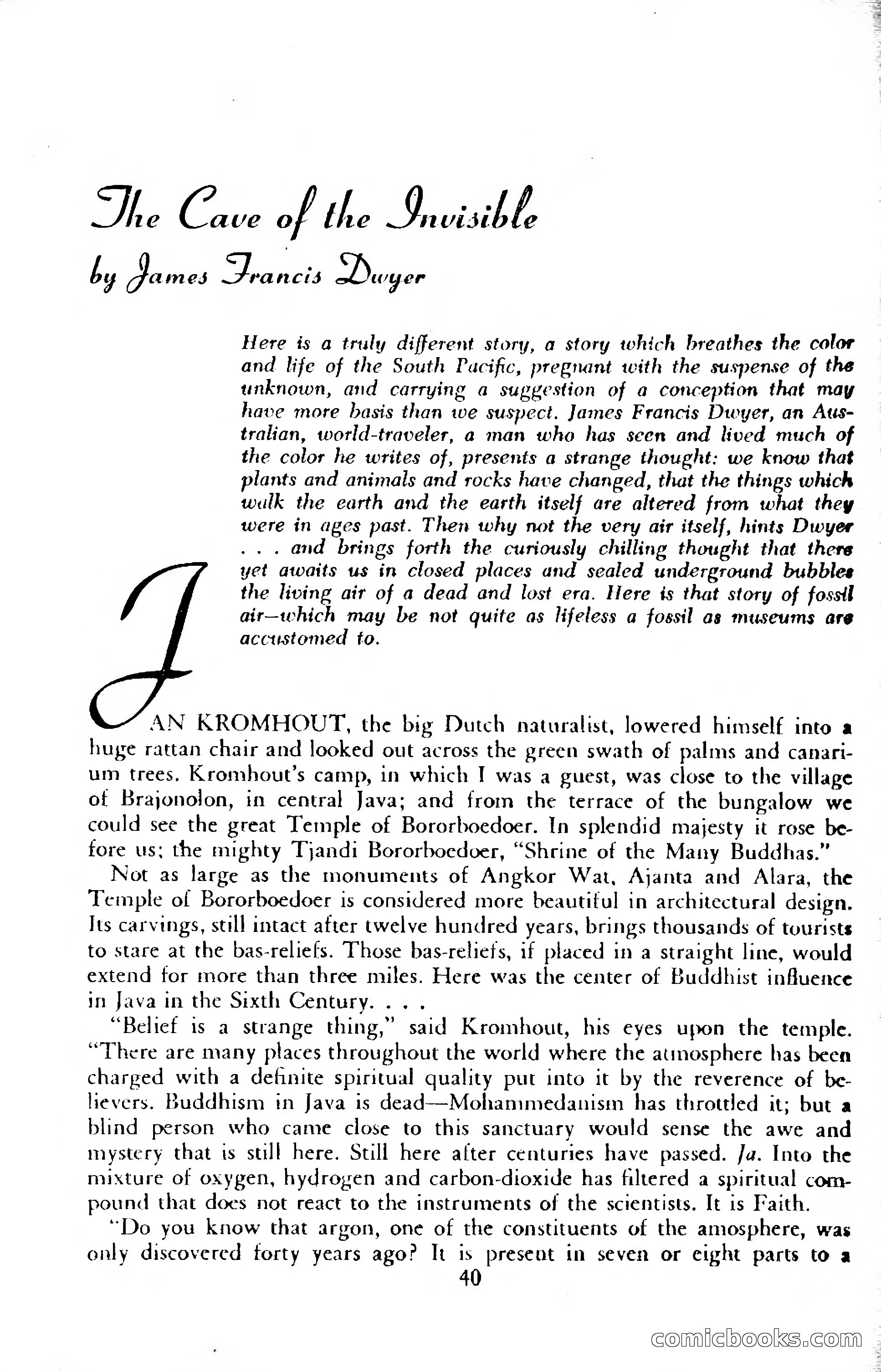
A restored page from Pulp Fiction, 1950. Page through the whole issue in the reader above.
📄 Transcribed text from this page (OCR, searchable)
Machine-transcribed from the original scan — historical spelling and the odd misread are preserved.
The Cive of the Invisible by james Francis Dwyer Here is a truly different story, a story which breathes the color and life of the South Pacific, pregnant with the suspense of the unknown, and carrying a suggestion of a conception that may have more basis than we suspect. James Francis Dwyer, an Aus- tralian, world-traveler, a man who has seen and lived much of the color he writes of, presents a strange thought: we know that plants and animals and rocks have changed, that the things which walk the earth and the earth itself are altered from what they were in ages past. Then why not the very air itself, hints Dwyer . and brings forth the curiously chilling thought that there yet awaits us in closed places and sealed underground bubbles the living air of a dead and lost era. Here is that story of fossil air—which may be not quite as lifeless a fossil as museums are accustomed to. AN KROMHOUT, the big Dutch naturalist, lowered himself into a huge rattan chair and looked out across the green swath of palms and canari- um trees. Kromhout’s camp, in which T was a guest, was close to the village of Brajonolon, in central Java; and from the terrace of the bungalow we could see the great Temple of Bororboedoer. In splendid majesty it rose be- fore us; the mighty Tjandi Bororboedoer, “Shrine of the Many Buddhas.” Not as large as the monuments of Angkor Wat, Ajanta and Alara, the Temple of Bororboedoer is considered more beautiful in architectural design. Its carvings, still intact after twelve hundred years, brings thousands of tourists to stare at the bas-reliefs. Those bas-reliefs, if placed in a straight line, would extend for more than three miles. Here was the center of Buddhist influence in Java in the Sixth Century. ... “Belief is a strange thing,” said Kromhout, his eyes upon the temple. “There are many places throughout the world where the atmosphere has been charged with a definite spiritual quality put into it by the reverence of be levers. Buddhism in Java is dead—Mohammedanism has throttled it; but a blind person who came close to this sanctuary would sense the awe and mystery that is still here. Still here after centuries have passed. Ja. Into the mixture of oxygen, hydrogen and carbon-dioxide has filtered a spiritual com- pound that does not react to the instruments of the scientists. It is Faith. “Do you know that argon, one of the constituents of the amosphere, was only discovered torty years ago? It is present in seven or eight parts to a 40 comiclsooks.com