
Pulp Fiction, 1950 · page 103 of 132
Avon Fantasy Reader No. 14 — page 103: what you’re looking at
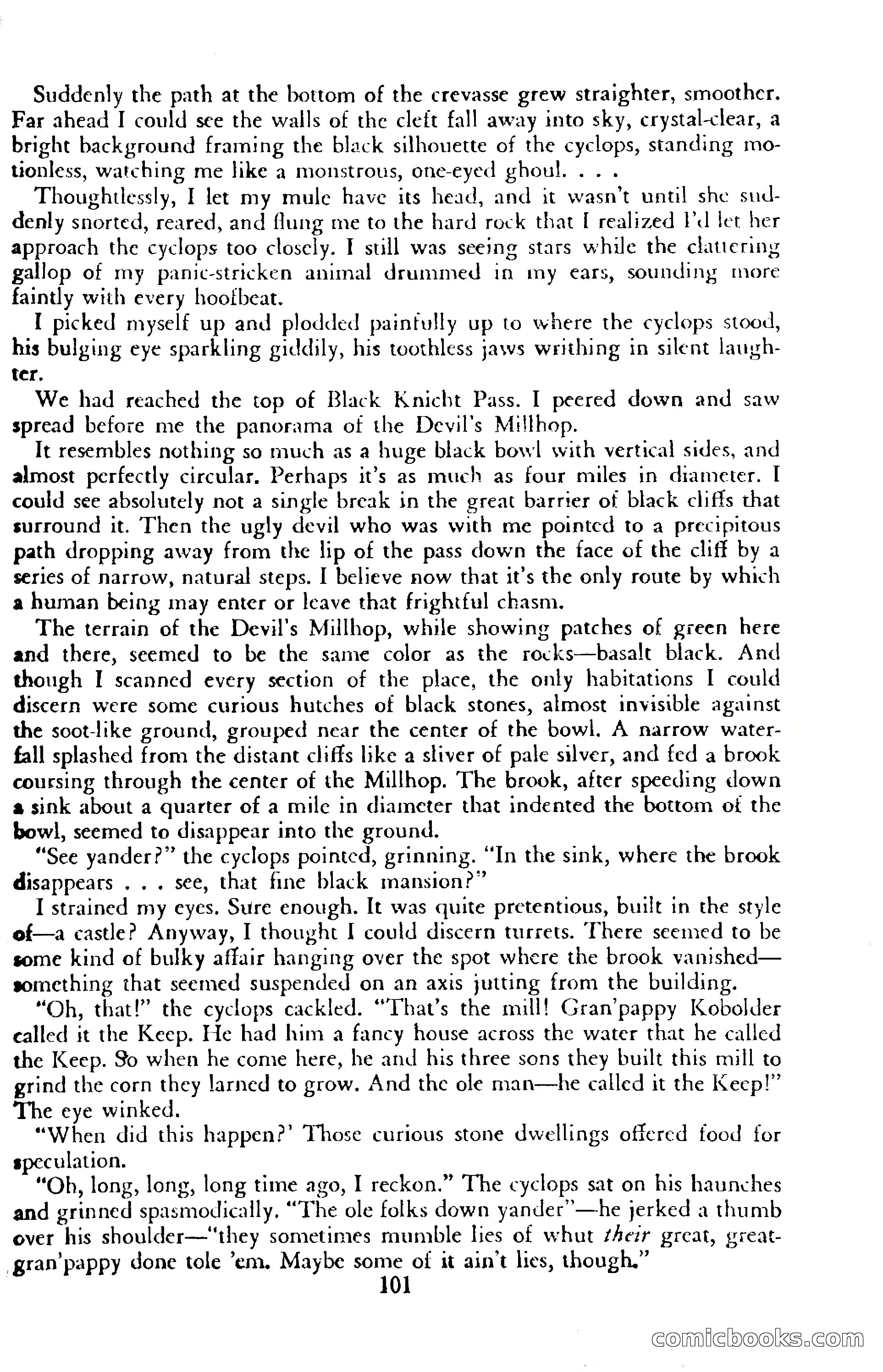
A restored page from Pulp Fiction, 1950. Page through the whole issue in the reader above.
📄 Transcribed text from this page (OCR, searchable)
Machine-transcribed from the original scan — historical spelling and the odd misread are preserved.
Suddenly the path at the bottom of the crevasse grew straighter, smoother. Far ahead I could see the walls of the cleft fall away into sky, crystal-clear, a bright background framing the black silhouette of the cyclops, standing mo- tionless, watching me like a monstrous, one-eyed ghoul... . Thoughtlessly, I let my mule have its head, and it wasn’t until she sud- denly snorted, reared, and flung me to the hard rock that [ realized Vd let her approach the cyclops too closely. I still was seeing stars while the clatiering gallop of my panic-stricken animal drummed in my ears, sounding more faintly with every hootbeat. I picked myself up and plodded paintully up to where the cyclops stood, his bulging eye sparkling giddily, his toothless jaws writhing in silent laugh- ter. We had reached the top of Black Knicht Pass. I peered down and saw spread before me the panorama of the Devil's Mil!hop. It resembles nothing so much as a huge black bowl with vertical sides, and almost perfectly circular. Perhaps it’s as much as four miles in diameter. I could see absolutely not a single break in the great barrier of black cliffs that surround it. Then the ugly devil who was with me pointed to a precipitous path dropping away from the lip of the pass down the face of the cliff by a series of narrow, natural steps. I believe now that it’s the only route by which a human being may enter or leave that frightful chasm. The terrain of the Devil's Millhop, while showing patches of green here and there, seemed to be the same color as the rocks—basale black. And though I scanned every section of the place, the only habitations I could discern were some curious hutches of black stones, almost invisible against the soot-like ground, grouped near the center of the bowl. A narrow water- fall splashed from the distant cliffs like a sliver of pale silver, and fed a brook coursing through the center of the Millhop. The brook, after speeding down a sink about a quarter of a mile in diameter that indented the bottom of the bowl, seemed to disappear into the ground. “See yander?” the cyclops pointed, grinning. “In the sink, where the brook disappears . . . see, that fine black mansion?” I strained my eyes. Sure enough. It was quite pretentious, built in the style of—a castle? Anyway, I thought I could discern turrets. There seemed to be some kind of bulky affair hanging over the spot where the brook vanished— something that seemed suspended on an axis jutting from the building. “Oh, that!” the cyclops cackled. “That’s the mill! Gran’pappy Kobolder called it the Keep. He had him a fancy house across the water that he called the Keep. So when he come here, he and his three sons they built this mill to grind the corn they larned to grow. And the ole man—he called it the Keep!” The eye winked. “When did this happen?’ Those curious stone dwellings offered food for speculation. “Oh, long, long, long time ago, I reckon.” The cyclops sat on his haunches and grinned spasmodically. “The ole folks down yander”—he jerked a thumb over his shoulder—“they sometimes mumble les of whut ‘Aeir great, great- _gran’pappy done tole ’em. Maybe some of it ain’t lies, though,” 101 comiclooks.com