
Pulp Fiction, 1950 · page 90 of 132
Avon Fantasy Reader No. 13 — page 90: what you’re looking at
A restored page from Pulp Fiction, 1950. Page through the whole issue in the reader above.
📄 Transcribed text from this page (OCR, searchable)
Machine-transcribed from the original scan — historical spelling and the odd misread are preserved.
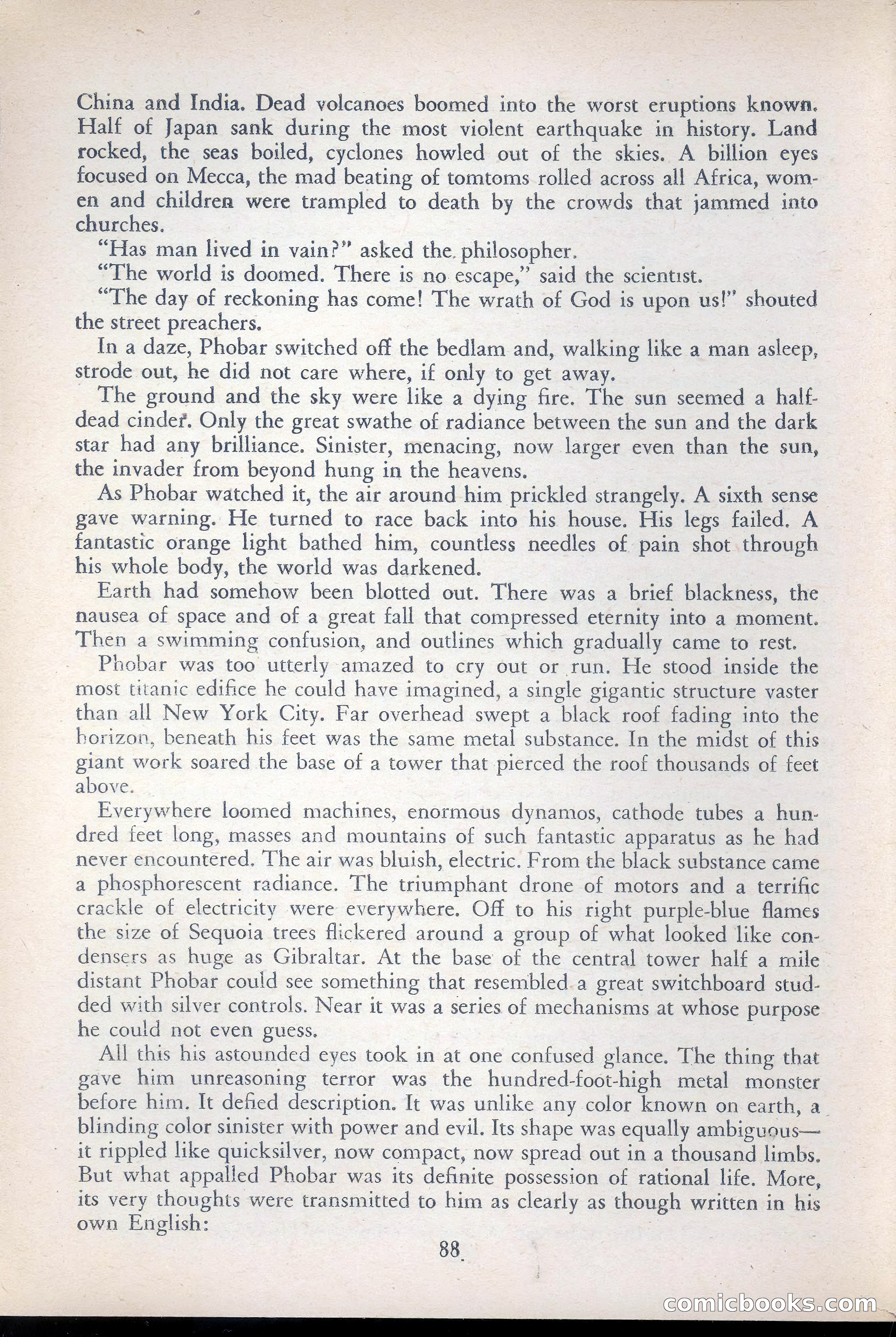
China and India. Dead volcanoes boomed into the worst eruptions known. Half of Japan sank during the most violent earthquake in history. Land rocked, the seas boiled, cyclones howled out of the skies. A billion eyes focused on Mecca, the mad beating of tomtoms rolled across all Africa, wom- en and children were trampled to death by the crowds that jammed into churches. 7 “Has man lived in vain?” asked the. philosopher. “The world is doomed. There is no escape,” said the scientist. “The day of reckoning has come! The wrath of God is upon us!” shouted the street preachers. In a daze, Phobar switched off the bedlam and, walking like a man asleep, strode out, he did not care where, if only to get away. The ground and the sky were like a dying fire. The sun seemed a half- dead cinder. Only the great swathe of radiance between the sun and the dark star had any brilliance. Sinister, menacing, now larger even than the sun, the invader from beyond hung in the heavens. As Phobar watched it, the air around him prickled strangely. A sixth sense gave warning. He turned to race back into his house. His legs failed. A fantastic orange light bathed him, countless needles of pain shot through his whole body, the world was darkened. Farth had somehow been blotted out. There was a brief blackness, the nausea of space and of a great fall that compressed eternity into a moment. Then a swimming confusion, and outlines which gradually came to rest. Phobar was too utterly amazed to cry out or run. He stood inside the most titanic edifice he could have imagined, a single gigantic structure vaster than all New York City. Far overhead swept a black roof fading into the horizon, beneath his feet was the same metal substance. In the midst of this giant work soared the base of a tower that pierced the roof thousands of feet above. Everywhere loomed machines, enormous dynamos, cathode tubes a hun- dred feet long, masses and mountains of such fantastic apparatus as he had never encountered. The air was bluish, electric. From the black substance came a phosphorescent radiance. The triumphant drone of motors and a terrific crackle of electricity were everywhere. Off to his right purple-blue flames the size of Sequoia trees flickered around a group of what looked like con- densers as huge as Gibraltar. At the base of the central tower half a mile distant Phobar could see something that resembled.a great switchboard stud- ded with silver controls. Near it was a series of mechanisms at whose purpose he could not even guess. | All this his astounded eyes took in at one confused glance. The thing that gave him unreasoning terror was the hundred-foot-high metal monster before him. It defied description. [t was unlike any color known on earth, a blinding color sinister with power and evil. Its shape was equally ambiguous— it rippled like quicksilver, now compact, now spread out in a thousand limbs. But what appalled Phobar was its definite possession of rational life. More, its very thoughts were transmitted to him as clearly as though written in his own English: | 2 88. Comicbooks:com=s ee ees