
Pulp Fiction, 1950 · page 88 of 132
Avon Fantasy Reader No. 13 — page 88: what you’re looking at
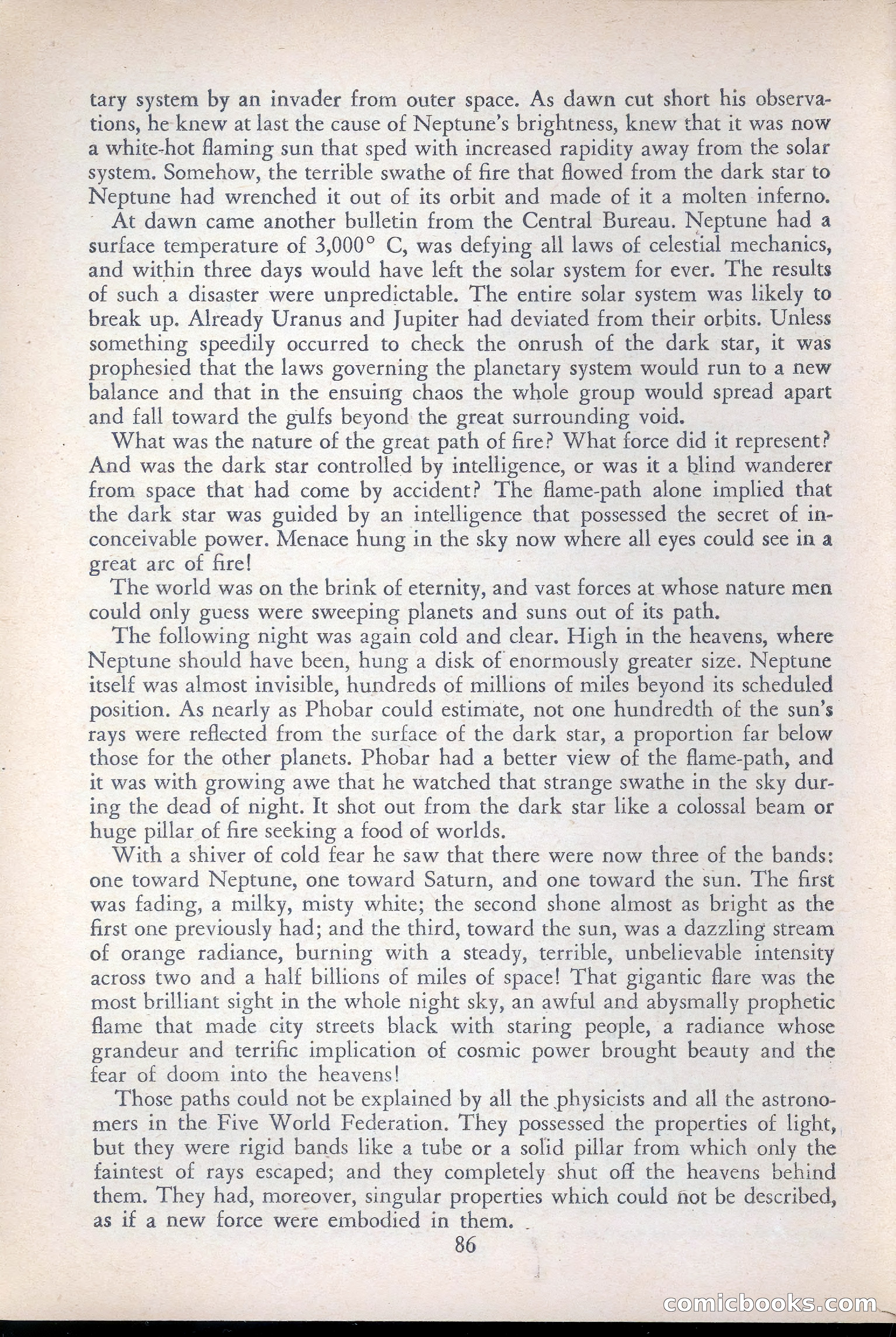
A restored page from Pulp Fiction, 1950. Page through the whole issue in the reader above.
📄 Transcribed text from this page (OCR, searchable)
Machine-transcribed from the original scan — historical spelling and the odd misread are preserved.
tary system by an invader from outer space. As dawn cut short his observa- tions, he knew at last the cause of Neptune’s brightness, knew that it was now a white-hot flaming sun that sped with increased rapidity away from the solar system. Somehow, the terrible swathe of fire that flowed from the dark star to Neptune had wrenched it out of its orbit and made of it a molten inferno. ~ At dawn came another bulletin from the Central Bureau. Neptune had a surface temperature of 3,000° C, was defying all laws of celestial mechanics, and within three days would have lef the solar system for ever. The results of such a disaster were unpredictable. The entire solar system was likely to break up. Already Uranus and Jupiter had deviated from their orbits. Unless something speedily occurred to check the onrush of the dark star, it was prophesied that the laws governing the planetary system would run to a new balance and that in the ensuing chaos the whole group would spread apart and fall toward the gulfs beyond the great surrounding void. What was the nature of the great path of fire? What force did it represent? And was the dark star controlled by intelligence, or was it a blind wanderer from space that had come by accident? The flame-path alone implied that the dark star was guided by an intelligence that possessed the secret of in- conceivable power. Menace hung in the sky now where all eyes could see in a great arc of fire! The world was on the brink of eternity, a vast forces at whose nature men could only guess were sweeping planets and suns out of its path. The following night was again cold and clear. High in the heavens, where Neptune should have been, hung a disk of enormously greater size. Neptune itself was almost invisible, hundreds of millions of miles beyond its scheduled position. As nearly as Phobar could estimate, not one hundredth of the sun’s rays were reflected from the surface of the dark star, a proportion far below those for the other planets. Phobar had a better view of the flame-path, and it was with growing awe that he watched that strange swathe in the sky dur- ing the dead of night. It shot out from the dark star like a colossal beam or huge pillar of fire seeking a food of worlds. With a shiver of cold fear he saw that there were now three of the bands: one toward Neptune, one toward Saturn, and one toward the sun. The first was fading, a milky, misty white; the second shone almost as bright as the first one previously had; and the third, toward the sun, was a dazzling stream of orange radiance, burning with a steady, terrible, unbelievable intensity across two and a half billions of ules of space! That gigantic flare was the most brilliant sight in the whole night sky, an awful and abysmally prophetic flame that made city streets black with staring people, a radiance whose grandeur and terrific implication of cosmic power brought beauty and the fear of doom into the heavens! Those paths could not be explained by all the physicists and all the astrono- mers in the Five World Federation. They possessed the properties of light, but they were rigid bands like a tube or a solid pillar from which only the faintest of rays escaped; and they completely shut off the heavens behind them. They had, moreover, singular properties which could not be described, as if a new force were embodied in them. : 86 ga : Conmicloxoolks,. Ceol, ee