
Pulp Fiction, 1950 · page 74 of 132
Avon Fantasy Reader No. 13 — page 74: what you’re looking at
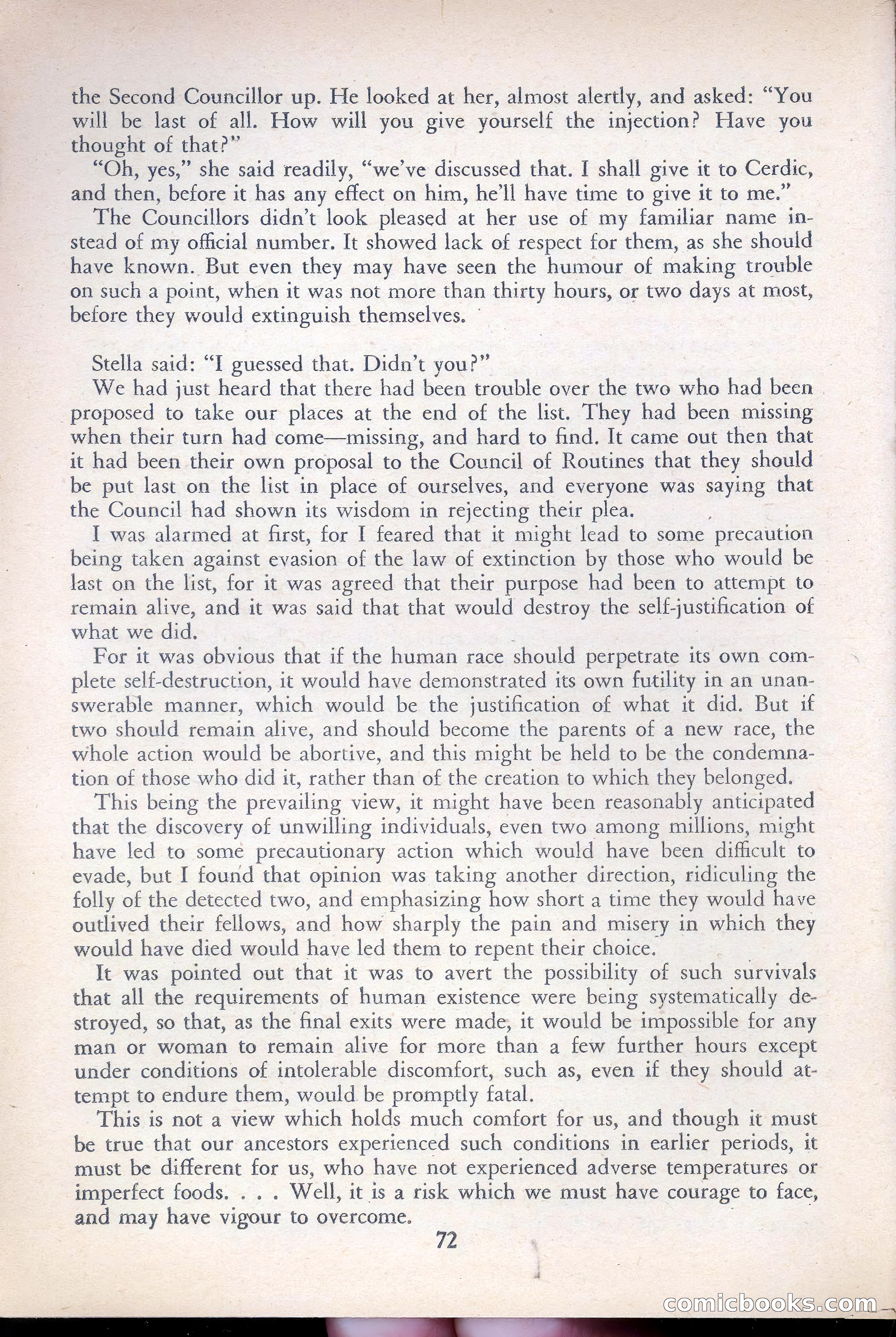
A restored page from Pulp Fiction, 1950. Page through the whole issue in the reader above.
📄 Transcribed text from this page (OCR, searchable)
Machine-transcribed from the original scan — historical spelling and the odd misread are preserved.
the Second Councillor up. He looked at her, almost alertly, and asked: “You will be last of all. How will you give yourself the injection? Have you thought of that?” “Oh, yes,” she said readily, “we’ve discussed that. I shall give it to Cerdic, and then, before it has any effect on him, he'll have time to give it to me.” The Councillors didn’t look pleased at her use of my familiar name in- stead of my official number. It showed lack of respect for them, as she should have known. But even they may have seen the humour of making trouble on such a point, when it was not more than thirty hours, or two days at most, before they would extinguish themselves. Stella said: “I guessed that. Didn’t you?” We had just heard that there had been trouble over the two who had been | proposed to take our places at the end of the list. They had been missing when their turn had come—missing, and hard to find. It came out then that it had been their own proposal to the Council of Routines that they should be put last on the list in place of ourselves, and everyone was saying that the Council had shown its wisdom in rejecting their plea. I was alarmed at first, for I feared that it might lead to some precaution being taken against evasion of the law of extinction by those who would be - last on the list, for it was agreed that their purpose had been to attempt to remain alive, and it was said that that would destroy the self-justification of what we did. : For it was obvious that if the human race should perpetrate its own com- plete self-destruction, it would have demonstrated its own futility in an unan- swerable manner, which would be the justification of what it did. But if two should remain alive, and should become the parents of a new race, the whole action would be abortive, and this might be held to be the condemna- tion of those who did it, rather than of the creation to which they belonged. This being the prevailing view, it might have been reasonably anticipated that the discovery of unwilling individuals, even two among millions, might have led to some precautionary action which would have been difficult to evade, but I found that opinion was taking another direction, ridiculing the folly of the detected two, and emphasizing how short a time they would have outlived their fellows, and how sharply the pain and misery in which they would have died would have led them to repent their choice. : It was pointed out that it was to avert the possibility of such survivals that all the requirements of human existence were being systematically de- stroyed, so that, as the final exits were made, it would be impossible for any man or woman to remain alive for more than a few further hours except under conditions of intolerable discomfort, such as, even if they should at- tempt to endure them, would be promptly fatal. This is not a view which holds much comfort for us, and though it must be true that our ancestors experienced such conditions in earlier periods, it must be different for us, who have not experienced adverse temperatures or imperfect foods. . . . Well, it is a risk which we must have courage to face, and may have eeu to overcome. 72 COmichooks.Conn