
Pulp Fiction, 1950 · page 71 of 132
Avon Fantasy Reader No. 13 — page 71: what you’re looking at
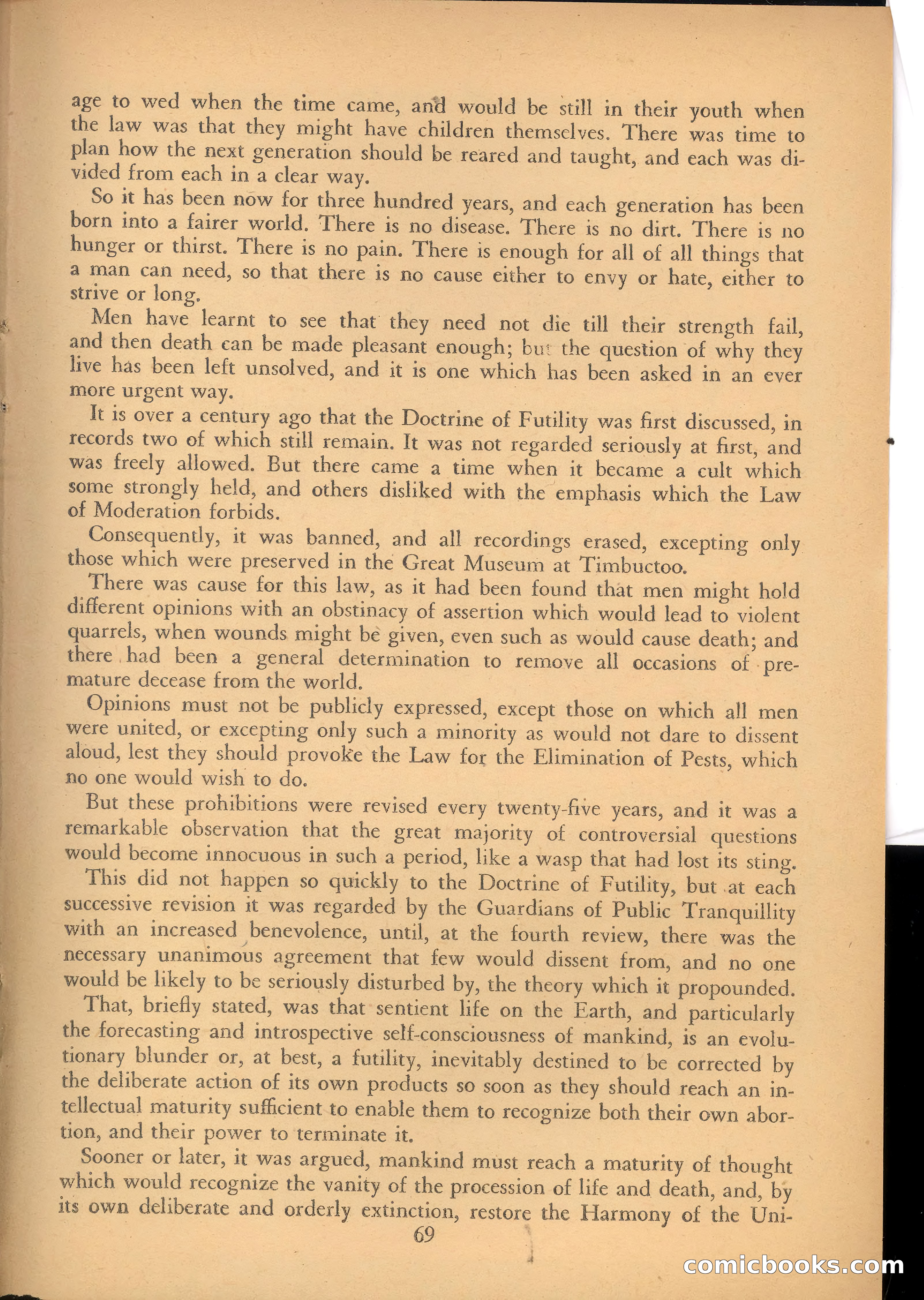
A restored page from Pulp Fiction, 1950. Page through the whole issue in the reader above.
📄 Transcribed text from this page (OCR, searchable)
Machine-transcribed from the original scan — historical spelling and the odd misread are preserved.
ei di Ce ——— ee CO CC 7" t ‘ age to wed when the time came, and would be still in their youth when the law was that they might have children themselves. There was time to plan how the next generation should be reared and taught, and each was di- vided from each in a clear way. So it has been now for three hundred years, and each generation has been born into a fairer world. There is no disease. There is no dirt. There is no _ hunger or thirst. There is no pain. There is enough for all of all things that a man can need, so that there is no cause either to envy or hate, either to strive or long. 7 Men have learnt to see that’ they need not die till their strength fail, and then death can be made pleasant enough; but the question of why they live has been left unsolved, and it is one which has been asked in an ever more urgent way. | | It is over a century ago that the Doctrine of F utility was first discussed, in records two of which still remain. It was not regarded seriously at first, and was freely allowed. But there came a time when it became a cult which some strongly held, and others disliked with the emphasis which the Law of Moderation forbids. Consequently, it was banned, and all recordings erased, excepting only those which were preserved in the Great Museum at Timbuctoo. There was cause for this law, as it had been found that men might hold different opinions with an obstinacy of assertion which would lead to violent quarrels, when wounds might be given, even such as would cause death; and there .had been a general determination to remove all occasions of pre- -mature decease from the world. Opinions must not be publicly expressed, except those on which all men were united, or excepting only such a minority as would not dare to dissent aloud, lest they should provoke the Law for the Elimination of Pests, which no one would wish to do. But these prohibitions were revised every twenty-five years, and it was a remarkable observation that the great majority of controversial questions would become innocuous in such a period, like a wasp that had lost its sting. This did not happen so quickly to the Doctrine of Futility, but .at each successive revision it was regarded by the Guardians of Public Tranquillity with an increased benevolence, until, at the fourth review, there was the mecessary unanimous agreement that few would dissent from, and no one would be likely to be seriously disturbed by, the theory which it propounded. That, briefly stated, was that sentient life on the Earth, and particularly the forecasting and introspective self-consciousness of mankind, is an evolu- tionary blunder or, at best, a futility, inevitably destined to be corrected by the deliberate action of its own products so soon as they should reach an in- tellectual maturity sufficient to enable them to recognize both their own abor- tion, and their power to terminate it. | Sooner or later, it was argued, mankind must reach a maturity of thought which would recognize the vanity of the procession of life and death, and, by its own deliberate and orderly extinction, restore the Harmony of the Uni- 69 . com (@) bool KS