
Pulp Fiction, 1950 · page 63 of 132
Avon Fantasy Reader No. 13 — page 63: what you’re looking at
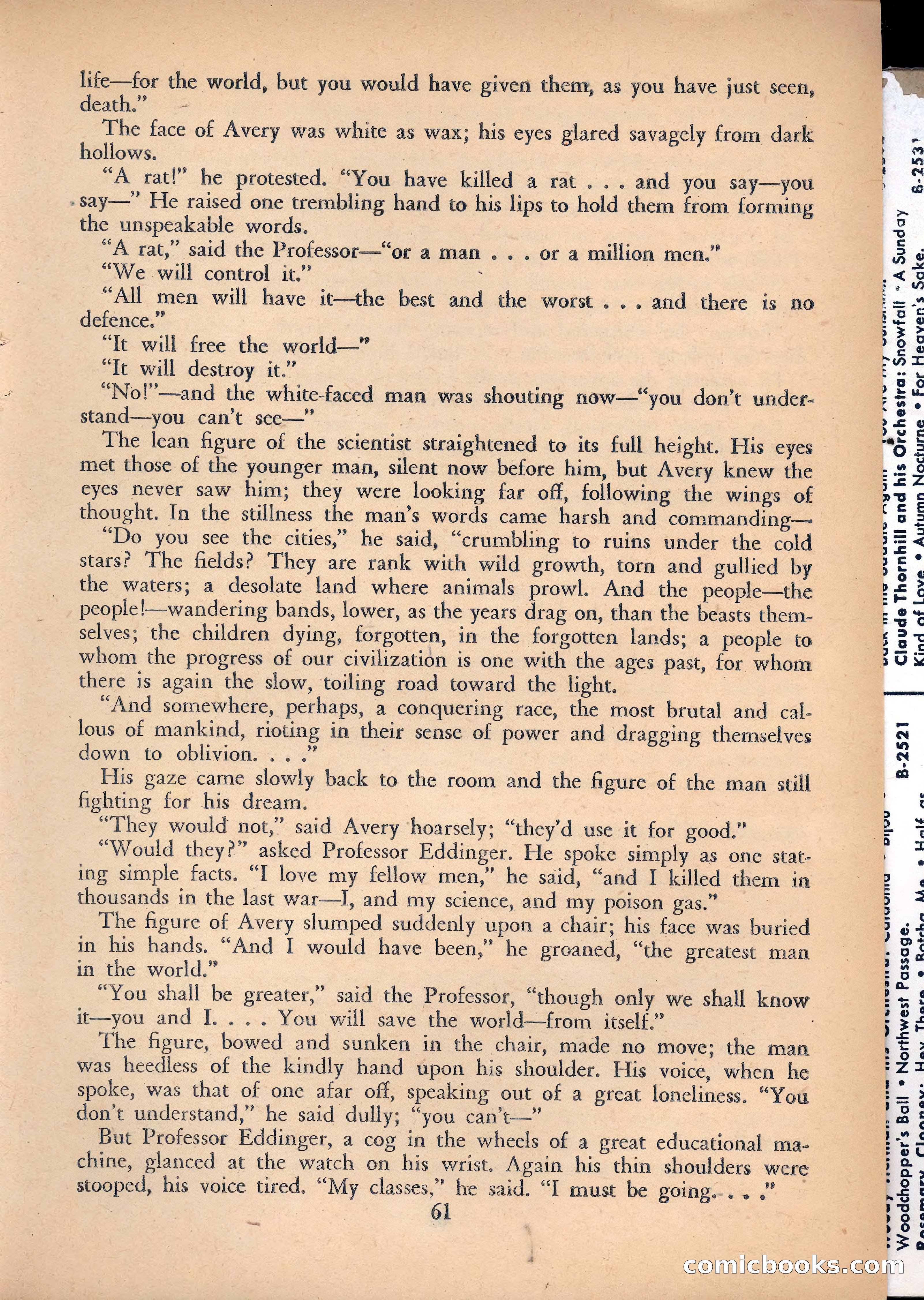
A restored page from Pulp Fiction, 1950. Page through the whole issue in the reader above.
📄 Transcribed text from this page (OCR, searchable)
Machine-transcribed from the original scan — historical spelling and the odd misread are preserved.
life—for the world, but you would have given them, as you have just seen, death.” — The face of Avery was white as wax; his eyes glared savagely from dark hollows. 3 “A rat!” he protested. “You have killed a rat... and you say—you -say—” He raised one trembling hand to his lips to hold them from forming the unspeakable words. | “A rat,” said the Professor—“or a man... or a million men.” “We will control it.” : “All men will have it—the best and the worst... and there is no defence.” | | “It will free the world—” “It will destroy it.” “No!"—and the white-faced man was shouting now—“you don’t under- stand—you can’t see—” fies The lean figure of the scientist straightened to its full height. His eyes met those of the younger man, silent now before him, but Avery knew the eyes never saw him; they were looking far off, following the wings of thought. In the stillness the man’s words came harsh and commanding— “Do you see the cities,” he said, “crumbling to ruins under the cold stars? The fields? They are rank with wild growth, torn and gullied by the waters; a desolate land where animals prowl. And the people—the people!—wandering bands, lower, as the years drag on, than the beasts them- selves; the children dying, forgotten, in the forgotten lands: a people to whom the progress of our civilization is one with the ages past, for whom there is again the slow, toiling road toward the light. | _ “And somewhere, perhaps, a conquering race, the most brutal and cal- lous of mankind, rioting in their sense of power and dragging themselves down to oblivion. .. .” Flis gaze came slowly back to the room and the figure of the man still fighting for his dream. “They would not,” said Avery hoarsely; “they’d use it for good.” “Would they?” asked Professor Eddinger. He spoke simply as one stat- ing simple facts. “I love my fellow men,” he said, “and I killed them in thousands in the last war—I, and my science, and my poison gas.” : The figure of Avery slumped suddenly upon a chair; his face was buried in his hands. “And I would have been,” he groaned, “the greatest man in the world.” 7 “You shall be greater,” said the Professor, “though only we shall know it—you and I. ... You will save the world—from itself.” | The figure, bowed and sunken in the chair, made no move: the man was heedless of the kindly hand upon his shoulder. His voice, when he spoke, was that of one afar off, speaking out of a great loneliness. “You don't understand,” he said dully; “you can’t—” But Professor Eddinger, a cog in the wheels of a great educational ma- chine, glanced at the watch on his wrist. Again his thin shoulders were stooped, his voice tired. “My classes,” he said. “I must be going... .” 61 cComichooks b ) : ‘WUern OU ew WIS Ty ite wouren FUP WEY FIVIITes VWUIUUIW od nd = Woodchopper’s Ball * Northwest Passage. * A Sunday 8-253? ore T IWMI FSe8 add cl Claude Thornhill and his Orchestra: Snowfall iad aflavea @ Autumn Nocturne © For Heaven's Sake. B-2521 DM te Be PUT) eC Ae cf ES ae ae) - (ee tn Tee ee eh elma mks 6 wewwwy eowse Fuel | S}