
Pulp Fiction, 1950 · page 61 of 132
Avon Fantasy Reader No. 13 — page 61: what you’re looking at
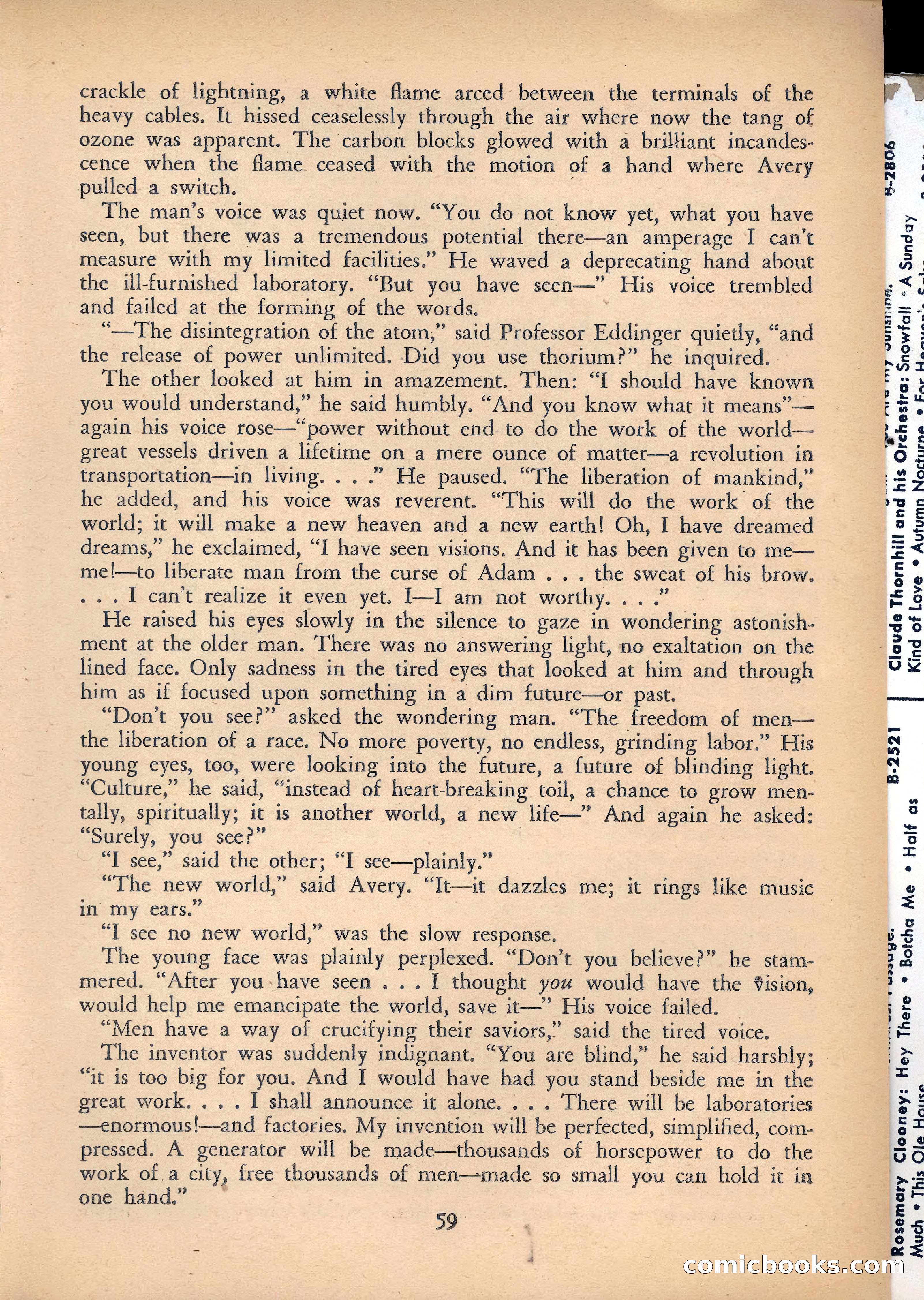
A restored page from Pulp Fiction, 1950. Page through the whole issue in the reader above.
📄 Transcribed text from this page (OCR, searchable)
Machine-transcribed from the original scan — historical spelling and the odd misread are preserved.
crackle of lightning, a white flame arced between the terminals of the heavy cables. It hissed ceaselessly through the air where now the tang of ozone was apparent. The carbon blocks glowed with a brilliant incandes- cence when the flame. ceased with the motion of a hand where Avery pulled a switch. | Ge | | The man’s voice was quiet now. “You do not know yet, what you have seen, but there was a tremendous potential there—an amperage I can’t measure with my limited facilities.’ He waved a deprecating hand about the ill-furnished laboratory. “But you have seen—” His voice trembled and failed at the forming of the words, | | “—The disintegration of the atom,” said Professor Eddinger quietly, “and the release of power unlimited. Did you use thorium?” he inquired. The other looked at him in amazement. Then: “I should have known you would understand,” he said humbly. “And you know what it means”— again his voice rose—“power without end to do the work of the world— great vessels driven a lifetime on a mere ounce of matter—a revolution in transportation—in living... .” He paused. “The liberation of mankind,” he added, and his voice was reverent. “This will do the work of the world; it will make a new heaven and a new earth! Oh, I have dreamed dreams,” he exclaimed, “I have seen visions. And it has been given to me— me!—to liberate man from the curse of Adam ... the sweat of his brow. ... I can't realize it even yet. I—I am not worthy... .” He raised his eyes slowly in the silence to gaze in wondering astonish- ment at the older man. There was no answering light, no exaltation on the lined face. Only sadness in the tired eyes that looked at him and through him as if focused upon something in a dim future—or past. “Don’t you see?” asked the wondering man. “The freedom of men— the liberation of a race. No more poverty, no endless, grinding labor.” His young eyes, too, were looking into the future, a future of blinding light. “Culture,” he said, “instead of heart-breaking toil, a chance to grow men- tally, spiritually; it is another world, a new life—’ And again he asked: “Surely, you see?” “T see,” said the other; “I see—plainly.” “The new world,” said Avery. “It—it dazzles me; it rings like music in my ears.” : “IT see no new world,” was the slow response. The young face was plainly perplexed. “Don’t you believe?” he stam- mered. “After you-have seen ...I thought you would have the @ision, would help me emancipate the world, save it—” His voice failed. _ “Men have a way of crucifying their saviors,” said the tired voice. The inventor was suddenly indignant. “You are blind,” he said harshly; — “it is too big for you. And I would have had you stand beside me in the great work. ...I shall announce it alone. . . . There will be laboratories —enormous!—and factories. My invention will be perfected, simplified, com- pressed. A generator will be made—thousands of horsepower to do the work of.a city, free thousands of men—made so small you can hold it ia one hand.” 29 ‘ cComicbooks (e(o) ao © & N $ a “A Sunday ind vee Ny GUMS WIE, rchestra: Snowfall ra @ | epee ee 8 hi w--e B-2521 Claude Thornhill and his O Kind of Love © Autumn Noaci: wer se ws YC. y: Hey There © Botcha Me ° Half as Iter —+ eee ww 5} =Rosemary Cloone Much e¢ This Ole Ha