
Pulp Fiction, 1950 · page 59 of 132
Avon Fantasy Reader No. 13 — page 59: what you’re looking at
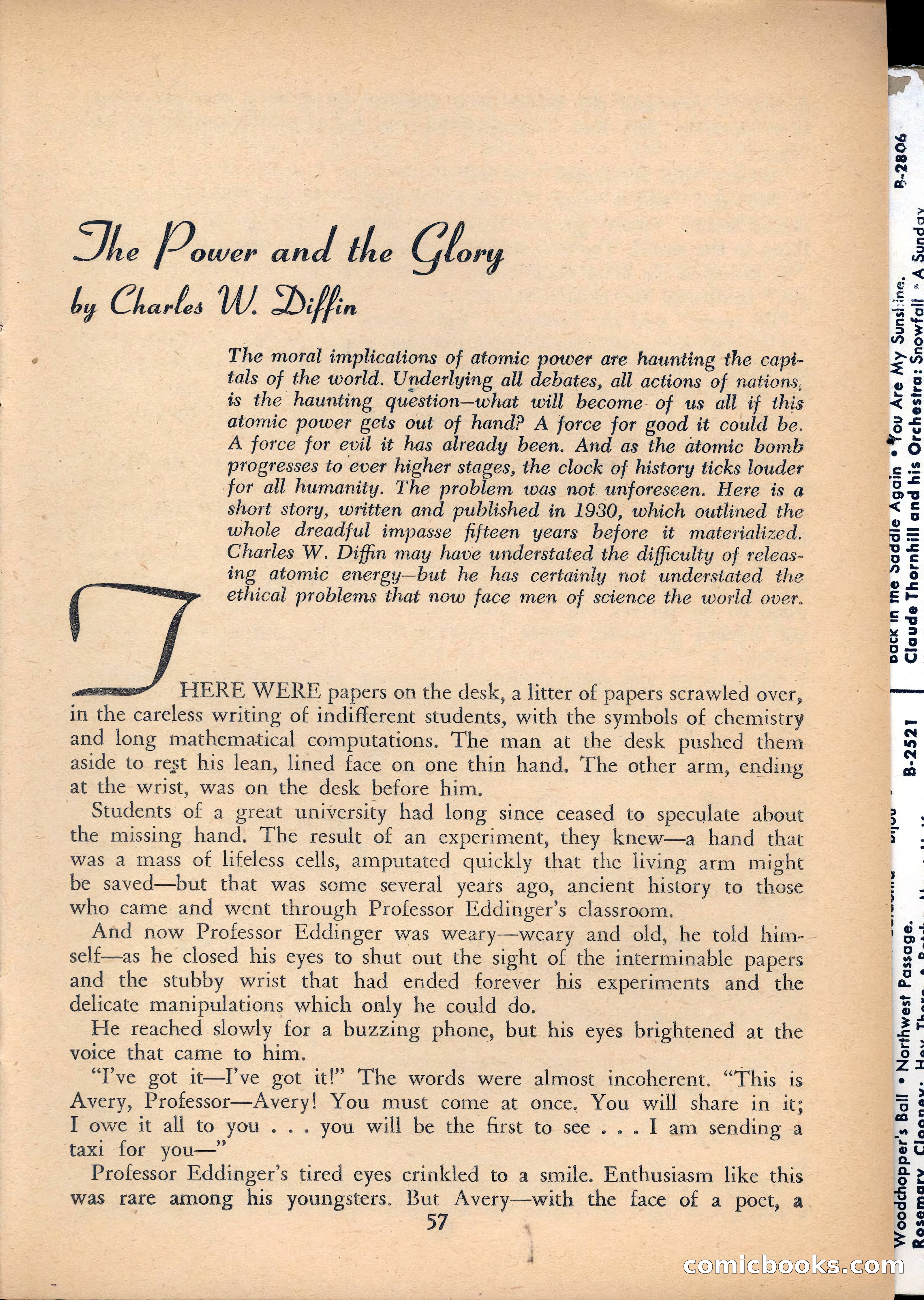
A restored page from Pulp Fiction, 1950. Page through the whole issue in the reader above.
📄 Transcribed text from this page (OCR, searchable)
Machine-transcribed from the original scan — historical spelling and the odd misread are preserved.
Jus (ey ower and the Glory : by Charles W. Diffin The moral implications of atomic power are haunting the capi- tals of the world. Underlying all debates, all actions of nations, is the haunting question—what will become of us all if this atomic power gets out of hand? A force for good it could be. _A force for evil it has already been. And as the atomic bomb progresses to ever higher stages, the clock of history ticks louder for all humanity. The problem was not unforeseen. Here is a short story, written and published in 1930, which outlined the whole dreadful impasse fifteen years before it materialized. Charles W. Diffin may have understated the difficulty of releas- ing atomic energy—but he has certainly not understated the ethical problems that now face men of science the world over. aan” TERE WERE papers on the desk, a litter of papers scrawled over, in the careless writing of indifferent students, with the symbols of chemistry and long mathematical computations. The man at the desk pushed them aside to rest his lean, lined face on one thin hand. The other arm, ending at the wrist, was on the desk before him. Students of a great university had long since ceased to speculate about the missing hand. The result of an experiment, they knew—a hand that was a mass of lifeless cells, amputated quickly that the living arm might be saved—but that was some several years ago, ancient history to those who came and went through Professor Eddinger’s classroom. And now Professor Eddinger was weary—weary and old, he told him- - self—as he closed his eyes to shut out the sight of the interminable papers and the stubby wrist that had ended forever his experiments and the delicate manipulations which only he could do. 3 He reached slowly for a buzzing phone, but his eyes brightened at the voice that came to him. — “I’ve got it—I’ve got it!” The words were almost incoherent. “This is Avery, Professor—Avery! You must come at once, You will share in it; I owe it all to you... you will be the first to see ...I am sending a taxi for you—” | 7 |” Professor Eddinger’s tired eyes crinkled to a smile. Enthusiasm like this- was rare among his youngsters. But Avery—with the face of a poet, a. Oo , GComichboo KS back In the Saddle Again ° You Are M Claude Thornhill and his Orchestra: a o 98) a a: Snowfall * A Sundav y Sunsi:ine. Northwest Passage. _ B-252] | jE eS b) of Sapam ee. WAT ake Cian = — Woodchopper’s Ball Roceamarv Clananayu.