
Pulp Fiction, 1950 · page 55 of 132
Avon Fantasy Reader No. 13 — page 55: what you’re looking at
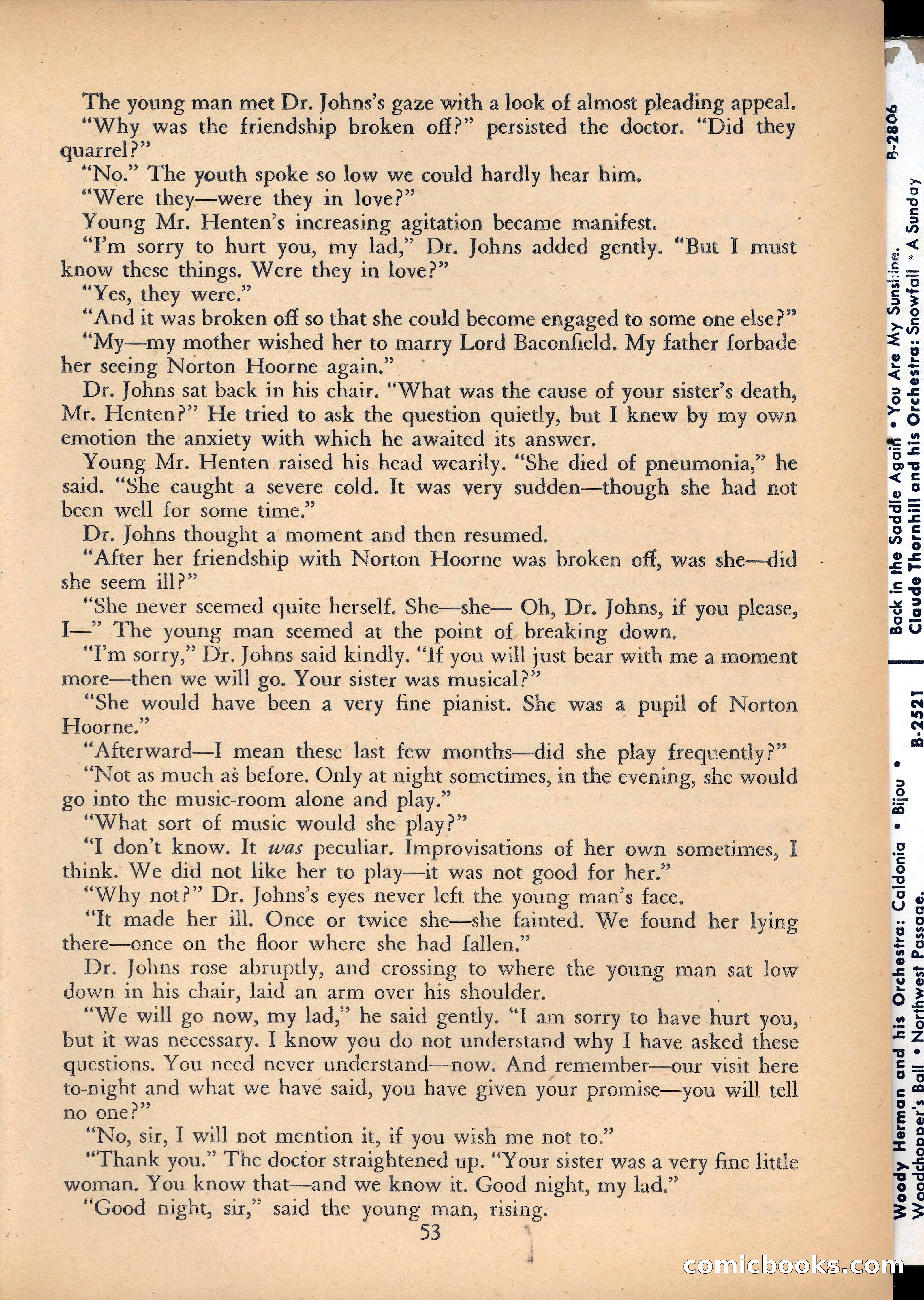
A restored page from Pulp Fiction, 1950. Page through the whole issue in the reader above.
📄 Transcribed text from this page (OCR, searchable)
Machine-transcribed from the original scan — historical spelling and the odd misread are preserved.
The young man met Dr. Johns’s gaze with a look of almost pleading appeal. “Why was the friendship broken off?” persisted the doctor. “Did they quarrel?” | “No.” The youth spoke so low we could hardly hear him. “Were they—were they in love?” Young Mr. Henten’s increasing agitation became tok nile “Pm sorry to hurt you, my lad,” Dr. Johns added gently. “But I must know these things. Were they in love?” “Yes, they were.’ “And it was broken off so that she could become engaged to some one else?” “My—my mother wished her to marry Lord Baconfield. My father forbade her seeing Norton Hoorne again.’ Dr. Johns sat back in his chair. “What was the cause of your sister’s death, Mr. Henten?” He tried to ask the question quietly, but I knew by my own emotion the anxiety with which he awaited its answer. Young Mr. Henten raised his head wearily. “She died of pneumonia,” he said. “She caught a severe cold. It was very sudden—though she had not been well for some time.” Dr. Johns thought a moment and then resumed. “After her friendship with Norton Hoorne was broken off, was she—did she seem ill?” “She never seemed quite herself. She—she— Oh, Dr. Johns, if you please, I—” The young man seemed at the point of breaking down. “Pm sorry,” Dr. Johns said kindly. “If you will just bear with me a moment more—then we will go. Your sister was musical ?” “She would have been a very fine pianist. She was a wap of Norton Hoorne.” “Afterward—I mean these last few months—did she play frequently?” - “Not as much as before. Only at night sometimes, in the evening, she would go into the music-room alone and play.” “What sort of music would she play?” “I don’t know. It was peculiar. Improvisations of her own sometimes, I think. We did not like her to play—it was not good for her.” “Why not?” Dr. Johns’s eyes never left the young man’s face. “It made her ill. Once or twice she—she fainted. We found her lying there—once on the floor where she had fallen.” Dr. Johns rose abruptly, and crossing to where the young man sat ea down in his chair, laid an arm over his shoulder. “We will go now, my lad,” he said gently. “I am sorry to have hurt you, _ but it was necessary. I inow you do not understand why I have asked these questions. You need never understand—now. And remember—our visit here to-night and what we have said, you have oe your promise—you will tell no one?” “No, sir, I will not mention it, if you wish me not to.” “Thank you.” The doctor straightened up. “Your sister was a very fine little woman, You know that—and we know it. Good night, ny lad. a “Good night, sir,” said the young man, rising. GComichboo LN KS Woedy Herman and his Orchestra: Caldonia * Bijou ° Weadchonper’'s Ball © Northwest Passage. hie “2 B-2806 Back in the Saddle Agaifi ° You Are My Sunsi:ine B-2521 Claude Thornhill and his Orchestra: Snowfall * A Sunday a