
Pulp Fiction, 1950 · page 51 of 132
Avon Fantasy Reader No. 13 — page 51: what you’re looking at
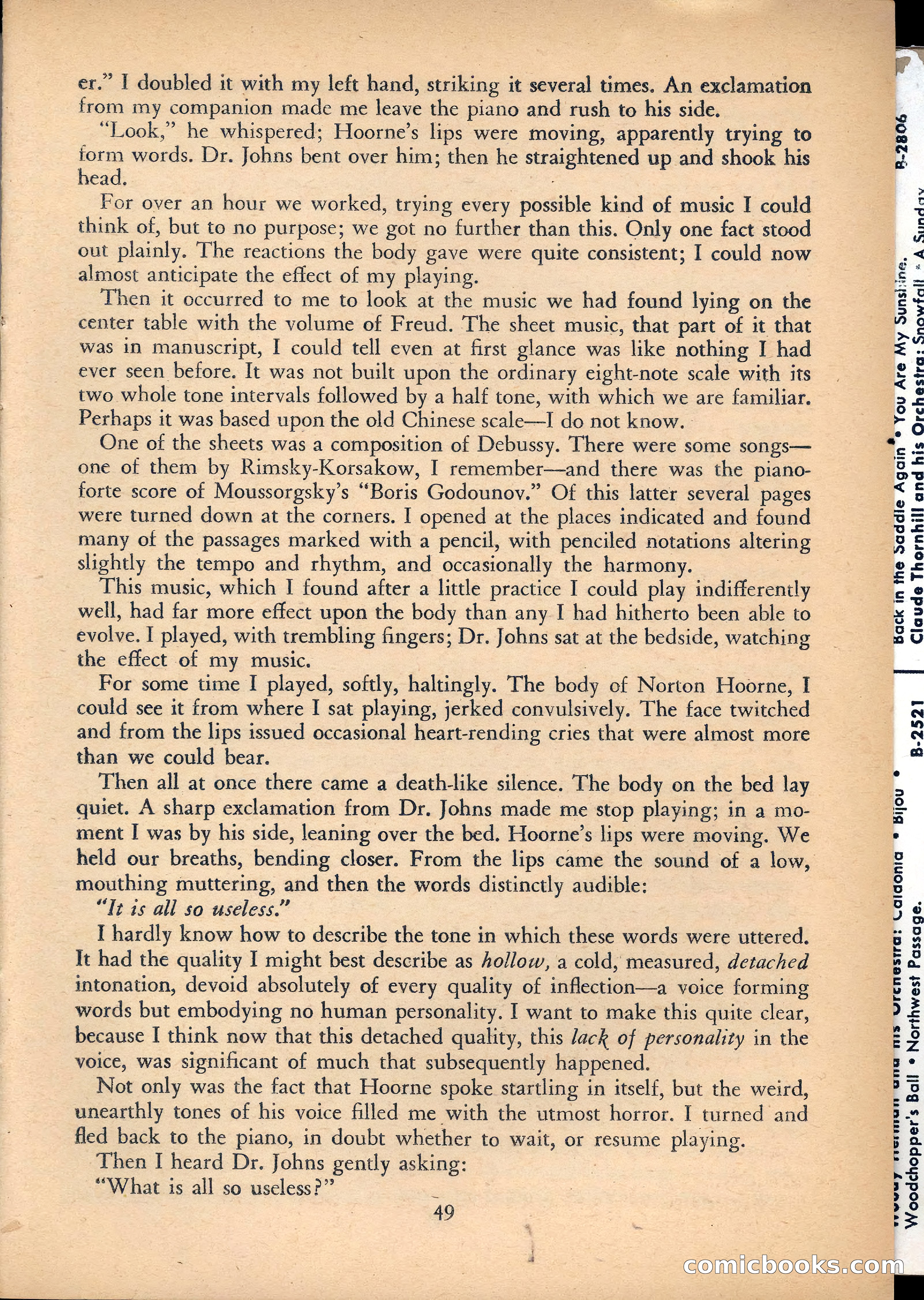
A restored page from Pulp Fiction, 1950. Page through the whole issue in the reader above.
📄 Transcribed text from this page (OCR, searchable)
Machine-transcribed from the original scan — historical spelling and the odd misread are preserved.
er.” I doubled it with my left hand, striking it several times. An exclamation from my companion made me leave the piano and rush to his side. “Look,” he whispered; Hoorne’s lips were moving, apparently trying to oe words. Dr. Johns bent over him; then he straightened up and shook his ead. For over an hour we worked, trying every possible kind of music I could think of, but to no purpose; we got no further than this. Only one fact stood out plainly. The reactions the body gave were quite consistent; I could now almost anticipate the effect of my playing. _ Then it occurred to me to look at the music we had found lying on the center table with the volume of Freud. The sheet music, that part of it that was in manuscript, I could tell even at first glance was like nothing I had ever seen before. It was not built upon the ordinary eight-note scale with its two whole tone intervals followed by a half tone, with which we are familiar. Perhaps it was based upon the old Chinese scale—I do not know. . One of the sheets was a composition of Debussy. There were some songs— one of them by Rimsky-Korsakow, I remember—and there was the piano- forte score of Moussorgsky’s “Boris Godounov.” Of this latter several pages were turned down at the corners. I opened at the places indicated and found many of the passages marked with a pencil, with penciled notations altering slightly the tempo and rhythm, and occasionally the harmony. } This music, which I found after a little practice I could play indifferenily well, had far more effect upon the body than any I had hitherto been able to evolve. I played, with trembling fingers; Dr. Johns sat at the bedside, watching the effect of my music. For some time I played, softly, haltingly. The body of Norton Hoorne, I could see it from where I sat playing, jerked convulsively. The face twitched and from the lips issued occasional heart-rending cries that were almost more than we could bear. | Then all at once there came a death-like silence. The body on the bed lay quiet. A sharp exclamation from Dr. Johns made me stop playing; in a mo- ment I was by his side, leaning over the bed. Hoorne’s lips were moving. We held our breaths, bending closer. From the lips came the sound of a low, mouthing muttering, and then the words distinctly audible: “It 1s all so useless.” I hardly know how to describe the tone in which these words were uttered. It had the quality I might best describe as hollow, a cold, measured, detached intonation, devoid absolutely of every quality of inflection—a voice forming — words but embodying no human personality. I want to make this quite clear, because I think now that this detached quality, this Jack of personality in the voice, was significant of much that subsequently happened. Not only was the fact that Hoorne spoke startling in itself, but the weird, unearthly tones of his voice filled me with the utmost horror. I turned and fled back to the piano, in doubt whether to wait, or resume playing. Then I heard Dr. Johns gently asking: “What is all so useless?” ~ 49 KS (eo) Zz 2) pe] ™ & ot: a Back in the Saddie Again © You Are My Sunsi:ine. , Claude Thornhill and his Orchestra: Snowfall * A Sunday jou ° B-252] | wyvuy rsiHUun UNM Is VIEenesira: Caldonia * Bi Woodchopper’s Ball * Northwest Passage. =