
Pulp Fiction, 1950 · page 49 of 132
Avon Fantasy Reader No. 13 — page 49: what you’re looking at
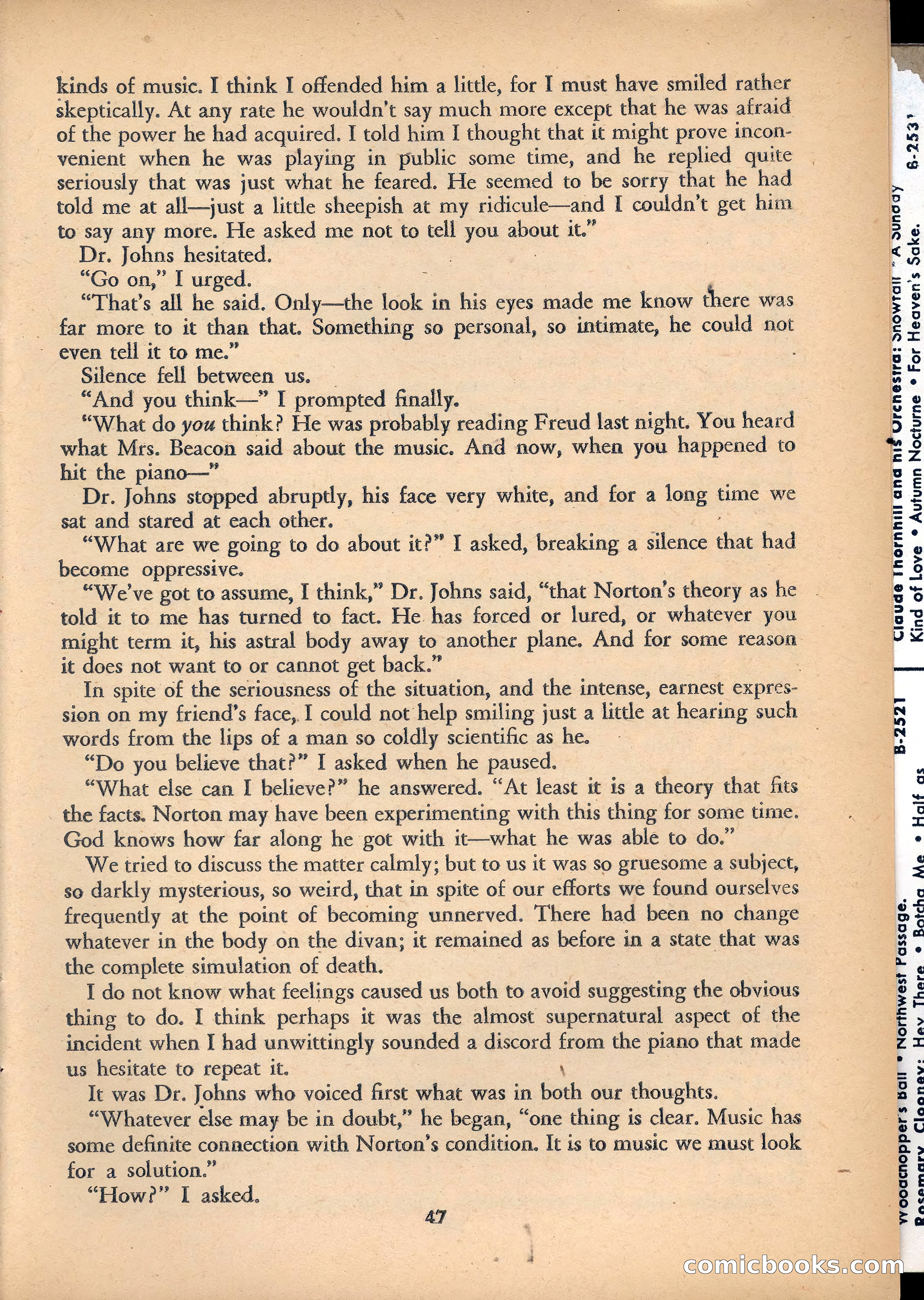
A restored page from Pulp Fiction, 1950. Page through the whole issue in the reader above.
📄 Transcribed text from this page (OCR, searchable)
Machine-transcribed from the original scan — historical spelling and the odd misread are preserved.
kinds of music. I think I offended him a little, for I must have smiled rather skeptically. At any rate he wouldn’t say much more except that he was afraid of the power he had acquired. I told him I thought that it might prove incon- venient when he was playing in public some time, and he replied quite seriously that was just what he feared. He seemed to be sorry that he had told me at all—just a little sheepish at my ridicule—and I couldn’t get him to say any more. He asked me not to tell you about it.” Dr. Johns hesitated. “Go on,” I urged. : “That’s all he said. Only—the look in his eyes made me know there was far more to it than that. Something so personal, so intimate, he could not even tell it to me.” | | Silence fell between us. _ “And you think—” I prompted finally. “What do you think? He was probably reading Freud last night. You heard what Mrs. Beacon said about the music. And now, when you happened to hit the piano—” ; Dr. Johns stopped abruptly, his face very white, and for a long time we sat and stared at each other. = “What are we going to do about it?” I asked, breaking a silence that had become oppressive. 3 | _ "We've got to assume, I think,” Dr. Johns said, “that Norton’s theory as he told it to me has turned to fact. He has forced or lured, or whatever you might term it, his astral body away to another plane. And for some reason it does not want to or cannot get back.” ! In spite of the seriousness of the situation, and the intense, earnest expres- sion on my friend’s face, I could not help smiling just a little at hearing such words from the lips of a man so coldly scientific as he. “Do you believe that?” I asked when he paused. “What else can I believe?” he answered. “At least it is a theory that fits _ the facts. Norton may have been experimenting with this thing for some time. God knows how far along he got with it—what he was able to do.” We tried to discuss the matter calmly; but to us it was so gruesome a subject, so darkly mysterious, so weird, that in spite of our efforts we found ourselves frequently at the point of becoming unnerved. There had been no change whatever in the body on the divan; it remained as before in a state that was the complete simulation of death. 3 I do not know what feelings caused us both to avoid suggesting the obvious thing to do. I think perhaps it was the almost supernatural aspect of the incident when I had unwittingly sounded a discord from the piano that made us hesitate to repeat it. } \ : It was Dr. Johns who voiced first what was in both our thoughts. | “Whatever else may be in doubt,” he began, “one thing is clear. Music has some definite connection with Norton’s condition. It is to music we must look for a solution.” — “How?” I asked. AT] LN KS 8-253" Orchestra: onowrall "A sunday Claude Thornhill ana hi Kind of Love © Autumn Nocturne ® For Heaven's Sake. -2521 Dacamarv Claanave Hav There © Rotcha Ma ® Half ae yy ooacnopper’s Ball *° Northwest Passage. GComichboo (E(0)