
Pulp Fiction, 1950 · page 120 of 132
Avon Fantasy Reader No. 13 — page 120: what you’re looking at
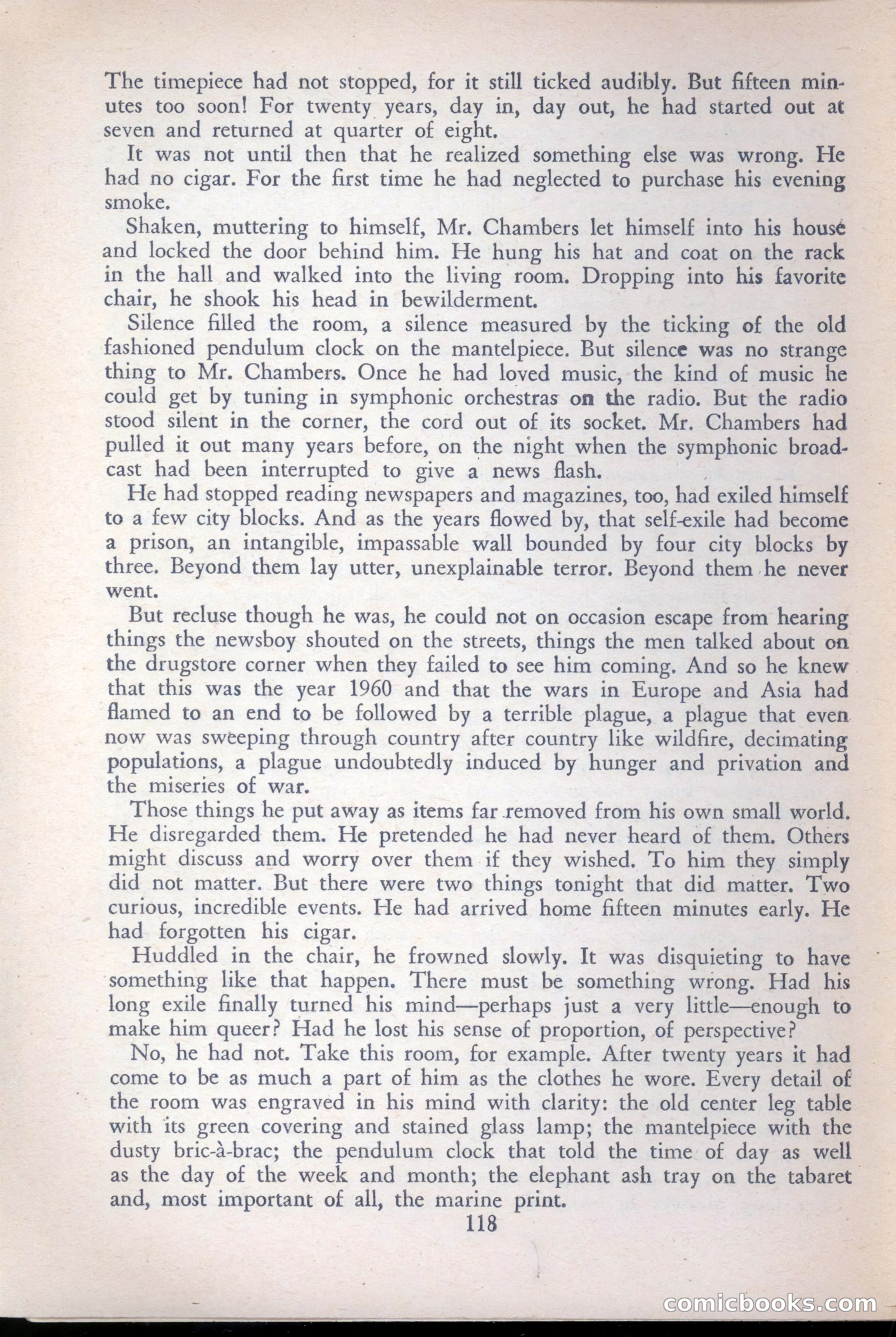
A restored page from Pulp Fiction, 1950. Page through the whole issue in the reader above.
📄 Transcribed text from this page (OCR, searchable)
Machine-transcribed from the original scan — historical spelling and the odd misread are preserved.
The timepiece had not stopped, for it still ticked audibly. But fifteen min- utes too soon! For twenty years, day in, day out, he had started out at seven and returned at quarter of eight. It was not until then that he realized something else was wrong. He had no cigar. For the first time he had neglected to purchase his evening smoke. Shaken, muttering to himself, Mr. Chambers let himself into his housé and locked the door behind him. He hung his hat and coat on the rack in the hall and walked into the living room. Dropping into his favorite chair, he shook his head in bewilderment. Silence filled the room, a silence measured by the ticking of the old fashioned pendulum clock on the mantelpiece. But silence was no strange thing to Mr. Chambers. Once he had loved music, the kind of music he could get by tuning in symphonic orchestras om the radio. But the radio stood silent in the corner, the cord out of its socket. Mr. Chambers had pulled it out many years before, on the night when the symphonic broad- cast had been interrupted to give a news flash. ; He had stopped reading newspapers and magazines, too, had exiled himself to a few city blocks. And as the years flowed by, that self-exile had become a prison, an intangible, impassable wall bounded by four city blocks by three. Beyond them lay utter, unexplainable terror. Beyond them he never went. But recluse though he was, he could not on occasion escape from hearing things the newsboy shouted on the streets, things the men talked about on the drugstore corner when they failed to see him coming. And so he knew that this was the year 1960 and that the wars in Europe and Asia had flamed to an end to be followed by a terrible plague, a plague that even now was sweeping through country after country like wildfire, decimating populations, a plague undoubtedly induced by hunger and privation and the miseries of war. Those things he put away as items far removed from his own small world. He disregarded them. He pretended he had never heard of them. Others might discuss and worry over them if they wished. To him they simply did not matter. But there were two things tonight that did matter. Two curious, incredible events. He had arrived home fifteen minutes early. He had forgotten his cigar. 7 Huddled in the chair, he frowned slowly. It was disquieting to have something like that happen. There must be something wrong. Had his long exile finally turned his mind—perhaps just a very littl—enough to make him queer? Had he lost his sense of proportion, of perspective? No, he had not. Take this room, for example. After twenty years it had come to be as much a part of him as the clothes he wore. Every detail of the room was engraved in his mind with clarity: the old center leg table with its green covering and stained glass lamp; the mantelpiece with the dusty bric-a-brac; the pendulum clock that told the time of day as well as the day of the week and month; the elephant ash tray on the tabaret and, most important of all, the marine print. 118 : , — cComicbooks.co m —