
Pulp Fiction, 1950 · page 117 of 132
Avon Fantasy Reader No. 13 — page 117: what you’re looking at
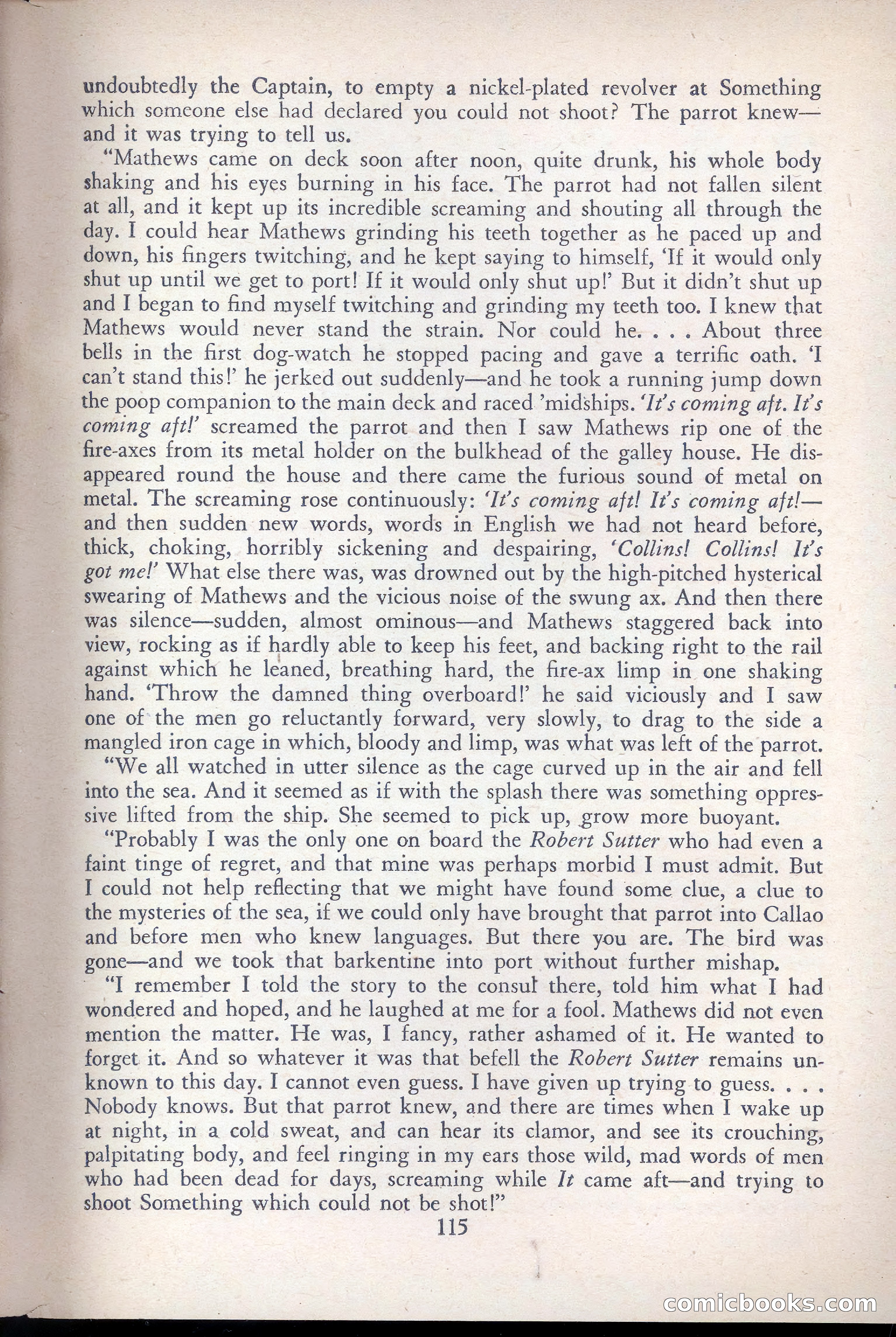
A restored page from Pulp Fiction, 1950. Page through the whole issue in the reader above.
📄 Transcribed text from this page (OCR, searchable)
Machine-transcribed from the original scan — historical spelling and the odd misread are preserved.
* hot 7 ae EP Se Pe te ee ha a tomes, roe Toh EN ie eae ee hee FA a bh wna my ec , papal TS aes <o ee a use ee Re ro wt ™e Wil SN ital a , ‘ WT ig , F ¥ “ ~* ee ey 2 ; Nida . in & 4 ; 5 7 t : > | ; * ’ re gies “ ’ 9 ‘ he ‘1 A ’ 7% ’ ‘ ; p ; Are are 4 undoubtedly the Captain, to empty a nickel-plated revolver at Something which someone else had declared you could not shoot? The parrot knew— and it was trying to tell us. “Mathews came on deck soon after noon, quite drunk, his whole body shaking and his eyes burning in his face. The parrot had not fallen silent at all, and it kept up its incredible screaming and shouting all through the day. I could hear Mathews grinding his teeth together as he paced up and _ down, his fingers twitching, and he kept saying to himself, ‘If it would only shut up until we get to port! If it would only shut up!’ But it didn’t shut up and I began to find myself twitching and grinding my teeth too. I knew that Mathews would never stand the strain. Nor could he. ... About three bells in the first dog-watch he stopped pacing and gave a terrific oath. ‘I can't stand this!’ he jerked out suddenly—and he took a running jump down the poop companion to the main deck and raced ’midships. ‘It’s coming aft. It’s coming aft!’ screamed the parrot and then I saw Mathews rip one of the fire-axes from its metal holder on the bulkhead of the galley house. He dis- appeared round the house and there came the furious sound of metal on metal. The screaming rose continuously: ‘It’s coming aft! It’s coming aftl— and then sudden new words, words in English we had not heard before, thick, choking, horribly sickening and despairing, ‘Collins! Collins! Iz’s got mel’ What else there was, was drowned out by the high-pitched hysterical swearing of Mathews and the vicious noise of the swung ax. And then there was silence—sudden, almost ominous—and Mathews staggered back into view, rocking as if hardly able to keep his feet, and backing right to the rail against which he leaned, breathing hard, the fire-ax limp in one shaking hand. “Throw the damned thing overboard!’ he said viciously and I saw one of the men go reluctantly forward, very slowly, to drag to the side a mangled iron cage in which, bloody and limp, was what was left of the parrot. “We all watched in utter silence as the cage curved up in the air and fell ~ into the sea. And it seemed as if with the splash there was something oppres- sive lifted from the ship. She seemed to pick up, grow more buoyant. “Probably I was the only one on board the Robert Sutter who had even a faint tinge of regret, and that mine was perhaps morbid I must admit. But I could not help reflecting that we might have found some clue, a clue to the mysteries of the sea, if we could only have brought that parrot into Callao and before men who knew languages. But there you are. The bird was gone—and we took that barkentine into port without further mishap. “I remember I told the story to the consul there, told him what I had wondered and hoped, and he laughed at me for a fool. Mathews did not even mention the matter. He was, I fancy, rather ashamed of it. He wanted to forget it. And so whatever it was that befell the Robert Sutter remains un- known to this day. I cannot even guess. I have given up trying to guess. . . . Nobody knows. But that parrot knew, and there are times when I wake up at night, in a cold sweat, and can hear its clamor, and see its crouching, palpitating body, and feel ringing in my ears those wild, mad words of men who had been dead for days, screaming while J¢ came aft—and trying to shoot Something which could not be shot!” 115