
Pulp Fiction, 1950 · page 69 of 132
Avon Fantasy Reader No. 12 — page 69: what you’re looking at
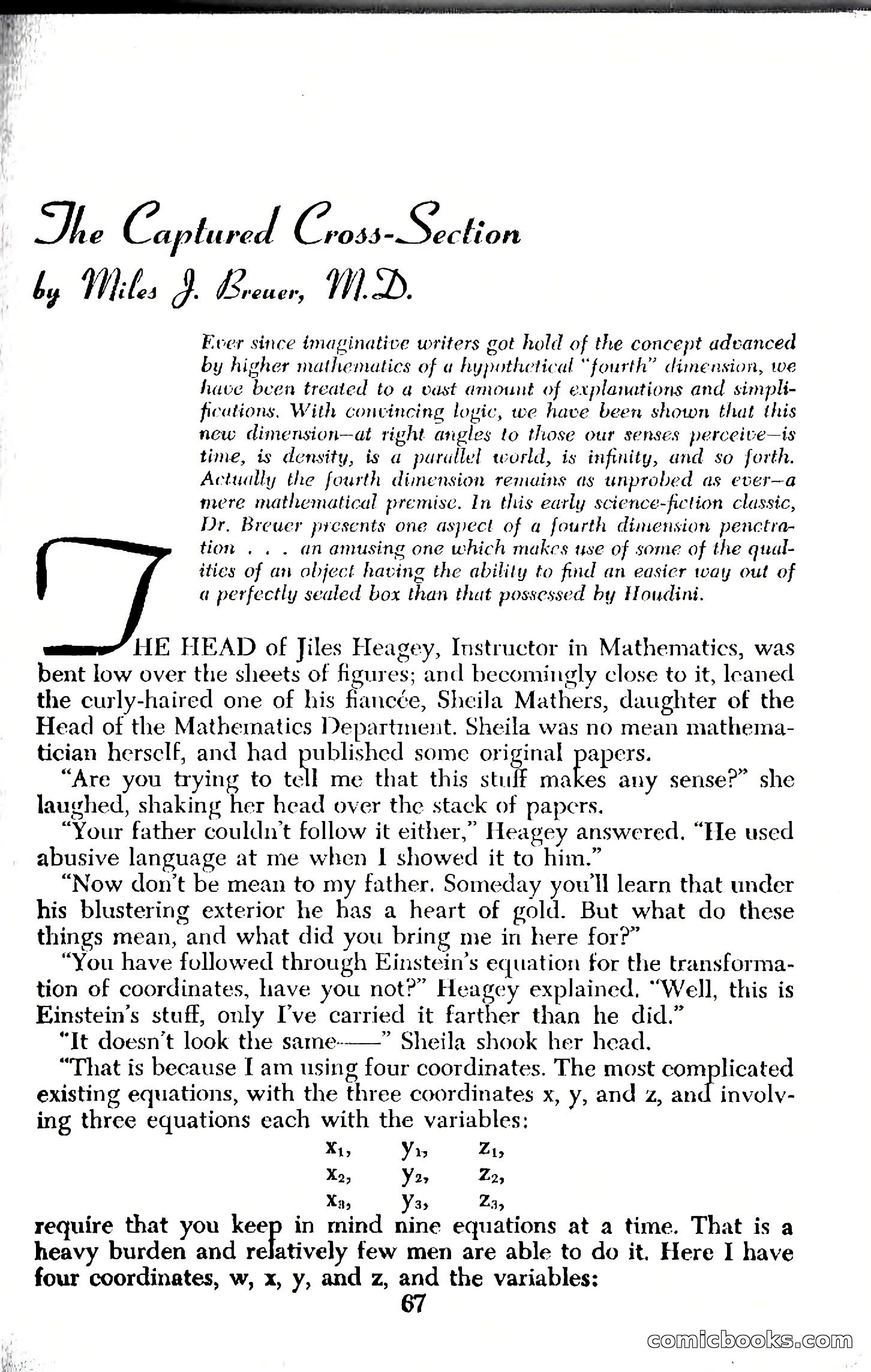
A restored page from Pulp Fiction, 1950. Page through the whole issue in the reader above.
📄 Transcribed text from this page (OCR, searchable)
Machine-transcribed from the original scan — historical spelling and the odd misread are preserved.
The Captured C088 Section by Wiks 3. Breuer, WD. Ever since imaginative writers got hold of the concept advanced by higher mathematics of a hypothetical “fourth” dimension, we have been treated to a vast amount of explanations and simpli- fications, With convincing logic, we have been shown that this new dimension—at right angles to those our senses perceive—is time, is density, is a purallel world, is infinity, and so forth. Actually the fourth dimension remains as unprobed as ever—a mere mathematical premise. In this early science-fiction classic, Dr. Breuer presents one aspect of a fourth dimension penctra- tion . . . an amusing one which makes use of some of the qual- ities of an object having the ability to find an easier way out of a perfectly sealed box than that possessed by Houdini. HE HEAD of Jiles Heagey, Instructor in Mathematics, was bent low over the sheets of figures; and becomingly close to it, leaned the curly-haired one of his fiancée, Sheila Mathers, daughter of the Head of the Mathematics Department. Sheila was no mean mathema- tician hersclf, and had published some original papers. “Are you trying to tell me that this stuf makes any sense?” she laughed, shaking her head over the stack of papers. “Your father couldn't follow it either,” Heagey answered. “He used abusive language at me when I showed it to him.” “Now don’t be mean to my father. Someday you'll learn that under his blustering exterior he has a heart of gold. But what do these things mean, and what did you bring me in here for?” “You have followed through Einstein’s equation for the transforma- tion of coordinates, have you not?” Heagey explained. “Well, this is Einstein’s stuff, only [ve carried it farther than he did.” “It doesn’t look the same-——” Sheila shook her head. “That is because I am using four coordinates. The most complicated existing equations, with the three coordinates x, y, and z, and involv- ing three equations each with the variables: Xi, Y15 Zi, Xa, y2, Z2, Xz, Y35 23, require that you Keep in mind nine equations at a time. That is a heavy burden and relatively few men are able to do it. Here I have four coordinates, w, x, y, and z, and the variables: comichbooks.com