
Pulp Fiction, 1949 · page 43 of 132
Avon Fantasy Reader No. 11 — page 43: what you’re looking at
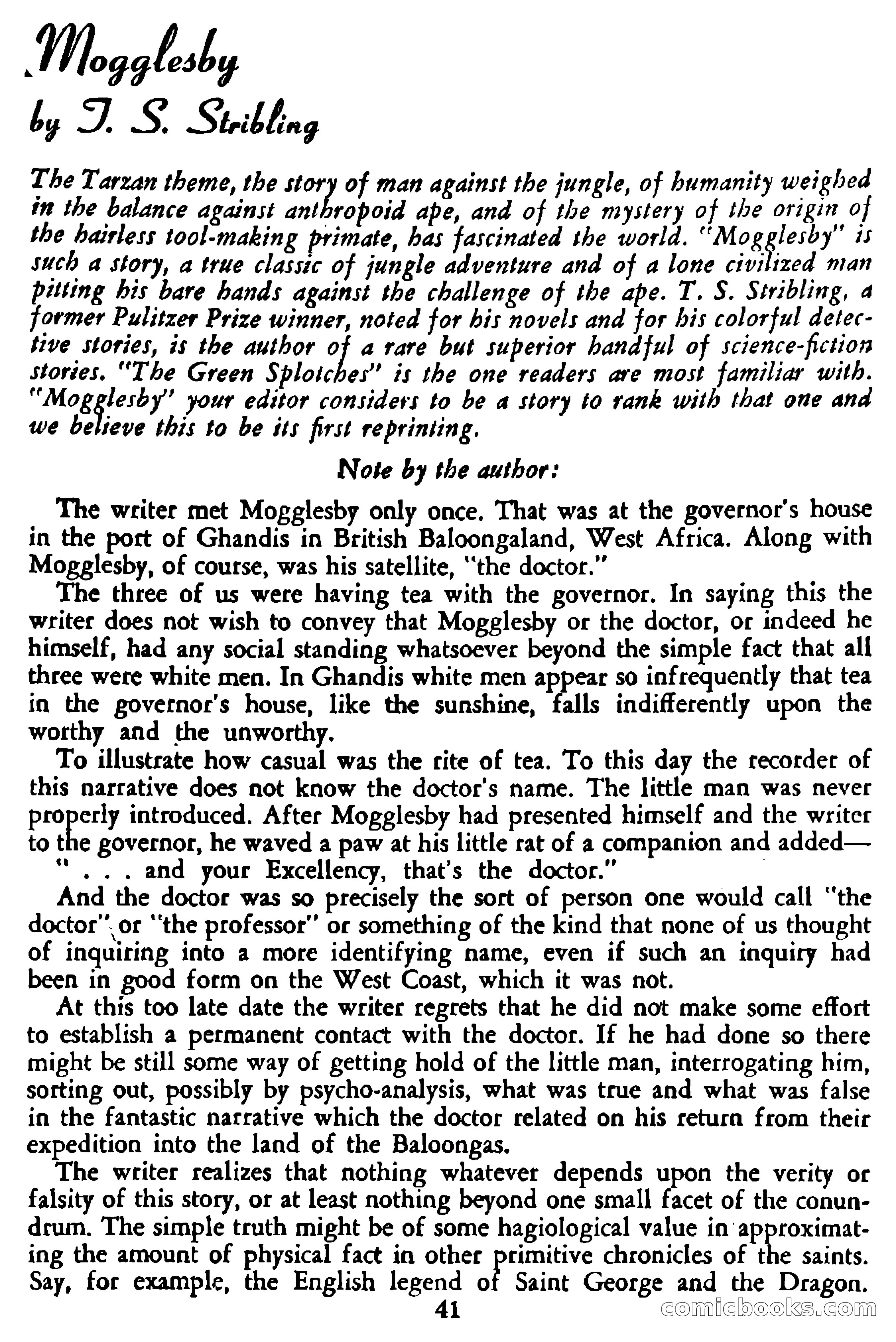
A restored page from Pulp Fiction, 1949. Page through the whole issue in the reader above.
📄 Transcribed text from this page (OCR, searchable)
Machine-transcribed from the original scan — historical spelling and the odd misread are preserved.
Mogagleshy by JZ S. Stribling Lhe Tarzan theme, the story of man against the jungle, of humanity weighed in the balance against anthropoid ape, and of the mystery of the origin of the hairless tool-making primate, has fascinated the world. “Mogglesby” is such a story, a true classic of jungle adventure and of a lone civilized man pitting his bare hands against the challenge of the ape. T. S. Stribling, a former Pulitzer Prize winner, noted for bis novels and for bis colorful detec- sive stories, is the author a4 a rare but superior handful of science-fiction storées. “The Green Sploiches’” is the one readers are most familiar with. ars ae your editor considers to be a story to rank with that one and we believe this to be its first reprinting. Note by the author: The writer met Mogglesby only once. That was at the governor's house in the port of Ghandis in British Baloongaland, West Africa. Along with Mogglesby, of course, was his satellite, “the doctor.” The three of us were having tea with the governor. In saying this the writer does not wish to convey that Mogglesby or the doctor, or indeed he himself, had any social standing whatsoever beyond the simple fact that all three were white men. In Ghandis white men appear so infrequently that tea in the govetnor's house, like the sunshine, falls indifferently upon the worthy and the unworthy. To illustrate how casual was the rite of tea. To this day the recorder of this narrative does not know the doctor's name. The little man was never properly introduced. After Mogglesby had presented himself and the writer to the governor, he waved a paw at his little rat of a companion and added— “... and your Excellency, that’s the doctor.” | And the doctor was so precisely the sort of person one would call ‘'the doctor”. or ‘the professor’ or something of the kind that none of us thought of inquiring into a more identifying name, even if such an inquiry had been in good form on the West Coast, which it was not. At this too late date the writer regrets that he did not make some effort to establish a permanent contact with the doctor. If he had done so there might be still some way of getting hold of the little man, interrogating him, sorting out, possibly by psycho-analysis, what was true and what was false in the fantastic narrative which the doctor related on his retura from their expedition into the land of the Baloongas. The weiter realizes that nothing whatever depends upon the verity or falsity of this story, or at least nothing beyond one small facet of the conun- drum. The simple truth might be of some hagiological value in approximat- ing the amount of physical fact in other primitive chronicles of the saints. Say, for example, the English legend of Saint George and the Dragon. Al Comicbooks.com