
Pulp Fiction, 1949 · page 54 of 132
Avon Fantasy Reader No. 9 — page 54: what you’re looking at
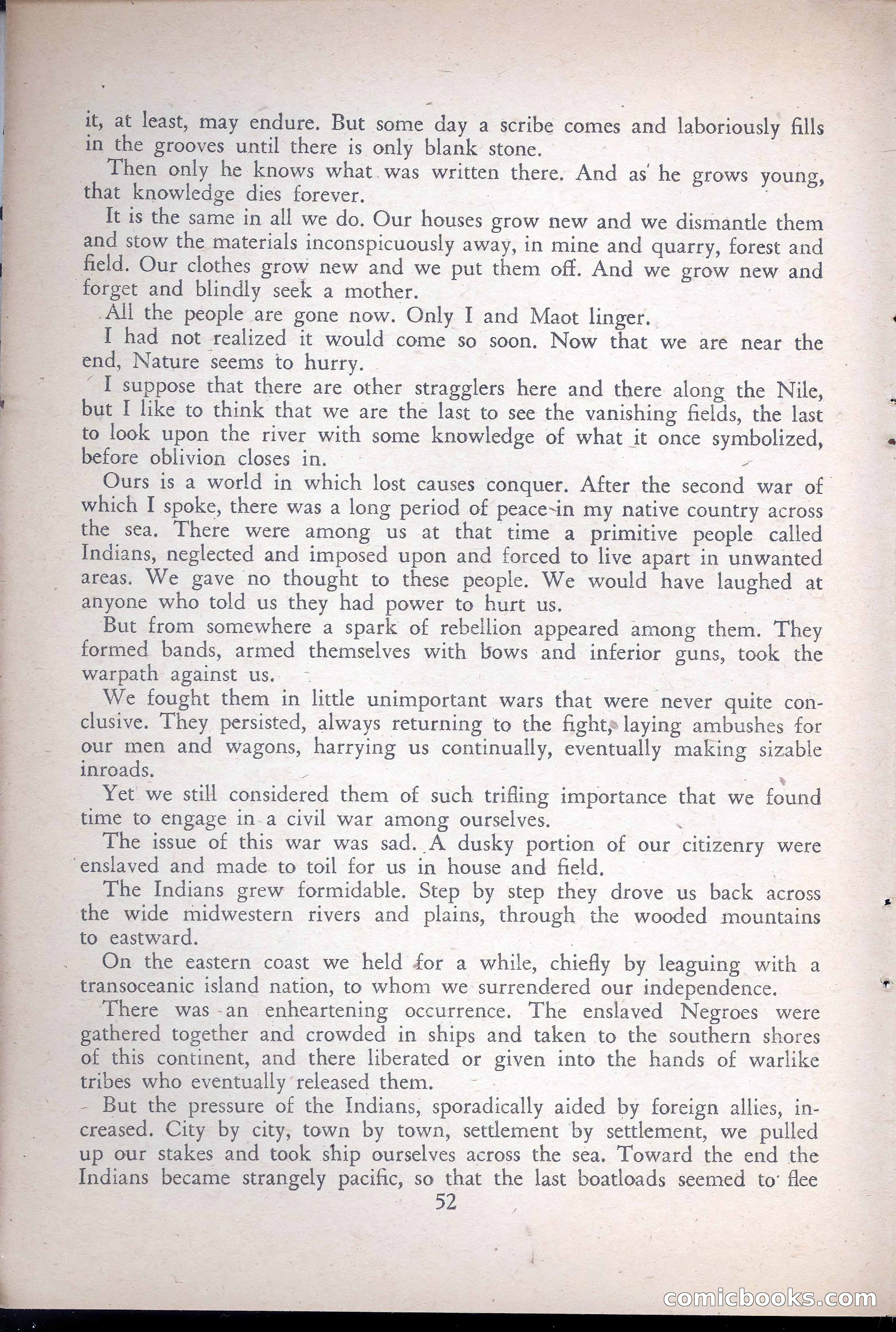
A restored page from Pulp Fiction, 1949. Page through the whole issue in the reader above.
📄 Transcribed text from this page (OCR, searchable)
Machine-transcribed from the original scan — historical spelling and the odd misread are preserved.
= it, at least, may endure. But some day a scribe comes and laboriously fills in the grooves until there is only blank stone. | Then only he knows what.was written there. And as’ he grows young, that knowledge dies forever. | : ; It is the same in all we do. Our houses grow new and we dismantle them and stow the materials inconspicuously away, in mine and quarry, forest and field. Our clothes grow new and we put them off. And we grow new and forget and blindly seek a mother. 3 All the people are gone now. Only I and Maot linger. ' I had not realized it would come so soon. Now that we are near the end, Nature seems to hurry. : ; I suppose that there are other stragglers here and there along the Nile, but I like to think that we are the last to see the vanishing fields, the last to look upon the river with some knowledge of what it once symbolized, “ before oblivion closes in. : - 3 Ours is a world in which lost causes conquer. After the second war of which I spoke, there was a long period of peace~in my native country across the sea. There were among us at that time a primitive people called Indians, neglected and imposed upon and forced to live apart in unwanted : _ areas. We gave no thought to these people. We would have laughed at : anyone who told us they had power to hurt us. ace But from somewhere a spark of rebellion appeared among them. They formed bands, armed themselves with bows and inferior guns, took the Warpath against us. ~ , | We fought them in little unimportant wars that were never quite con- clusive. They persisted, always returning to the fights laying ambushes for - our men and wagons, harrying us continually, eventually making sizable inroads. : . Yet we still considered them of such trifling importance that we found time to engage in-a civil war among ourselves. ‘ The issue of this war was sad. A dusky portion of our citizenry were enslaved and made to toil for us in house and field. : The Indians grew formidable. Step by step they drove us back across the wide midwestern rivers and plains, through the wooded mountains to eastward. : On the eastern coast we held for a while, chiefly by leaguing with a transoceanic island nation, to whom we surrendered our independence. coe There was-an enheartening occurrence. The enslaved Negroes were gathered together and crowded in ships and taken to the southern shores of this continent, and there liberated or given into the hands of warlike tribes who eventually released them. - But the pressure of the Indians, sporadically aided by foreign allies, in- creased, City by city, town by town, settlement by settlement, we pulled up our stakes and took ship ourselves across the sea. Toward the end the Indians became strangely pacific, so that the last boatloads seemed to’ flee hi Yor ore ee en ee Te eee cComichbooks.;com