
Pulp Fiction, 1949 · page 37 of 132
Avon Fantasy Reader No. 9 — page 37: what you’re looking at
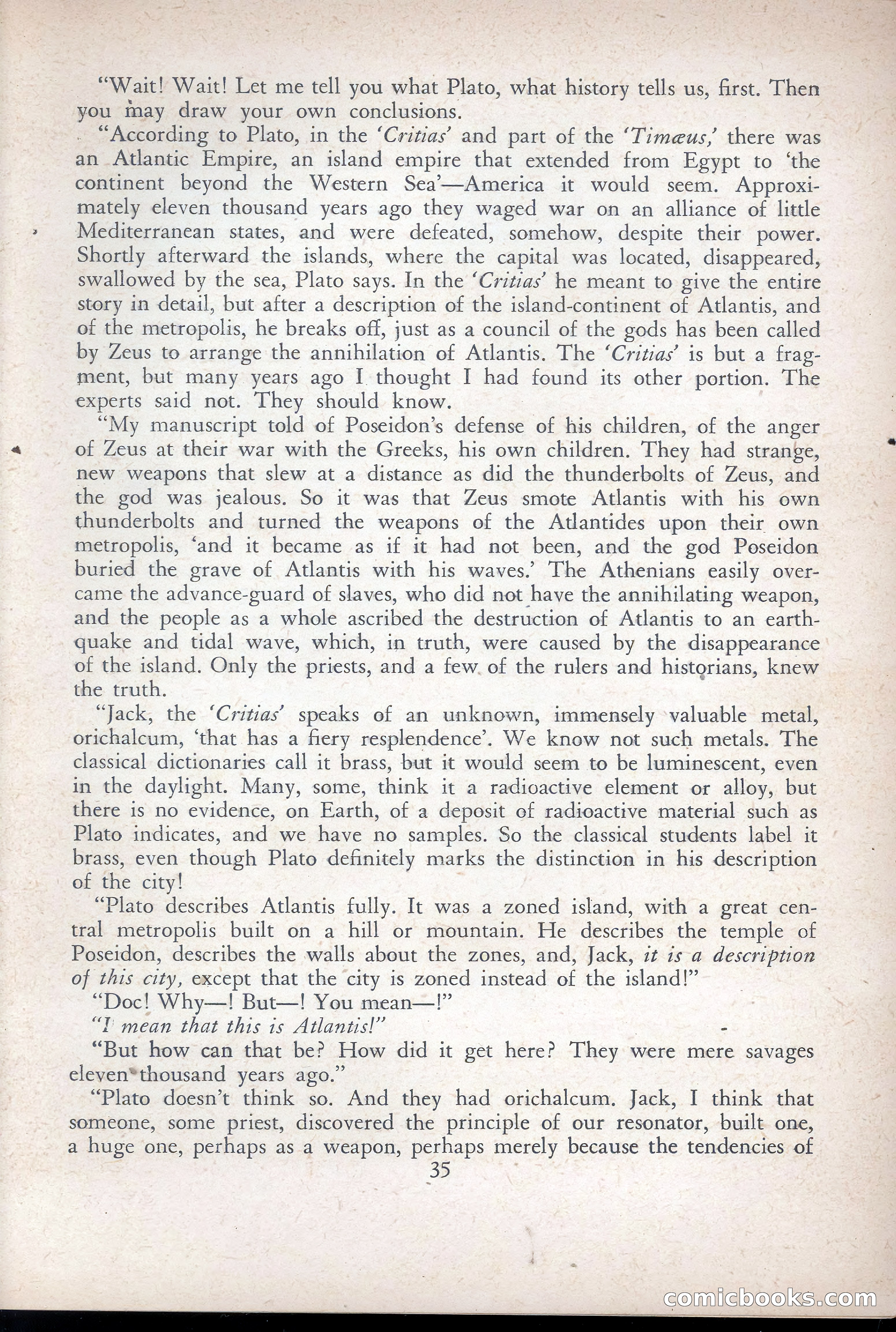
A restored page from Pulp Fiction, 1949. Page through the whole issue in the reader above.
📄 Transcribed text from this page (OCR, searchable)
Machine-transcribed from the original scan — historical spelling and the odd misread are preserved.
_ “Wait! Wait! Let me tell you what Plato, what history tells us, first. Then you may draw your own conclusions. “According to Plato, in the ‘Critias’ and part of the ‘Timeus, there was an Atlantic Empire, an island empire that extended from Egypt to ‘the continent beyond the Western Sea—America it would seem. Approxi- mately eleven thousand years ago they waged war on an alliance of little » Mediterranean states, and were defeated, somehow, despite their power. Shortly afterward the islands, where the capital was located, disappeared, swallowed by the sea, Plato says. In the ‘Critias’ he meant to give the entire story in detail, but after a description of the island-continent of Atlantis, and of the metropolis, he breaks off, just as a council of the gods has been called by Zeus to arrange the annihilation of Atlantis. The ‘Critias’ is but a frag- ment, but many years ago I thought I had found its other portion. The experts said not. They should know. “My manuscript told of Poseidon’s defense of his children, of the anger 4 of Zeus at their war with the Greeks, his own children. They had strange, new weapons that slew at a distance as did the thunderbolts of Zeus, and the god was jealous. So it was that Zeus smote Atlantis with his own thunderbolts and turned the weapons of the Atlantides upon their own metropolis, “and it became as if it had not been, and the god Poseidon buried the grave of Atlantis with his waves.’ The Athenians easily over- came the advance-guard of slaves, who did not have the annihilating weapon, and the people as a whole ine riedide deus ot Atlantis to an earth- quake and tidal wave, which, in truth, were caused by the disappearance of the island. Only the priests, and a few. of the rulers and historians, knew the truth. “Jack, the ‘Critias’ speaks of an unknown, immensely ‘valuable metal, orichalcum, ‘that has a fiery resplendence’. We know not such metals. The classical dictionaries call it brass, but it would seem to be luminescent, even in the daylight. Many, some, think it a radioactive element or alloy, but there is no evidence, on Earth, of a deposit ef radioactive material such as Plato indicates, and we have no samples. So the classical students label it brass, even though Plato definitely marks the distinction in his description of the city! “Plato describes Atlantis fully. It was a zoned island, with a great cen- tral metropolis built on a hill or mountain. He describes the temple of Poseidon, describes the walls about the zones, and, Jack, it is a description of this city, except that the city is zoned instead of the island!” “Doc! Why—! But—! You mean—!” “LP mean that this is Atlantis!” | - “But how can that be? How did it get here? They were mere savages eleven*thousand years ago.” “Plato doesn’t think so. And they had orichalcum. Jack, I think that someone, some priest, discovered the principle of our resonator, built one, a huge one, perhaps as a weapon, perhaps merely because the tendencies of comichooks.conn 3 1