
Pulp Fiction, 1949 · page 34 of 132
Avon Fantasy Reader No. 9 — page 34: what you’re looking at
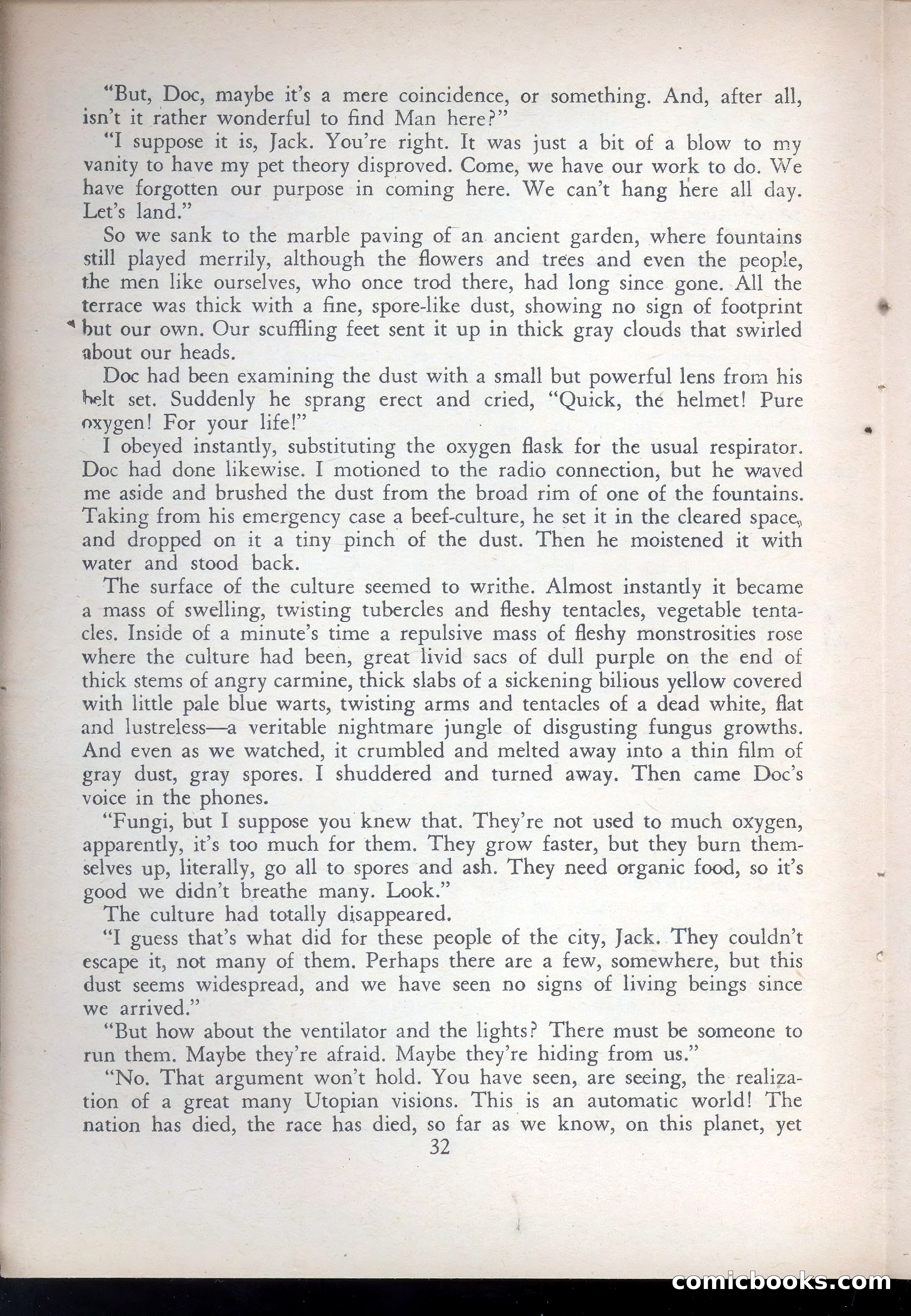
A restored page from Pulp Fiction, 1949. Page through the whole issue in the reader above.
📄 Transcribed text from this page (OCR, searchable)
Machine-transcribed from the original scan — historical spelling and the odd misread are preserved.
s “But, Doc, maybe it’s a mere coincidence, or something. And, after all, isn’t it rather wonderful to find Man here?” “I suppose it is, Jack. You’re right. It was just a bit of a blow to my vanity to have my pet theory disproved. Come, we have our work to do. We have forgotten our purpose in coming here. We can’t hang here all day. Let’s land.” So we sank to the marble paving of an ancient garden, where fountains still played merrily, although the flowers and trees and even the people, the men like ourselves, who once trod there, had long since gone. All the terrace was thick with a fine, spore-like dust, showing no sign of footprint but our own. Our scuffing feet sent it up in thick gray clouds that swirled about our heads. Doc had been examining the dust with a small but powerful lens from his helt set. Suddenly he sprang erect and cried, “Quick, thé helmet! Pure oxygen! For your life!” I obeyed instantly, substituting the oxygen flask for the usual respirator. Doc had done likewise. I motioned to the radio connection, but he waved me aside and brushed the dust from the broad rim of one of the fountains. Taking from his emergency case a beef-culture, he set it in the cleared space, and dropped on it a tiny pinch of the dust. Then he moistened it with water and stood back. The surface of the culture seemed to writhe. Almost instantly it became a mass of swelling, twisting tubercles and fleshy tentacles, vegetable tenta- cles. Inside of a minute’s time a repulsive mass of fleshy monstrosities rose where the culture had been, great livid sacs of dull purple on the end of thick stems of angry carmine, thick slabs of a sickening bilious yellow covered with little pale blue warts, twisting arms and tentacles of a dead white, flat and lustreless—a veritable nightmare jungle of disgusting fungus growths. And even as we watched, it crumbled and melted away into a thin film of gray dust, gray spores. I shuddered and turned away. Then came Doc’s voice in the phones. “Fungi, but I suppose you knew that. They’re not used to much oxygen, apparently, it’s too much for them. They grow faster, but they burn them- selves up, literally, go all to spores and ash. They need organic food, so it’s good we didn’t breathe many. Look.” The culture had totally disappeared. “T guess that’s what did for these people of the city, Jack. They couldn’t escape it, not many of them. Perhaps there are a few, somewhere, but this dust seems widespread, and we have seen no signs of living beings since we arrived.” “But how about the ventilator and the lights? There must be someone to run them, Maybe they’re afraid. Maybe they’re hiding from us.’ “No. That argument won't hold. You have seen, are seeing, the realiza- tion of a great many Utopian visions. This is an automatic world! The nation has died, the race has died, so far as we know, on this planet, yet 32