
Pulp Fiction, 1949 · page 20 of 132
Avon Fantasy Reader No. 9 — page 20: what you’re looking at
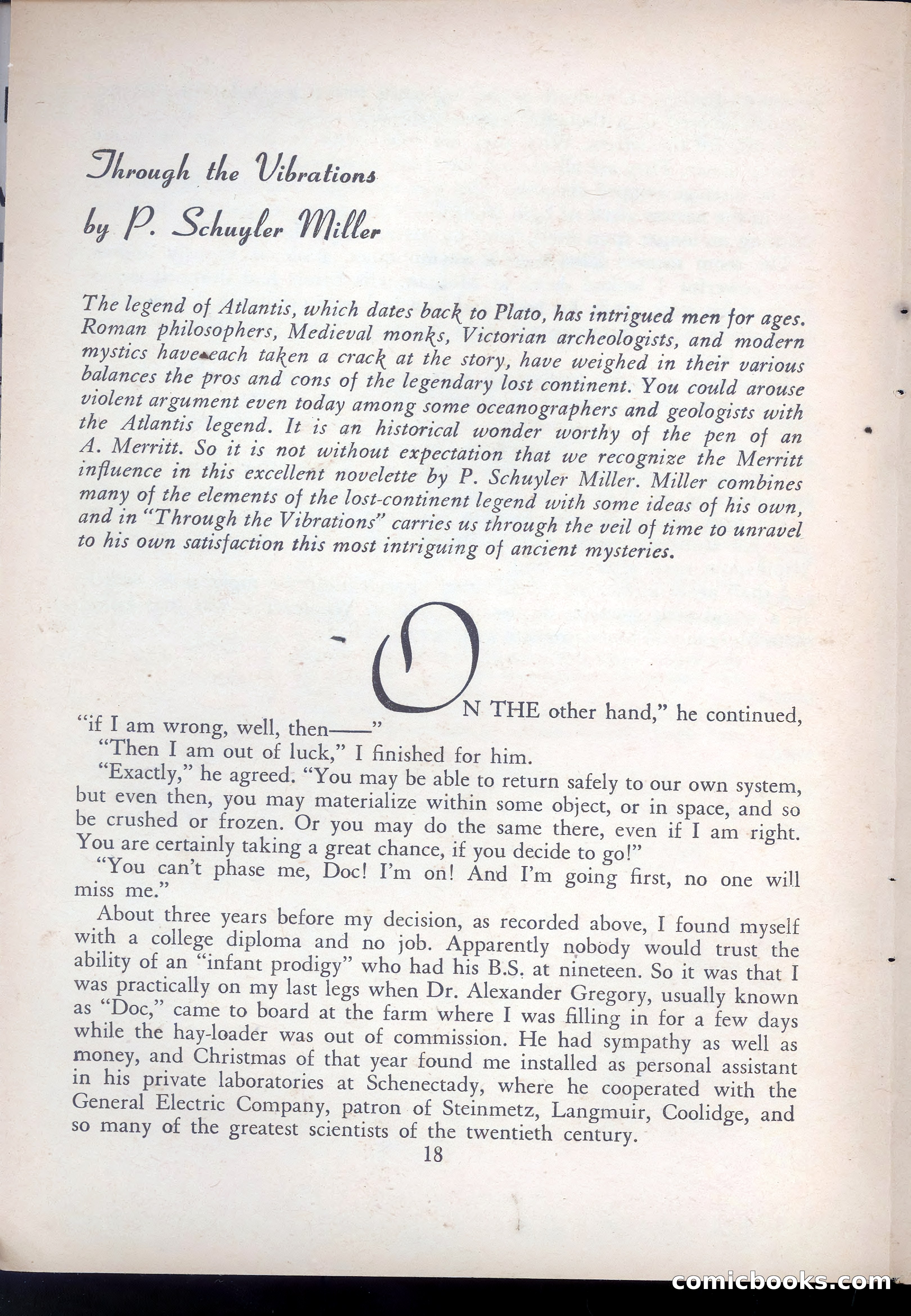
A restored page from Pulp Fiction, 1949. Page through the whole issue in the reader above.
📄 Transcribed text from this page (OCR, searchable)
Machine-transcribed from the original scan — historical spelling and the odd misread are preserved.
Through the Wirchions by P Schuyler Wilber The legend of Atlantis, which dates back to Plato, has intrigued men for ages. Roman philosophers, Medieval monks, Victorian archeologists, and modern mystics haveaeach taken a crack at the story, have weighed in their various balances the pros and cons of the legendary lost continent. You could arouse violent argument even today among some oceanographers and geologists with the Atlantis legend. It is an historical wonder worthy of the pen of an A. Merritt. So it is not without expectation that we recognize the Merritt influence in this excellent novelette by P. Schuyler Miller. Miller combines many of the elements of the lost-continent legend with some ideas of his own, and in “Through the Vibrations” carries us throu gh the veil of time to unravel to his own satisfaction this most intriguing of ancient mysteries. : N THE other hand,” he continued, “1f Tam wrong, well, then - ~ Then I am out of luck,” I finished for him. “Exactly,” he agreed: “You may be able to return safely to our own system, but even then, you may materialize within some object, or in space, and so be crushed or frozen. Or you may do the same there, even if I am right. You are certainly taking a great chance, if you decide to go!” “You can’t phase me, Doc! I’m on! And I’m going first, no one will miss me. About three years before my decision, as recorded above, I found myself with a college diploma and no job. Apparently nobody would trust the ability of an “infant prodigy” who had his B.S, at nineteen. So it was that I was practically on my last legs when Dr. Alexander Gregory, usually known as “Doc,” came to board at the farm where I was filling in for a few days while the hay-loader was out of commission. He had sympathy as well as money, and Christmas of that year found me installed as personal assistant in his private laboratories at Schenectady, where he cooperated with the General Electric Company, patron. of Steinmetz, Langmuir, Coolidge, and so many of the greatest scientists of the twentieth century. 18