
Pulp Fiction, 1949 · page 110 of 132
Avon Fantasy Reader No. 9 — page 110: what you’re looking at
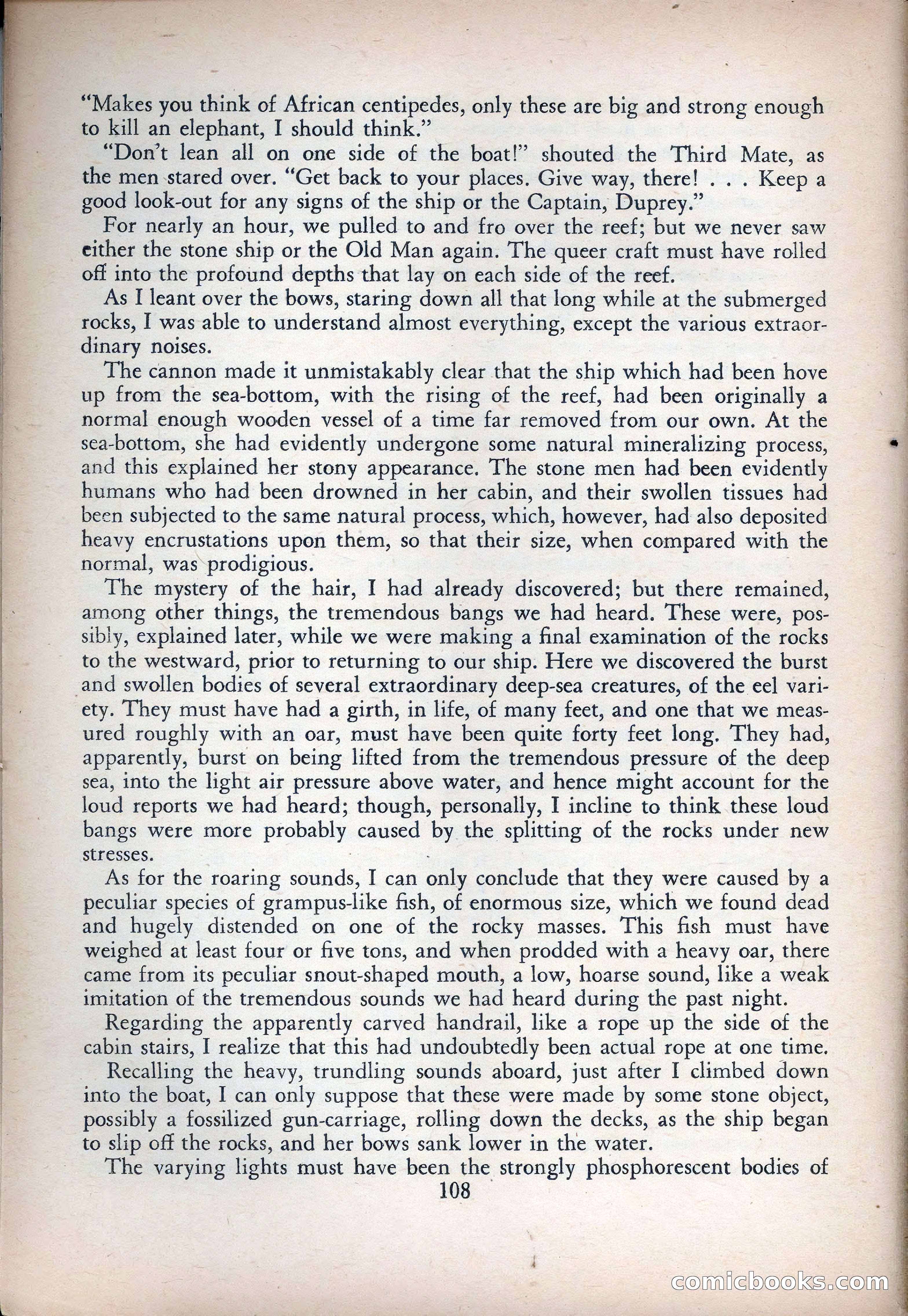
A restored page from Pulp Fiction, 1949. Page through the whole issue in the reader above.
📄 Transcribed text from this page (OCR, searchable)
Machine-transcribed from the original scan — historical spelling and the odd misread are preserved.
“Makes you think of African centipedes, only these are big and strong enough to kill an elephant, I should think.” “Don’t lean all on one side of the boat!’ shouted the Third Mate, as the men stared over. “Get back to your places, Give way, there! .. . Keep a good look-out for any signs of the ship or the Captain, Duprey.” For nearly an hour, we pulled to and fro over the reef; but we never saw either the stone ship or the Old Man again. The queer craft must have rolled off into the profound depths that lay on each side of the reef. As I leant over the bows, staring down all that long while at the subprersd. rocks, I was able to understand almost everything, except the various extraor- dinary noises. The cannon made it unmistakably clear that the chip which had been hove up from the sea-bottom, with the rising of the reef, had been originally a normal enough wooden vessel of a time far removed from our own. At the sea-bottom, she had evidently undergone some natural mineralizing process, and this explained her stony appearance. The stone men had been evidently humans who had been drowned in her cabin, and their swollen tissues had been subjected to the same natural process, which, however, had also deposited heavy encrustations upon them, so that their size, when compared with the normal, was prodigious. The mystery of the hair, I had already discovered; but there remained, among other things, the tremendous bangs we had heard. These were, pos- sibly, explained later, while we were making a final examination of the rocks to the westward, prior to returning to our ship. Here we discovered the burst and swollen bodies of several extraordinary deep-sea creatures, of the eel vari- ety. They must have had a girth, in life, of many feet, and one that we meas- ured roughly with an oar, must have been quite forty feet long. They had, apparently, burst on being lifted from the tremendous pressure of the deep sea, into the light air pressure above water, and hence might account for the loud reports we had heard; though, personally, I incline to think these loud bangs were more probably caused by the splitting of the rocks under new stresses. As for the roaring ade I can one conclude that they were caused by a peculiar species of grampus- Like fish, of enormous size, which we found dead and hugely distended on one of the rocky masses. This fish must have weighed at least four or five tons, and when prodded with a heavy oar, there came from its peculiar snout-shaped mouth, a low, hoarse sound, like a weak imitation of the tremendous sounds we had heard during the past night. Regarding the apparently carved handrail, like a rope up the side of the cabin stairs, I realize that this had undoubtedly been actual rope at one time. Recalling the heavy, trundling sounds aboard, just after I climbed down into the boat, I can only suppose that these were made by some stone object, possibly a fossilized gun-carriage, rolling down the decks, as the ship began to slip off the rocks, and her bows sank lower in the water. The varying lights must have been the strongly phosphorescent bodies of 108 Conic ooolks Com