
Pulp Fiction, 1948 · page 99 of 132
Avon Fantasy Reader No. 8 — page 99: what you’re looking at
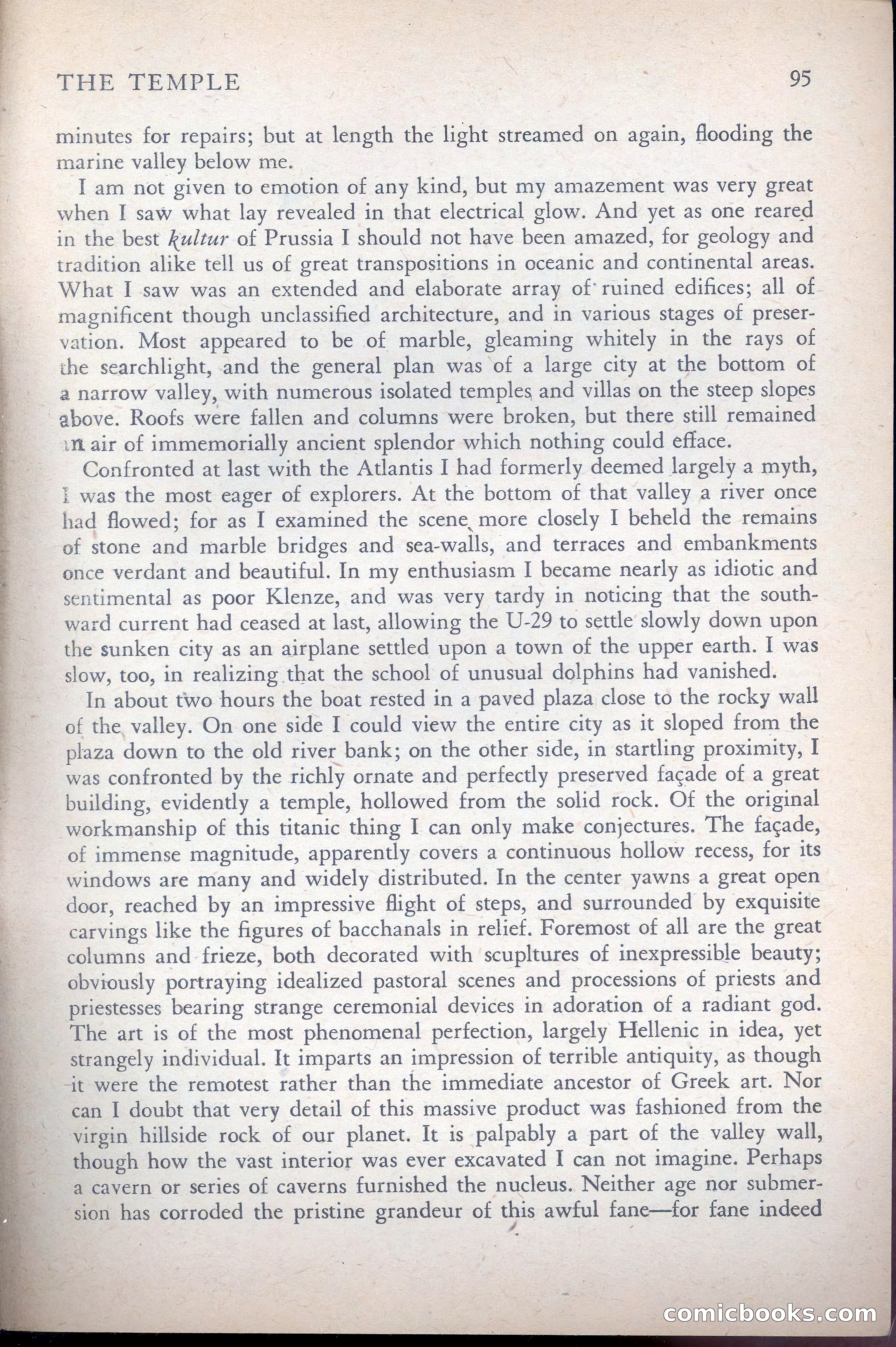
A restored page from Pulp Fiction, 1948. Page through the whole issue in the reader above.
📄 Transcribed text from this page (OCR, searchable)
Machine-transcribed from the original scan — historical spelling and the odd misread are preserved.
THE TEMPLE sae 2 3 95 minutes for repairs; but at length the light streamed on again, flooding the marine valley below me. : I am not given to emotion of any kind, but my amazement was very great when I saw what lay revealed in that electrical glow. And yet as one reared in the best kultur of Prussia I should not have been amazed, for geology and tradition alike tell us of great transpositions in oceanic and continental areas. What I saw was an extended and elaborate array of’ ruined edifices; all of magnificent though unclassified architecture, and in various stages of preser- vation. Most appeared to be of marble, gleaming whitely in the rays of ihe searchlight, and the general plan was of a large city at the bottom of _ a narrow valley, with numerous isolated temples and villas on the steep slopes above. Roofs were fallen and columns were broken, but there still remained im air of immemorially ancient splendor which nothing could efface. Confronted at last with the Atlantis I had formerly deemed largely a myth, i was the most eager of explorers. At the bottom of that valley a river once had flowed; for as I examined the scene more closely I beheld the remains of stone and marble bridges and sea-walls, and terraces and embankments once verdant and beautiful. In my enthusiasm I became nearly as idiotic and sentimental as poor Klenze, and was very tardy in noticing that the south- ward current had ceased at last, allowing the U-29 to settle slowly down upon the sunken city as an airplane settled upon a town of the upper earth. I was slow, too, in realizing that the school of unusual dolphins had vanished. In about two hours the boat rested in a paved plaza close to the rocky wall of the valley. On one side I could view the entire city as it sloped from the plaza down to the old river bank; on the other side, in startling proximity, I was confronted by the richly ornate and perfectly preserved facade of a great building, evidently a temple, hollowed from the solid rock. Of the original workmanship of this titanic thing I can only make conjectures. The facade, of immense magnitude, apparently covers a continuous hollow recess, for its windows are many and widely distributed. In the center yawns a great open door, reached by an impressive flight of steps, and surrounded by exquisite carvings like the figures of bacchanals in relief. Foremost of all are the great columns and frieze, both decorated with scupltures of inexpressible beauty; obviously portraying idealized pastoral scenes and processions of priests and 3 priestesses bearing strange ceremonial devices in adoration of a radiant god. Bi The art is of the most phenomenal perfection, largely Hellenic in idea, yet a strangely individual. It imparts an impression of terrible antiquity, as though -it were the remotest rather than the immediate ancestor of Greek art. Nor can I doubt that very detail of this massive product was fashioned from the virgin hillside rock of our planet. It is palpably a part of the valley wall, though how the vast interior was ever excavated I can not imagine. Perhaps *. a cavern or series of caverns furnished the nucleus. Neither age nor submer- _ sion has corroded the pristine grandeur of this awful fane—for fane indeed “aX ae "comicbookscon s (as