
Pulp Fiction, 1956 · page 90 of 162
Authentic Science Fiction Monthly No. 72 — page 90: what you’re looking at
A restored page from Pulp Fiction, 1956. Page through the whole issue in the reader above.
📄 Transcribed text from this page (OCR, searchable)
Machine-transcribed from the original scan — historical spelling and the odd misread are preserved.
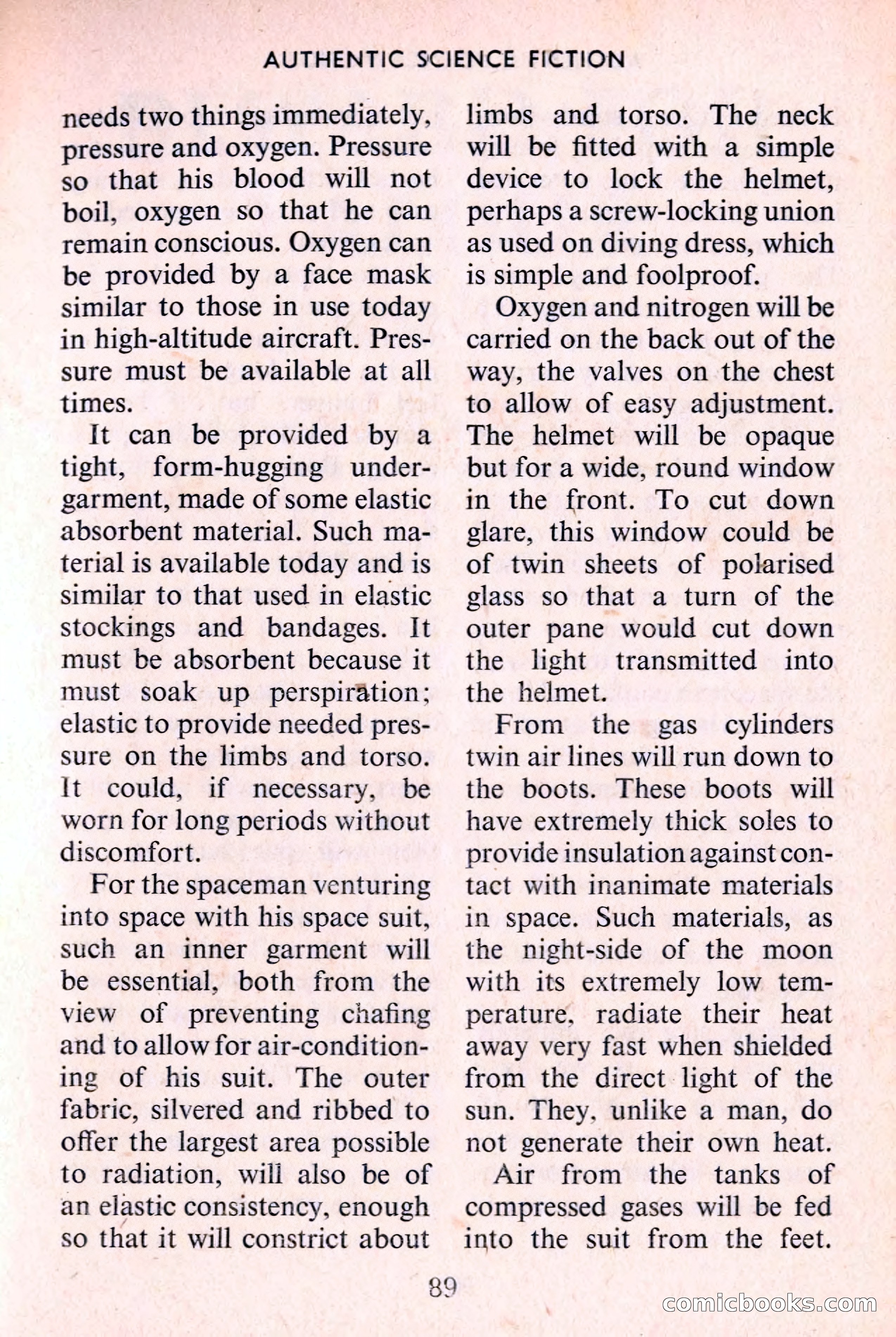
AUTHENTIC SCIENCE FICTION needs two things immediately, pressure and oxygen. Pressure so that his blood will not boil, oxygen so that he can remain conscious. Oxygen can be provided by a face mask similar to those in use today in high-altitude aircraft. Pres- sure must be available at all times. It can be provided by a tight, form-hugging under- garment, made of some elastic absorbent material. Such ma- terial is available today and is similar to that used in elastic stockings and bandages. It must be absorbent because it must soak up perspiration; elastic to provide needed pres- sure on the limbs and torso. It could, if necessary, be worn for long periods without discomfort. For the spaceman venturing into space with his space suit, such an inner garment will be essential, both from the view of preventing chafing and to allow for air-condition- ing of his suit. The outer fabric, silvered and ribbed to offer the largest area possible to radiation, wili also be of an elastic consistency, enough so that it will constrict about 89 limbs and torso. The neck will be fitted with a simple device to lock the helmet, perhaps a screw-locking union as used on diving dress, which is simple and foolproof. Oxygen and nitrogen will be carried on the back out of the way, the valves on the chest to allow of easy adjustment. The helmet will be opaque but for a wide, round window in the front. To cut down glare, this window could be of twin sheets of polarised glass so that a turn of the outer pane would cut down the light transmitted into the helmet. From the gas cylinders twin air lines will run down to the boots. These boots will have extremely thick soles to provide insulation against con- tact with inanimate materials in space. Such materials, as the night-side of the moon with its extremely low tem- perature, radiate their heat away very fast when shielded from the direct light of the sun. They, unlike a man, do not generate their own heat. Air from the tanks of compressed gases will be fed into the suit from the feet. comiclooks.cormn