
Pulp Fiction, 1956 · page 155 of 162
Authentic Science Fiction Monthly No. 72 — page 155: what you’re looking at
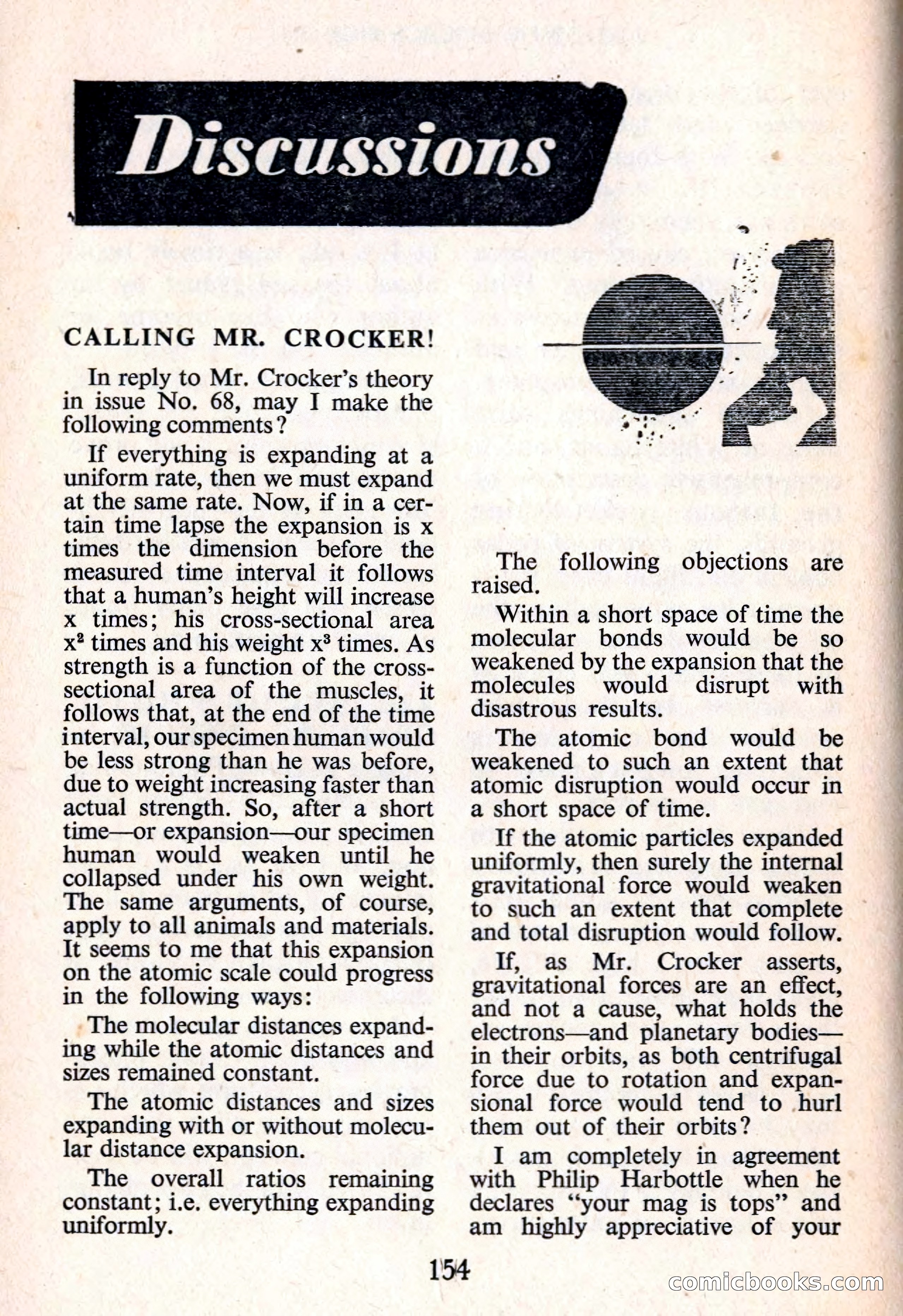
A restored page from Pulp Fiction, 1956. Page through the whole issue in the reader above.
📄 Transcribed text from this page (OCR, searchable)
Machine-transcribed from the original scan — historical spelling and the odd misread are preserved.
Discussions CALLING MR. CROCKER! In reply to Mr. Crocker’s theory in issue No. 68, may I make the following comments? If everything is expanding at a uniform rate, then we must expand at the same rate. Now, if in a cer- tain time lapse the expansion is x times the dimension before the measured time interval it follows that a human’s height will increase x times; his cross-sectional area x® times and his weight x® times. As strength is a function of the cross- sectional area of the muscles, it follows that, at the end of the time interval, our specimen human would be less strong than he was before, due to weight increasing faster than actual strength. So, after a short time—or expansion—our specimen human would weaken until he collapsed under his own weight. The same arguments, of course, apply to all animals and materials. It seems to me that this expansion on the atomic scale could progress in the following ways: The molecular distances expand- ing while the atomic distances and sizes remained constant. The atomic distances and sizes expanding with or without molecu- lar distance expansion. The overall ratios remaining constant; i.e. everything expanding uniformly. 154 The following objections are raised, Within a short space of time the molecular bonds would be so weakened by the expansion that the molecules would disrupt with disastrous results. The atomic bond would be weakened to such an extent that atomic disruption would occur in a short space of time. If the atomic particles expanded uniformly, then surely the internal gravitational force would weaken to such an extent that complete and total disruption would follow. If, as Mr. Crocker asserts, gravitational forces are an effect, and not a cause, what holds the electrons—and planetary bodies— in their orbits, as both centrifugal force due to rotation and expan- sional force would tend to hurl them out of their orbits? I am completely in agreement with Philip Harbottle when he declares “‘your mag is tops” and am highly appreciative of your comiclbooks.corn