
Pulp Fiction, 1956 · page 153 of 162
Authentic Science Fiction Monthly No. 72 — page 153: what you’re looking at
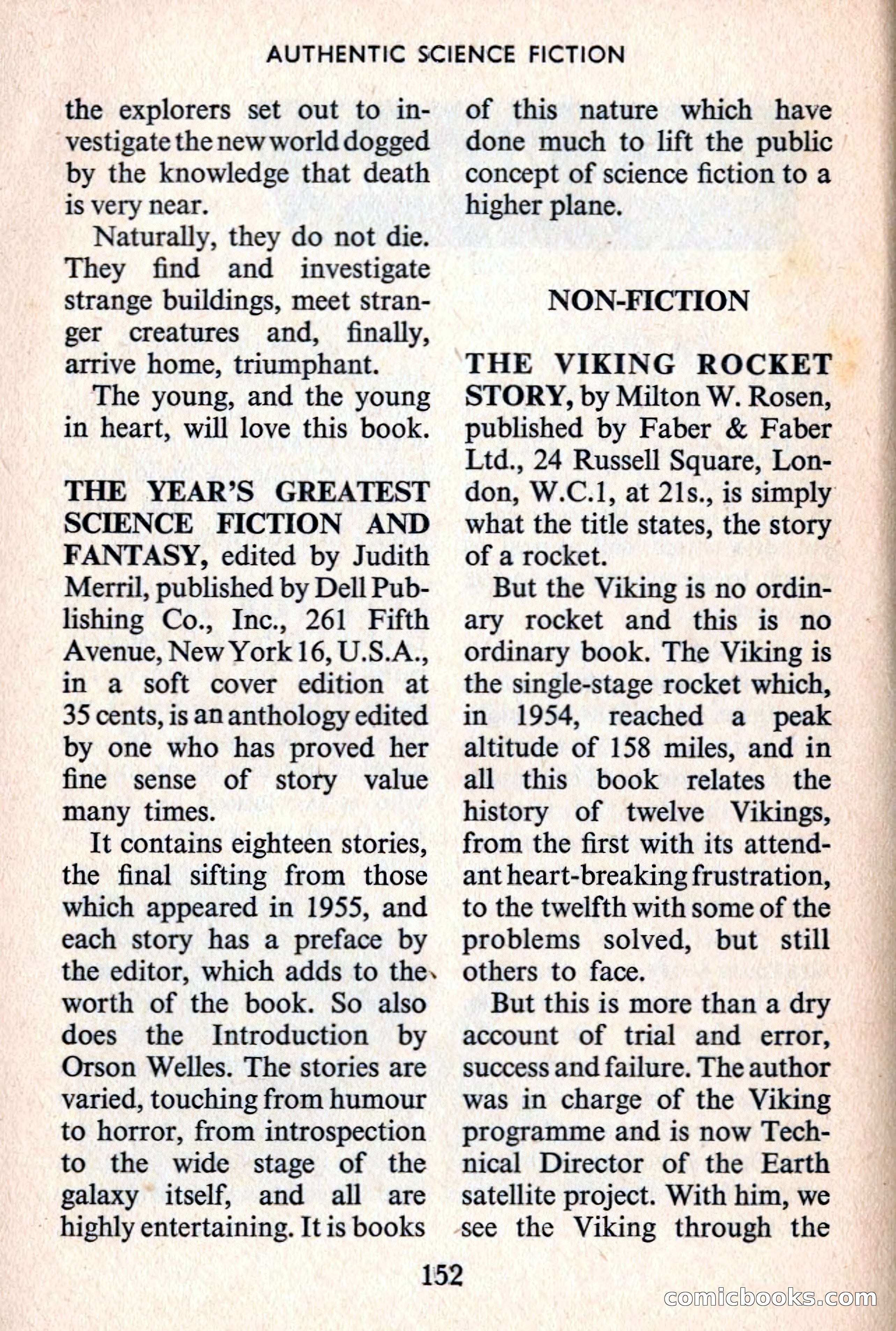
A restored page from Pulp Fiction, 1956. Page through the whole issue in the reader above.
📄 Transcribed text from this page (OCR, searchable)
Machine-transcribed from the original scan — historical spelling and the odd misread are preserved.
AUTHENTIC SCIENCE FICTION the explorers set out to in- vestigate the new world dogged by the knowledge that death is very near. Naturally, they do not die. They find and investigate strange buildings, meet stran- ger creatures and, finally, arrive home, triumphant. The young, and the young in heart, will love this book. THE YEAR’S GREATEST SCIENCE FICTION AND FANTASY, edited by Judith Merril, published by Dell Pub- lishing Co., Inc., 261 Fifth Avenue, New York 16, U.S.A.., in a soft cover edition at 35 cents, is an anthology edited by one who has proved her fine sense of story value many times. It contains eighteen stories, the final sifting from those which appeared in 1955, and each story has a preface by the editor, which adds to the, worth of the book. So also does the Introduction by Orson Welles. The stories are varied, touching from humour to horror, from introspection to the wide stage of the galaxy itself, and all are highly entertaining. It is books of this nature which have done much to lift the public concept of science fiction to a higher plane. NON-FICTION THE VIKING ROCKET STORY, by Milton W. Rosen, published by Faber & Faber Ltd., 24 Russell Square, Lon- don, W.C.1, at 21s., is simply what the title states, the story of a rocket. But the Viking is no ordin- ary rocket and this is no ordinary book. The Viking is the single-stage rocket which, in 1954, reached a _ peak altitude of 158 miles, and in all this book relates the history of twelve Vikings, from the first with its attend- ant heart-breaking frustration, to the twelfth with some of the problems solved, but still others to face. But this is more than a dry account of trial and error, success and failure. The author was in charge of the Viking programme and is now Tech- nical Director of the Earth satellite project. With him, we see the Viking through the 152 comichooks.com