
Pulp Fiction, 1956 · page 31 of 164
Authentic Science Fiction Monthly No. 71 — page 31: what you’re looking at
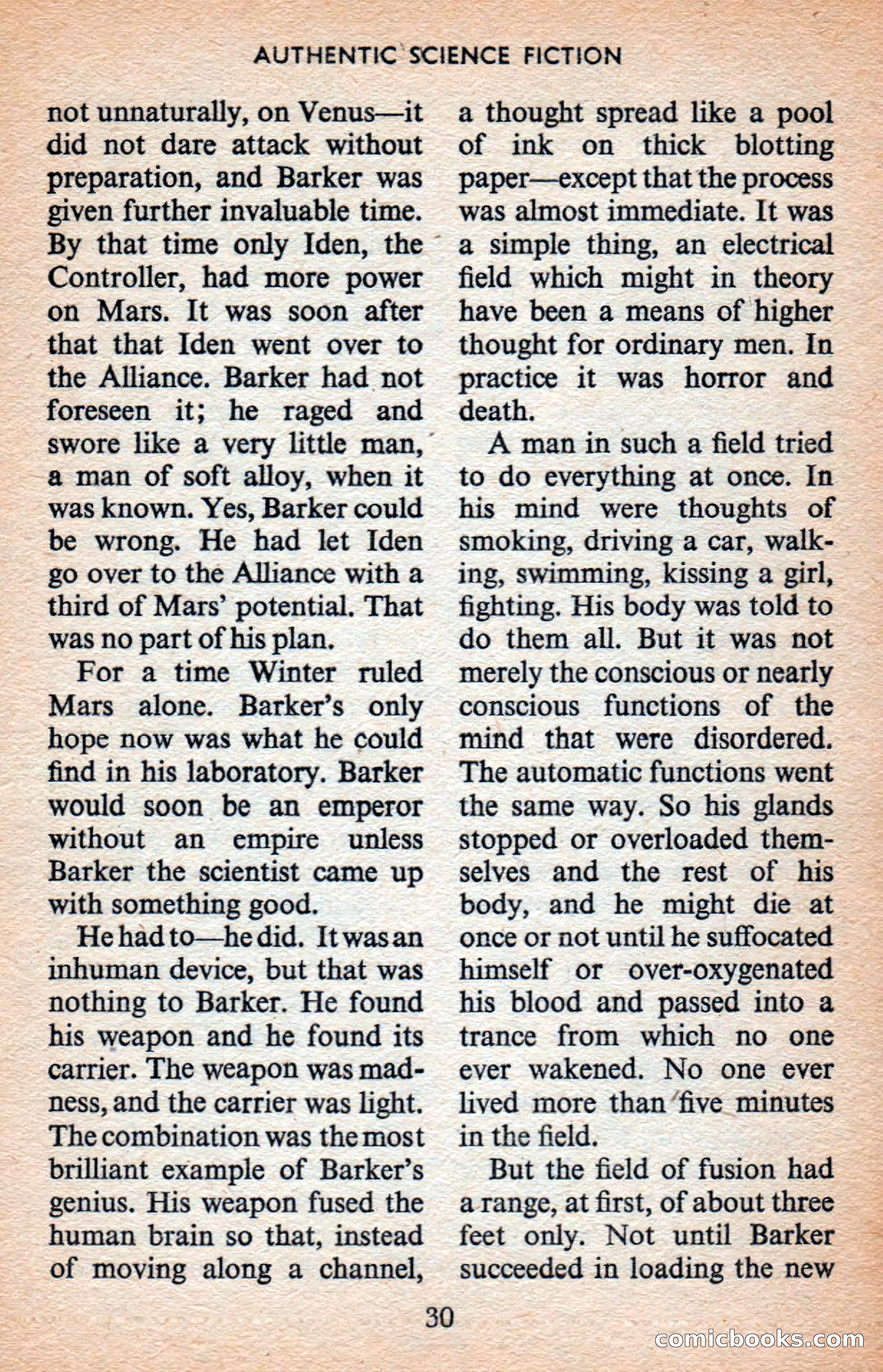
A restored page from Pulp Fiction, 1956. Page through the whole issue in the reader above.
📄 Transcribed text from this page (OCR, searchable)
Machine-transcribed from the original scan — historical spelling and the odd misread are preserved.
AUTHENTIC SCIENCE FICTION not unnaturally, on Venus—it did not dare attack without preparation, and Barker was given further invaluable time. By that time only Iden, the © Controller, had more power on Mars. It was soon after _ that that Iden went over to the Alliance. Barker had not foreseen it; he raged and swore like a very little man, a man of soft alloy, when it was known. Yes, Barker could be wrong. He had let Iden go over to the Alliance with a third of Mars’ potential. That was no part of his plan. For a time Winter ruled Mars alone. Barker’s only hope now was what he could find in his laboratory. Barker would soon be an emperor without an empire unless Barker the scientist came up with something good. He had to—he did. It wasan inhuman device, but that was nothing to Barker. He found his weapon and he found its carrier. The weapon was mad- ness, and the carrier was light. The combination was the most brilliant example of Barker’s genius. His weapon fused the human brain so that, instead of moving along a channel, 30 a thought spread like a pool of ink on thick blotting paper—except that the process was almost immediate. It was a simple thing, an electrical field which might in theory have been a means of higher thought for ordinary men. In practice it was horror and death. A man in such a field tried to do everything at once. In his mind were thoughts of smoking, driving a car, walk- ing, swimming, kissing a girl, fighting. His body was told to do them all. But it was not merely the conscious or nearly conscious functions of the mind that were disordered. The automatic functions went the same way. So his glands stopped or overloaded them- selves and the rest of his body, and he might die at once or not until he suffocated © himself or over-oxygenated his blood and passed into a trance from which no one ever wakened. No one ever lived more than ‘five minutes in the field. But the field of fusion had arange, at first, of about three feet only. Not until Barker succeeded in loading the new COnmcooolkS.conn