
Pulp Fiction, 1956 · page 161 of 164
Authentic Science Fiction Monthly No. 71 — page 161: what you’re looking at
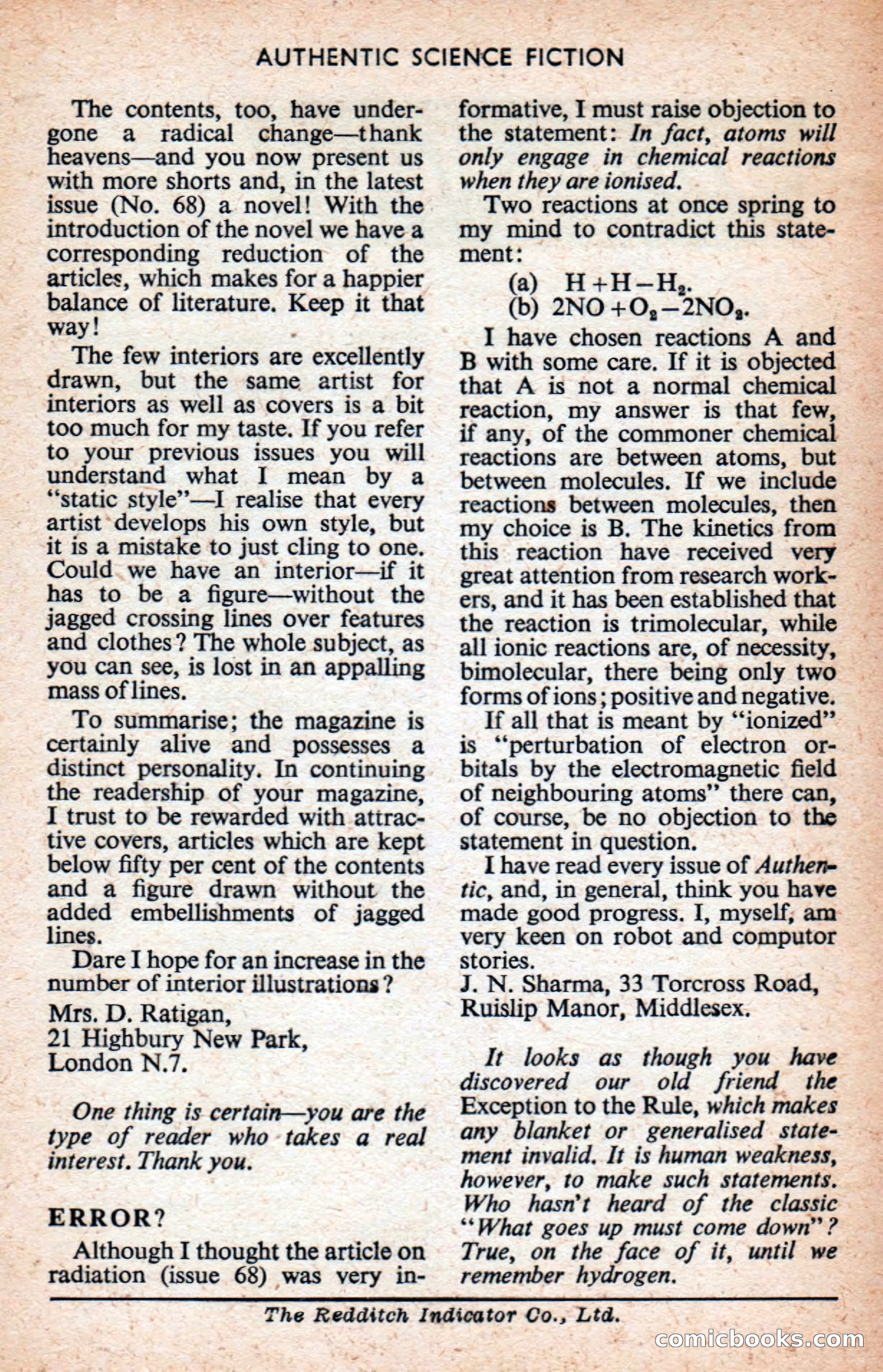
A restored page from Pulp Fiction, 1956. Page through the whole issue in the reader above.
📄 Transcribed text from this page (OCR, searchable)
Machine-transcribed from the original scan — historical spelling and the odd misread are preserved.
AUTHENTIC SCIENCE FICTION The contents, too, have under- gone a radical change—thank heayens—and you now present us with more shorts and, in the latest issue (No. 68) a novel! With the introduction of the novel we have a corresponding reduction of the articles, which makes for a happier balance of literature. aor it that way! The few interiors are excellently drawn, but the same artist for interiors as well as covers is a bit too much for my taste. If you refer to your previous issues you will understand what I mean by a “static style’’—I realise that every artist develops his own style, but it is a mistake to just cling to one. Could we have an interior—if it has to be a figure—without the jagged crossing lines over features and clothes? The whole subject, as you can see, is lost in an appalling mass of lines. To summarise; the magazine is certainly alive and possesses a distinct personality. In continuing the readership of your magazine, I trust to be rewarded with atirac- tive covers, articles which are kept below fifty per cent of the contents and a figure drawn without the added embellishments of jagged lines. Dare I hope for an increase in the number of interior illustrations ? Mrs. D. Ratigan, 21 Highbury New Park, London N.7. One thing is certain—you are the type of reader who -takes a real interest. Thank you. ERROR? Although I thought the article on radiation (issue 68) was very in- The Redditch Indicator Co., Ltd. formative, I must raise objection to the statement: Jn fact, atoms will only engage in chemical reactions when they are ionised, - Two reactions at once spring to my mind to contradict this state- ment: (a) H+H—H,. (b) 2NO +O,—2NQs,. I have chosen reactions A and B with some care. If it is objected that A is not a normal chemical reaction, my answer is that few, if any, of the commoner chemical reactions are between atoms, but between molecules. If we include reactions between molecules, then my choice is B. The kinetics from this reaction have received very great attention from research work- ers, and it has been established that the reaction is trimolecular, while all ionic reactions are, of necessity, bimolecular, there being only two forms of ions; positive and negative. If all that is meant by “‘ionized” is “‘perturbation of electron or- bitals by the electromagnetic field of neighbouring atoms’’ there can, of course, be no objection to the statement in question. I have read every issue of Authen- tic, and, in general, think you have made good progress. I, myself; am very keen on robot and computor stories. J. N. Sharma, 33 Torcross Road, Ruislip Manor, Middlesex. It looks as though you have discovered our old friend the Exception to the Rule, which makes any blanket or generalised state- ment invalid. It is human weakness, however, to make such statements. Who hasn’ t heard of the classic ‘What goes up must come down” ? True, on the face of it, until we — remember hydrogen. comiclbooks.com =