
Pulp Fiction, 1956 · page 144 of 164
Authentic Science Fiction Monthly No. 71 — page 144: what you’re looking at
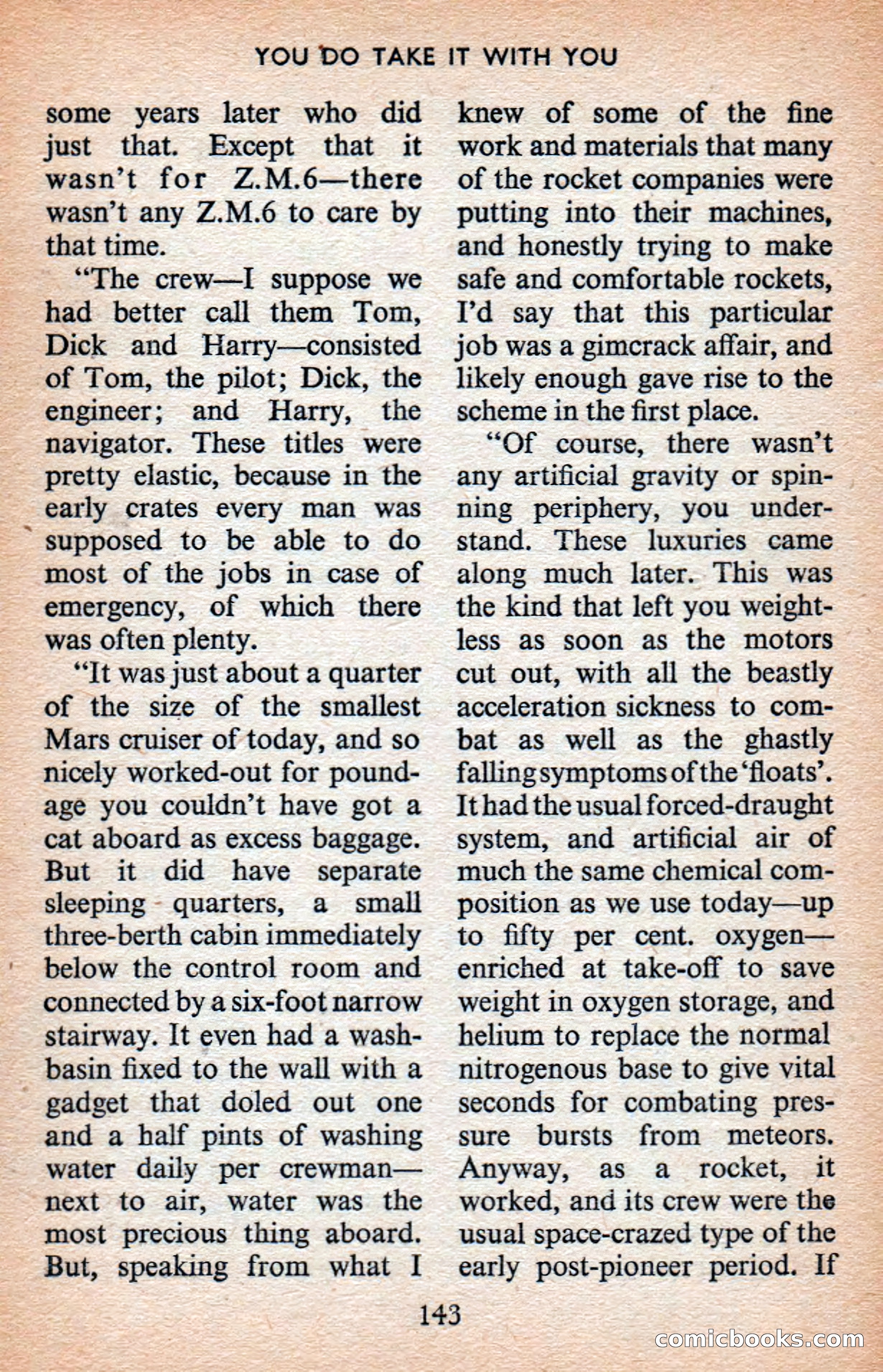
A restored page from Pulp Fiction, 1956. Page through the whole issue in the reader above.
📄 Transcribed text from this page (OCR, searchable)
Machine-transcribed from the original scan — historical spelling and the odd misread are preserved.
~ YOU DO TAKE some years later who did just that. Except that it wasn’t for Z.M.6—there wasn’t any Z.M.6 to care by that time. “The crew—I suppose we had better call them Tom, Dick and Harry—consisted of Tom, the pilot; Dick, the engineer; and Harry, the navigator. These titles were - pretty elastic, because in the early crates every man was * supposed to be able to do most of the jobs in case of emergency, of which there was often plenty. “It was just about a quarter of the size of the smallest Mars cruiser of today, and so nicely worked-out for pound- age you couldn’t have got a cat aboard as excess baggage. But it did have separate sleeping - quarters, a small three-berth cabin immediately below the control room and connected by a six-foot narrow stairway. It even had a wash- basin fixed to the wall with a gadget that doled out one and a half pints of washing water daily per crewman— next to air, water was the most precious thing aboard. But, speaking from what I 143 IT WITH YOU knew of some of the fine work and materials that many of the rocket companies were putting into their machines, and honestly trying to make safe and comfortable rockets, I’d say that this particular job was a gimcrack affair, and likely enough gave rise to the scheme in the first place. “Of course, there wasn’t any artificial gravity or spin- ning periphery, you under- stand. These luxuries came along much later. This was the kind that left you weight- less as soon as the motors cut out, with all the beastly acceleration sickness to com- bat as well as the ghastly fallingsymptoms of the ‘floats’. It had the usual forced-draught system, and artificial air of much the same chemical com- position as we use today—up to fifty per cent. oxygen— enriched at take-off to save weight in oxygen storage, and helium to replace the normal nitrogenous base to give vital seconds for combating pres- sure bursts from meteors. Anyway, as a_ rocket, it worked, and its crew were the usual space-crazed type of the early post-pioneer period. If Comichooks:com — i % ath tye APs £) a a