
Pulp Fiction, 1956 · page 131 of 164
Authentic Science Fiction Monthly No. 71 — page 131: what you’re looking at
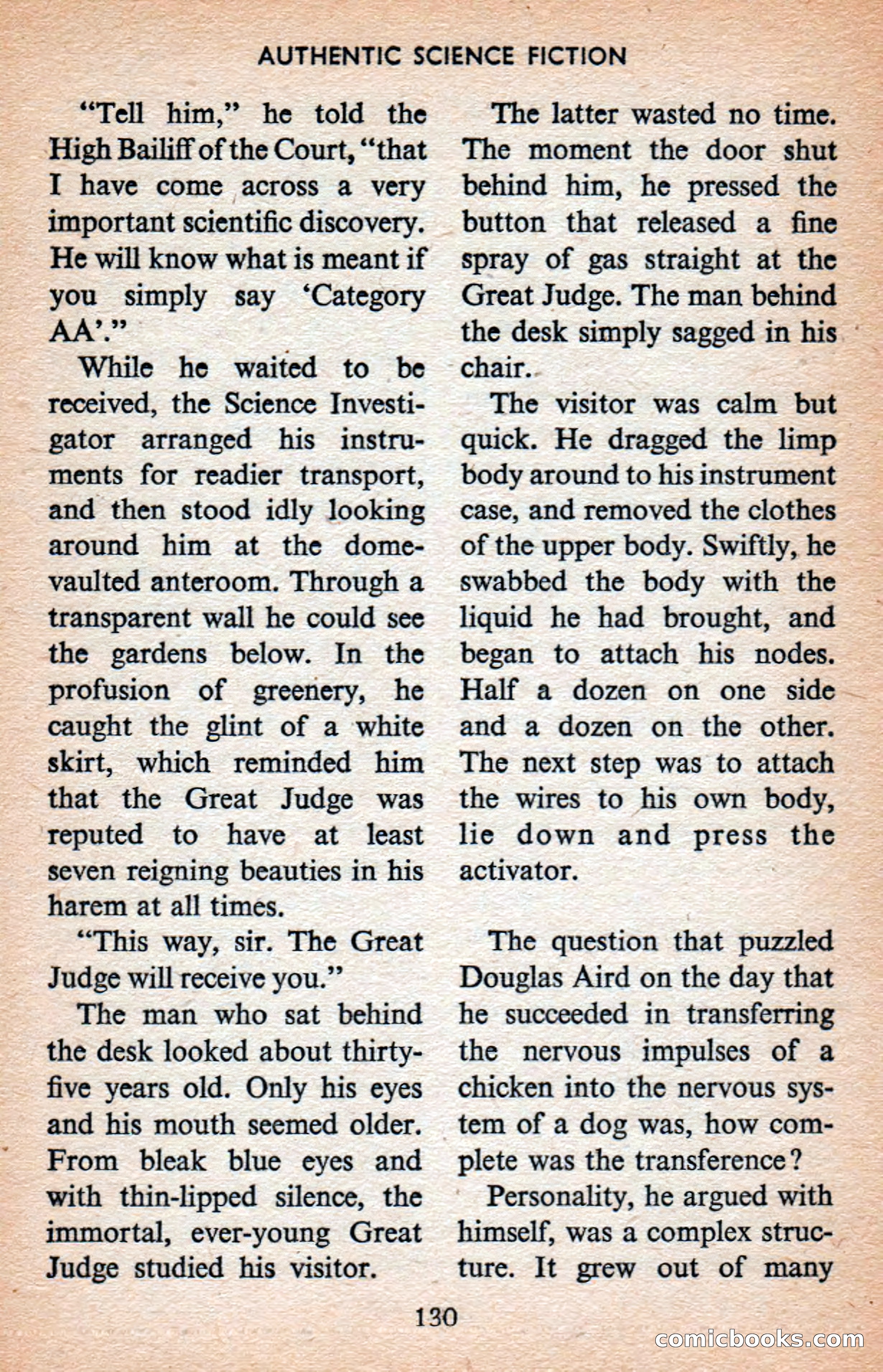
A restored page from Pulp Fiction, 1956. Page through the whole issue in the reader above.
📄 Transcribed text from this page (OCR, searchable)
Machine-transcribed from the original scan — historical spelling and the odd misread are preserved.
AUTHENTIC SCIENCE FICTION “Tell him,” he told the High Bailiff of the Court, “that I have come across a very important scientific discovery. He will know what is meant if you simply say ‘Category AA’.” While he waited to be received, the Science Investi- gator arranged his instru- ments for readier transport, and then stood idly looking around him at the dome- vaulted anteroom. Through a transparent wall he could see the gardens below. In the profusion of greenery, he caught the glint of a white skirt, which reminded him that the Great Judge was reputed to have at least seven reigning beauties in his harem at all times. “This way, sir. The Great Judge will receive you.” The man who sat behind the desk looked about thirty- five years old. Only his eyes and his mouth seemed older. From bleak blue eyes and with thin-lipped silence, the immortal, ever-young Great Judge studied his visitor. 130 The latter wasted no time. The moment the door shut behind him, he pressed the button that released a fine spray of gas straight at the Great Judge. The man behind the desk simply sagged in his © chair.. The visitor was calm but quick. He dragged the limp body around to his instrument case, and removed the clothes of the upper body. Swiftly, he swabbed the body with the liquid he had brought, and began to attach his nodes. Half a dozen on one side — and a dozen on the other. The next step was to attach the wires to his own body, lie down and press the activator. The question that puzzled Douglas Aird on the day that he succeeded in transferring the nervous impulses of a chicken into the nervous sys- tem of a dog was, how com- plete was the transference? Personality, he argued with himself, was a complex struc- ture. It grew out of many conmicldooksS.conn