
Pulp Fiction, 1956 · page 129 of 164
Authentic Science Fiction Monthly No. 71 — page 129: what you’re looking at
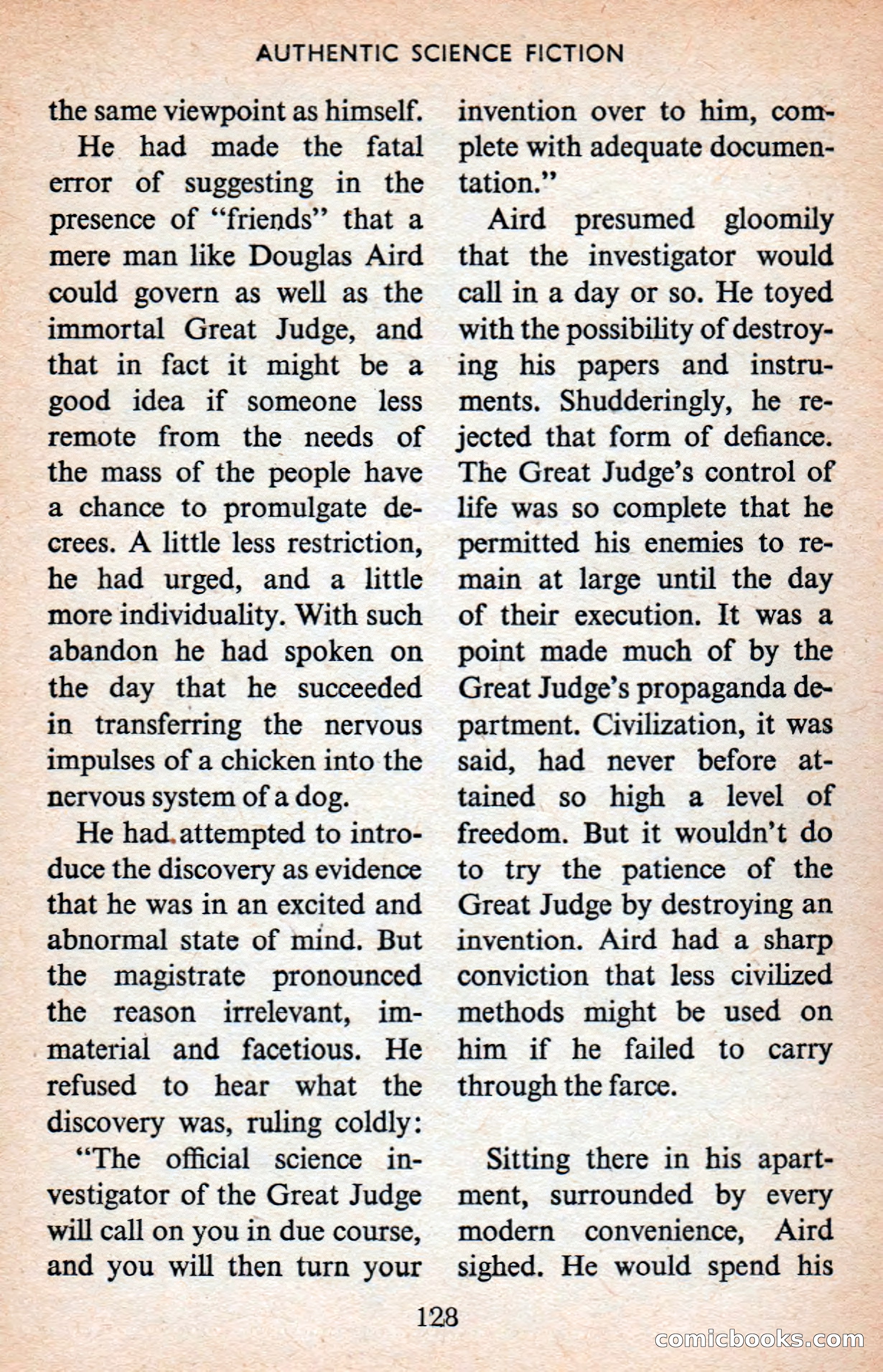
A restored page from Pulp Fiction, 1956. Page through the whole issue in the reader above.
📄 Transcribed text from this page (OCR, searchable)
Machine-transcribed from the original scan — historical spelling and the odd misread are preserved.
AUTHENTIC SCIENCE FICTION the same viewpoint as himself. He had made the fatal error of suggesting in the presence of “friends” that a mere man like Douglas Aird could govern as well as the immortal Great Judge, and that in fact it might be a good idea if someone less remote from the needs of the mass of the people have a chance to promulgate de- crees. A little less restriction, he had urged, and a little more individuality. With such abandon he had spoken on the day that he succeeded in transferring the nervous impulses of a chicken into the nervous system of a dog. He had. attempted to intro- duce the discovery as evidence that he was in an excited and abnormal state of mind. But the magistrate pronounced the reason irrelevant, im- material and facetious. He refused to hear what the discovery was, ruling coldly: “The official science in- vestigator of the Great Judge will call on you in due course, and you will then turn your invention over to him, com- plete with adequate documen- tation.” Aird presumed gloomily that the investigator would call in a day or so. He toyed with the possibility of destroy- ing his papers and instru- ments. Shudderingly, he re- jected that form of defiance. The Great Judge’s control of life was so complete that he permitted his enemies to re- main at large until the day of their execution. It was a point made much of by the Great Judge’s propaganda de- partment. Civilization, it was said, had never before at- tained so high a level of freedom. But it wouldn’t do to try the patience of the Great Judge by destroying an invention. Aird had a sharp conviction that less civilized methods might be used on him if he failed to carry through the farce. Sitting there in his apart- ment, surrounded by every modern convenience, Aird sighed. He would spend his 128 conniclbooks.conn