
Pulp Fiction, 1956 · page 125 of 164
Authentic Science Fiction Monthly No. 71 — page 125: what you’re looking at
A restored page from Pulp Fiction, 1956. Page through the whole issue in the reader above.
📄 Transcribed text from this page (OCR, searchable)
Machine-transcribed from the original scan — historical spelling and the odd misread are preserved.
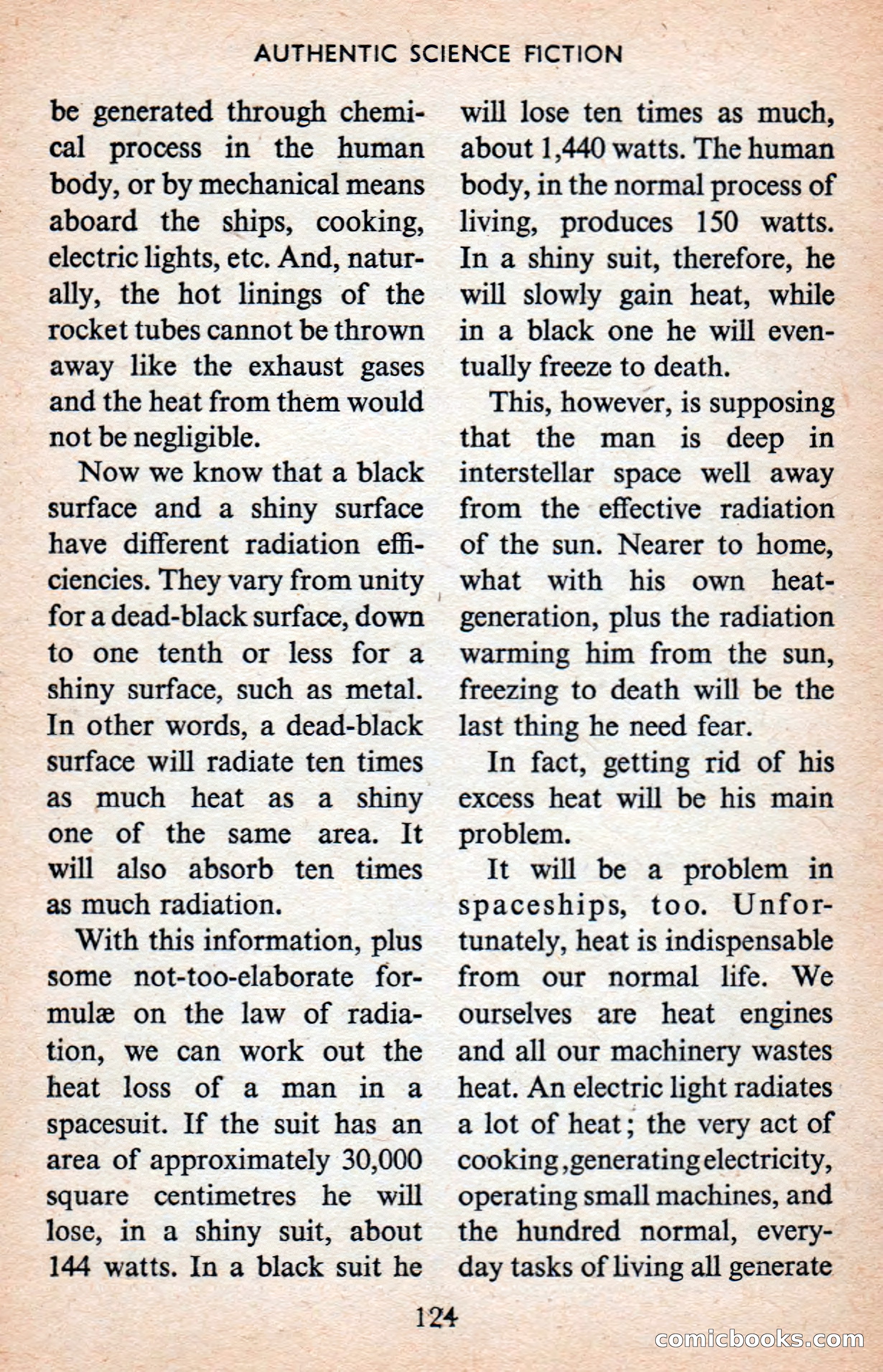
AUTHENTIC SCIENCE FICTION be generated through chemi- cal process in the human body, or by mechanical means aboard the ships, cooking, electric lights, etc. And, natur- ally, the hot linings of the rocket tubes cannot be thrown away like the exhaust gases and the heat from them would not be negligible. Now we know that a black surface and a shiny surface have different radiation effi- ciencies. They vary from unity — for a dead-black surface, down to one tenth or less for a shiny surface, such as metal. In other words, a dead-black surface will radiate ten times as much heat as a shiny one of the same area. It will also absorb ten times as much radiation. With this information, plus some not-too-elaborate for- mule on the law of radia- tion, we can work out the heat loss of a man in a spacesuit. If the suit has an area of approximately 30,000 square centimetres he will lose, in a shiny suit, about 144 watts. In a black suit he will lose ten times as much, about 1,440 watts. The human body, in the normal process of living, produces 150 watts. In a shiny suit, therefore, he will slowly gain heat, while in a black one he wiil even- tually freeze to death. This, however, is supposing that the man is deep in interstellar space well away from the effective radiation of the sun. Nearer to home, what with his own _heat- generation, plus the radiation warming him from the sun, freezing to death will be the last thing he need fear. In fact, getting rid of his excess heat will be his main problem. It will be a problem in spaceships, too. Unfor- tunately, heat is indispensable from our normal life. We ourselves are heat engines and all our machinery wastes heat. An electric light radiates a lot of heat; the very act of cooking ,generating electricity, operating small machines, and the hundred normal, every- day tasks of living all generate 124 conmiclsooks.comn