
Pulp Fiction, 1956 · page 93 of 162
Authentic Science Fiction Monthly, No. 67 — page 93: what you’re looking at
A restored page from Pulp Fiction, 1956. Page through the whole issue in the reader above.
📄 Transcribed text from this page (OCR, searchable)
Machine-transcribed from the original scan — historical spelling and the odd misread are preserved.
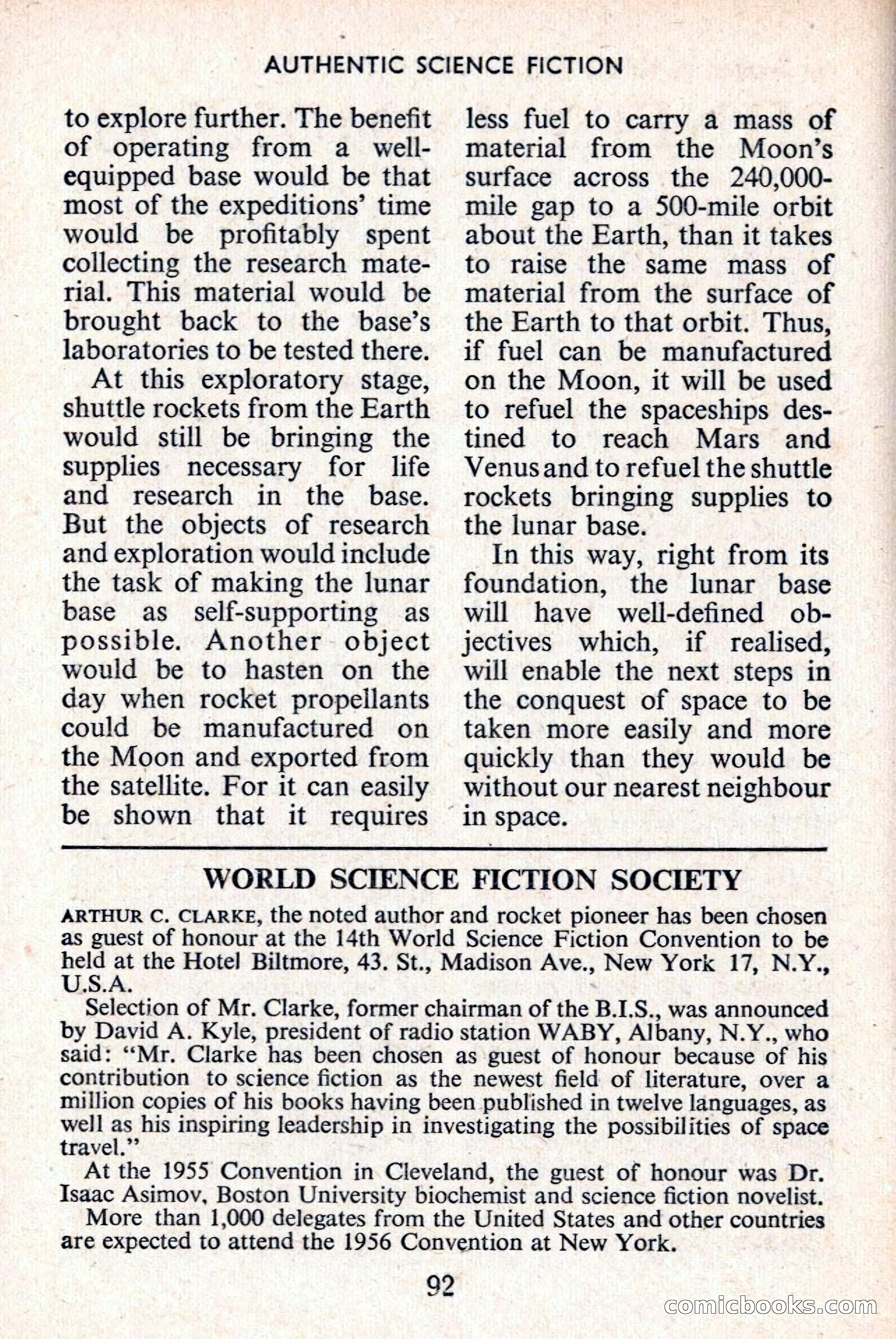
AUTHENTIC SCIENCE FICTION to explore further. The benefit of operating from a _ well- equipped base would be that most of the expeditions’ time would be profitably spent collecting the research mate- rial. This material would be brought back to the base’s laboratories to be tested there. At this exploratory stage, shuttle rockets from the Earth would still be bringing the supplies necessary for life and research in the base. But the objects of research and exploration would include the task of making the lunar base as self-supporting as possible. Another object would be to hasten on the day when rocket propellants could be manufactured on the Moon and exported from the satellite. For it can easily be shown that it requires less fuel to carry a mass of material from the Moon’s surface across the 240,000- mile gap to a 500-mile orbit about the Earth, than it takes to raise the same mass of material from the surface of the Earth to that orbit. Thus, if fuel can be manufactured on the Moon, it will be used to refuel the spaceships des- tined to reach Mars and Venusand to refuel the shuttle rockets bringing supplies to the lunar base. In this way, right from its foundation, the lunar base will have well-defined ob- jectives which, if realised, will enable the next steps in the conquest of space to be taken more easily and more quickly than they would be without our nearest neighbour In space. WORLD SCIENCE FICTION SOCIETY ARTHUR C. CLARKE, the noted author and rocket pioneer has been chosen as guest of honour at the 14th World Science Fiction Convention to be ae at the Hotel Biltmore, 43. St., Madison Ave., New York 17, N.Y., Ade Selection of Mr. Clarke, former chairman of the B.I.S., was announced by David A. Kyle, president of radio station WABY, Albany, N.Y., who said: ‘‘Mr. Clarke has been chosen as guest of honour because of his contribution to science fiction as the newest field of literature, over a million copies of his books having been published in twelve languages, as well t his inspiring leadership in investigating the possibilities of space travel.” At the 1955 Convention in Cleveland, the guest of honour was Dr. Isaac Asimov, Boston University biochemist and science fiction novelist. More than 1,000 delegates from the United States and other countries are expected to attend the 1956 Convention at New York. Q? Qa comiclooks.corn