
Pulp Fiction, 1956 · page 91 of 162
Authentic Science Fiction Monthly, No. 67 — page 91: what you’re looking at
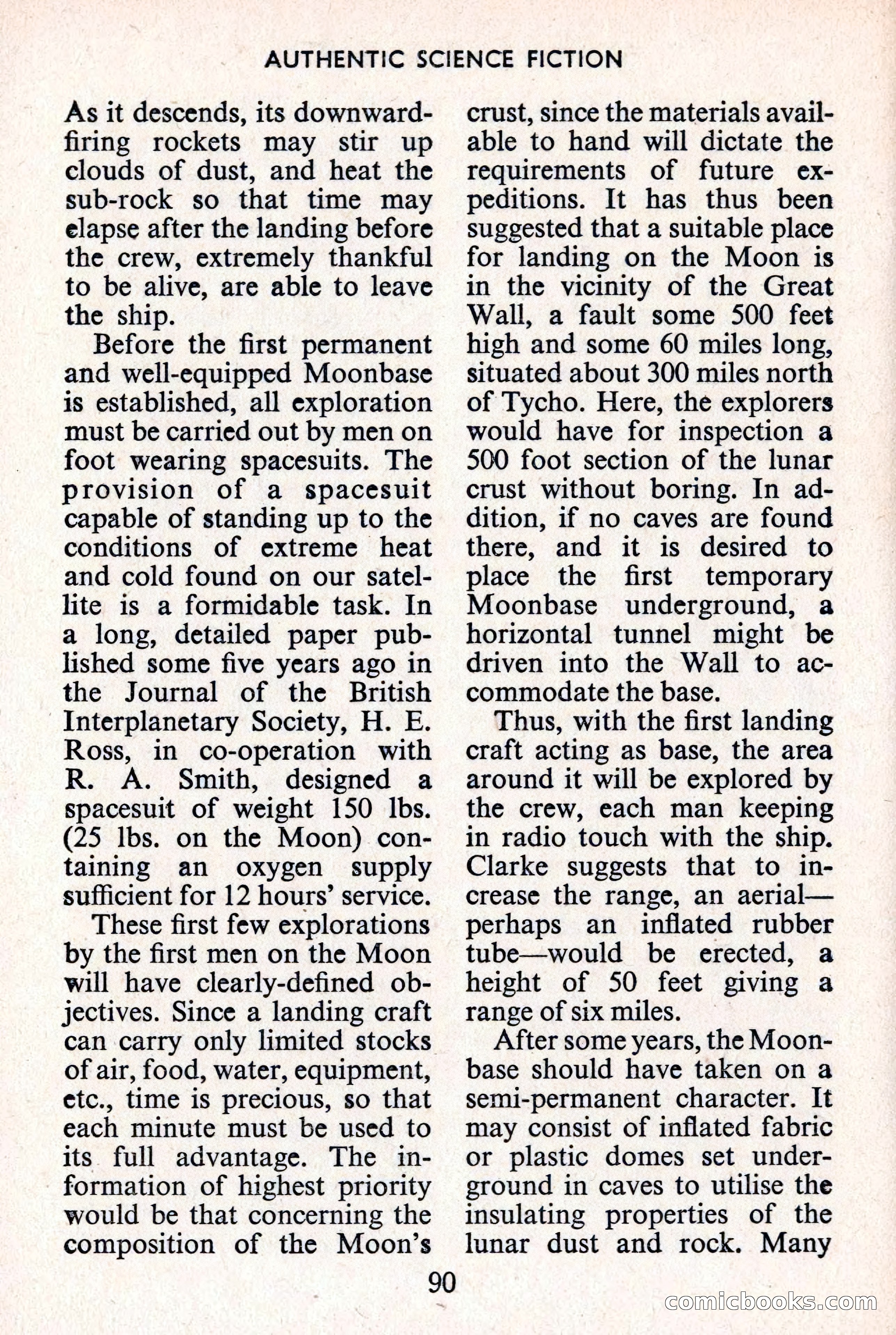
A restored page from Pulp Fiction, 1956. Page through the whole issue in the reader above.
📄 Transcribed text from this page (OCR, searchable)
Machine-transcribed from the original scan — historical spelling and the odd misread are preserved.
AUTHENTIC SCIENCE FICTION As it descends, its downward- firing rockets may stir up clouds of dust, and heat the sub-rock so that time may elapse after the landing before the crew, extremely thankful to be alive, are able to leave the ship. Before the first permanent and well-equipped Moonbase is established, all exploration must be carried out by men on foot wearing spacesuits. The provision of a spacesuit capable of standing up to the conditions of extreme heat and cold found on our satel- lite is a formidable task. In a long, detailed paper pub- lished some five years ago in the Journal of the British Interplanetary Society, H. E. Ross, in co-operation with R. A. Smith, designed a spacesuit of weight 150 Ibs. (25 lbs. on the Moon) con- taining an oxygen supply sufficient for 12 hours’ service. These first few explorations by the first men on the Moon will have clearly-defined ob- jectives. Since a landing craft can carry only limited stocks of air, food, water, equipment, etc., time is precious, so that each minute must be used to its full advantage. The in- formation of highest priority would be that concerning the composition of the Moon’s 90 crust, since the materials avail- able to hand will dictate the requirements of future ex- peditions. It has thus been suggested that a suitable place for landing on the Moon is in the vicinity of the Great Wall, a fault some S00 feet high and some 60 miles long, situated about 300 miles north of Tycho. Here, the explorers would have for inspection a 500 foot section of the lunar crust without boring. In ad- dition, if no caves are found there, and it is desired to place the first temporary Moonbase underground, a horizontal tunnel might be driven into the Wall to ac- commodate the base. Thus, with the first landing craft acting as base, the area around it will be explored by the crew, each man keeping in radio touch with the ship. Clarke suggests that to in- crease the range, an aerial— perhaps an inflated rubber tube—would be erected, a height of 5O feet giving a range of six miles. — After some years, the Moon- base should have taken on a semi-permanent character. It may consist of inflated fabric or plastic domes set under- ground in caves to utilise the insulating properties of the lunar dust and rock. Many comiclbooks.cormn