
Pulp Fiction, 1956 · page 86 of 162
Authentic Science Fiction Monthly, No. 67 — page 86: what you’re looking at
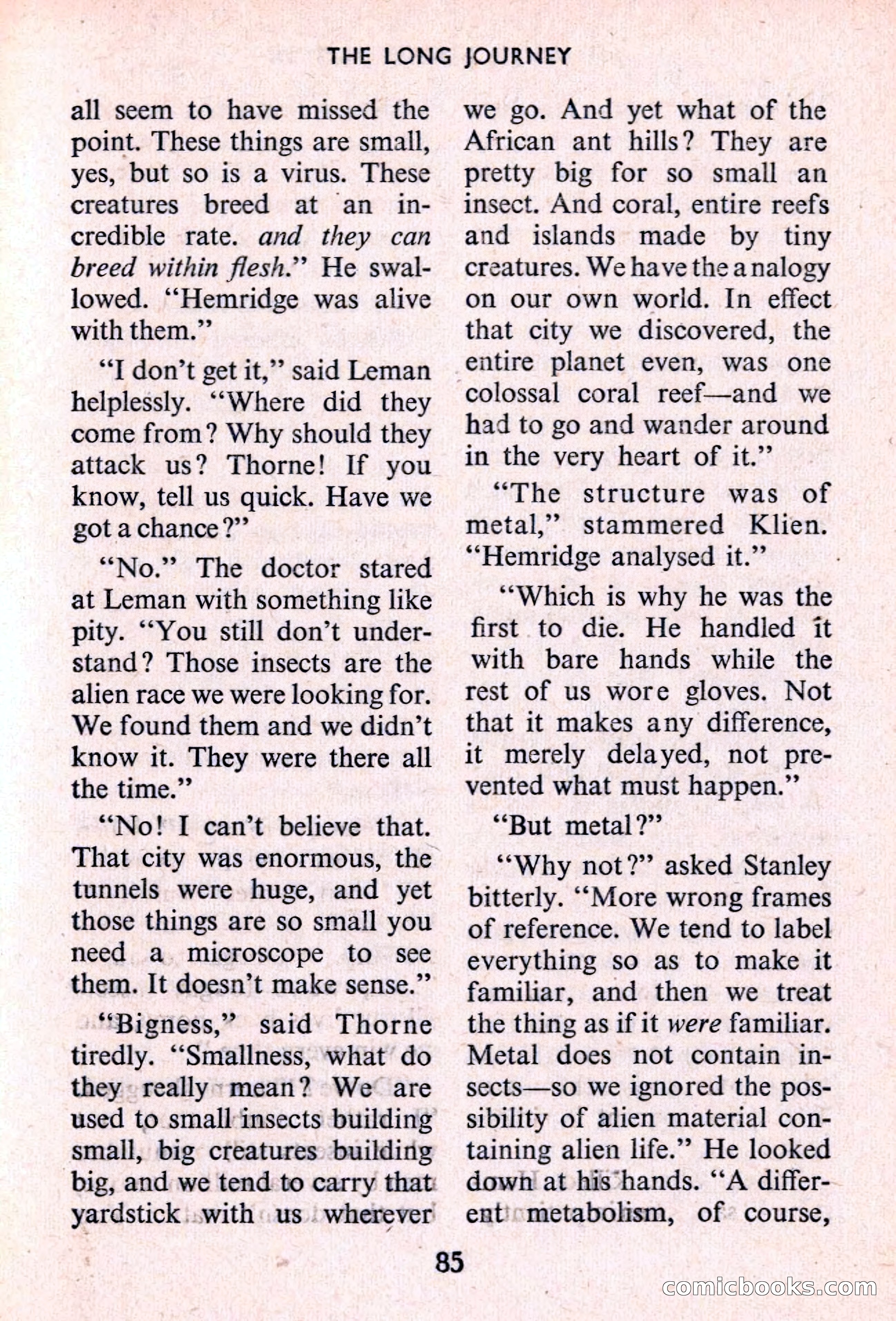
A restored page from Pulp Fiction, 1956. Page through the whole issue in the reader above.
📄 Transcribed text from this page (OCR, searchable)
Machine-transcribed from the original scan — historical spelling and the odd misread are preserved.
THE LONG JOURNEY all seem to have missed the point. These things are small, yes, but so is a virus. These creatures breed at an in- credible rate. and they can breed within flesh.’ He swal- lowed. ““Hemridge was alive with them.” “I don’t get it,” said Leman helplessly. “‘Where did they come from? Why should they attack us? Thorne! If you know, tell us quick. Have we got a chance?” “No.” The doctor stared at Leman with something like pity. ““You still don’t under- stand? Those insects are the alien race we were looking for. We found them and we didn’t know it. They were there all the time.” ““No! I can’t believe that. That city was enormous, the tunnels were huge, and yet those things are so small you need a microscope to see them. It doesn’t make sense.” *“Bigness,” said Thorne tiredly. ““Smallness, what do they really» mean? We are used to small insects building small, big creatures building big, and we tend to carry that: yardstick..with us . wherever 85 we go. And yet what of the African ant hills? They are pretty big for so small an insect. And coral, entire reefs and islands made by tiny creatures. We have the analogy on our own world. In effect that city we discovered, the entire planet even, was one colossal coral reef—and we had to go and wander around in the very heart of it.” “The structure was of metal,” stammered Klien. *‘Hemridge analysed it.” *“Which is why he was the first to die. He handled it with bare hands while the rest of us wore gloves. Not that it makes any difference, it merely delayed, not pre- vented what must happen.” ‘But metal ?’’ ‘““Why not?’ asked Stanley bitterly. “‘More wrong frames of reference. We tend to label everything so as to make it familiar, and then we treat the thing as if it were familiar. Metal does not contain in- sects—so we ignored the pos- sibility of alien material con- taining alien life.” He looked down at his hands. “‘A differ- ent! metabolism, of course, comclboooks.con