
Pulp Fiction, 1956 · page 79 of 162
Authentic Science Fiction Monthly, No. 67 — page 79: what you’re looking at
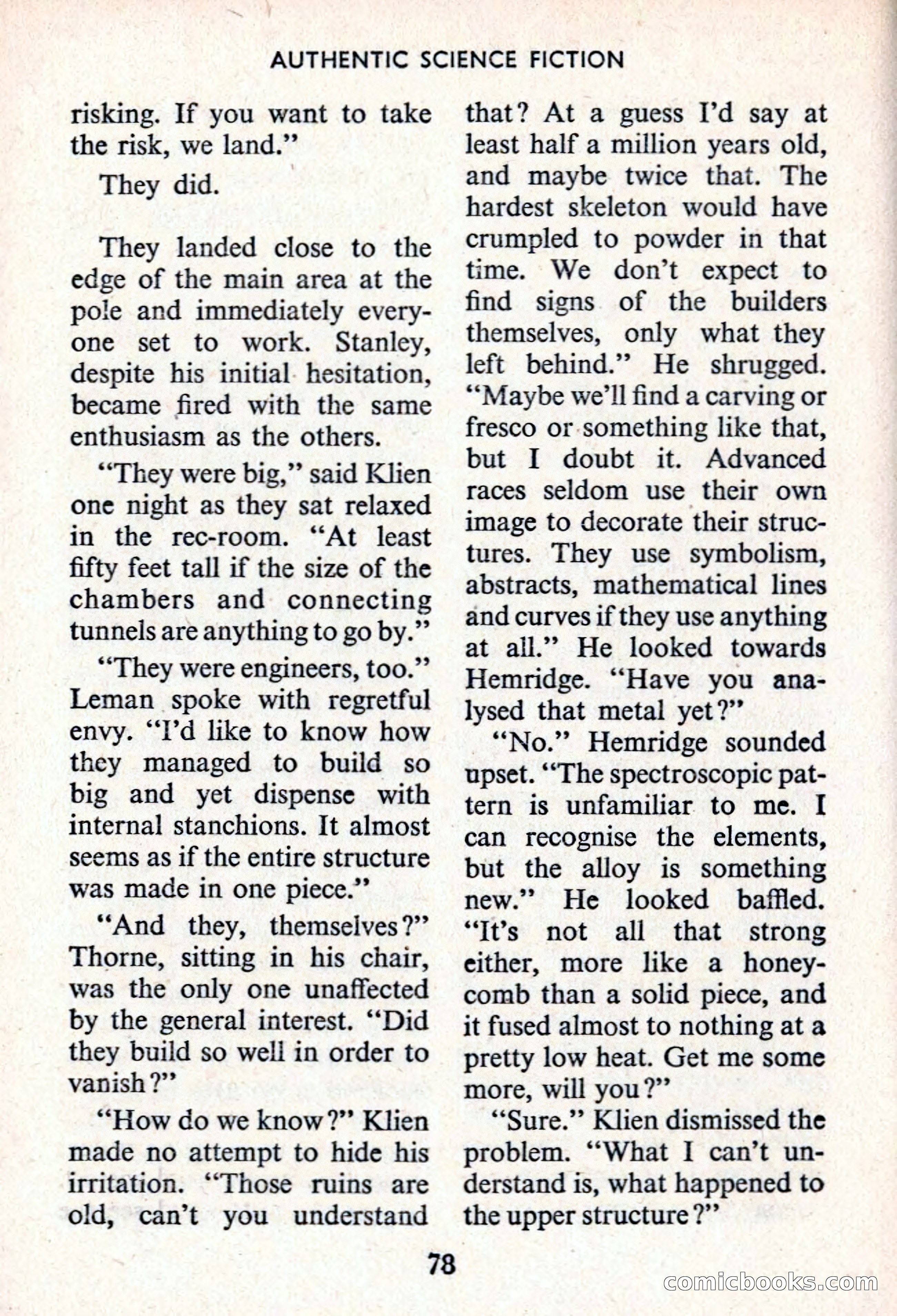
A restored page from Pulp Fiction, 1956. Page through the whole issue in the reader above.
📄 Transcribed text from this page (OCR, searchable)
Machine-transcribed from the original scan — historical spelling and the odd misread are preserved.
AUTHENTIC SCIENCE FICTION risking. If you want to take the risk, we land.”’ They did. They landed close to the edge of the main area at the pole and immediately every- one set to work. Stanley, despite his initial. hesitation, became fired with the same enthusiasm as the others. “They were big,” said Klien one night as they sat relaxed in the rec-room. “At least fifty feet tall if the size of the chambers and connecting tunnels are anything to go by.” “They were engineers, too.” Leman spoke with regretful envy. “‘I’d like to know how they managed to build so big and yet dispense with internal stanchions. It almost seems as if the entire structure was made in one piece.”’ “And they, themselves?’ Thorne, sitting in his chair, was the only one unaffected by the general interest. “‘Did they build so well in order to vanish ?” ““How do we know?” Klien made no attempt to hide his irritation. ““Those ruins are old, can’t you understand 78 that? At a guess I’d say at least half a million years old, and maybe twice that. The hardest skeleton would have crumpled to powder in that time. We don’t expect to find signs of the builders themselves, only what they left behind.” He shrugged. ““Maybe we’ll find a carving or fresco or something like that, but I doubt it. Advanced races seldom use their own image to decorate their struc- tures. They use symbolism, abstracts, mathematical lines and curves if they use anything at all.”” He looked towards Hemridge. “Have you ana- lysed that metal yet?” ““No.” Hemridge sounded upset. ““The spectroscopic pat- tern is unfamiliar to me. I[ can recognise the elements, but the alloy is something new.” He looked baffled. “It’s not all that strong either, more like a honey- comb than a solid piece, and it fused almost to nothing at a pretty low heat. Get me some more, will you?” “‘Sure.”’ Klien dismissed the problem. ““What I can’t un- derstand is, what happened to the upper structure ?”’ comicloooks.com