
Pulp Fiction, 1956 · page 44 of 162
Authentic Science Fiction Monthly, No. 67 — page 44: what you’re looking at
A restored page from Pulp Fiction, 1956. Page through the whole issue in the reader above.
📄 Transcribed text from this page (OCR, searchable)
Machine-transcribed from the original scan — historical spelling and the odd misread are preserved.
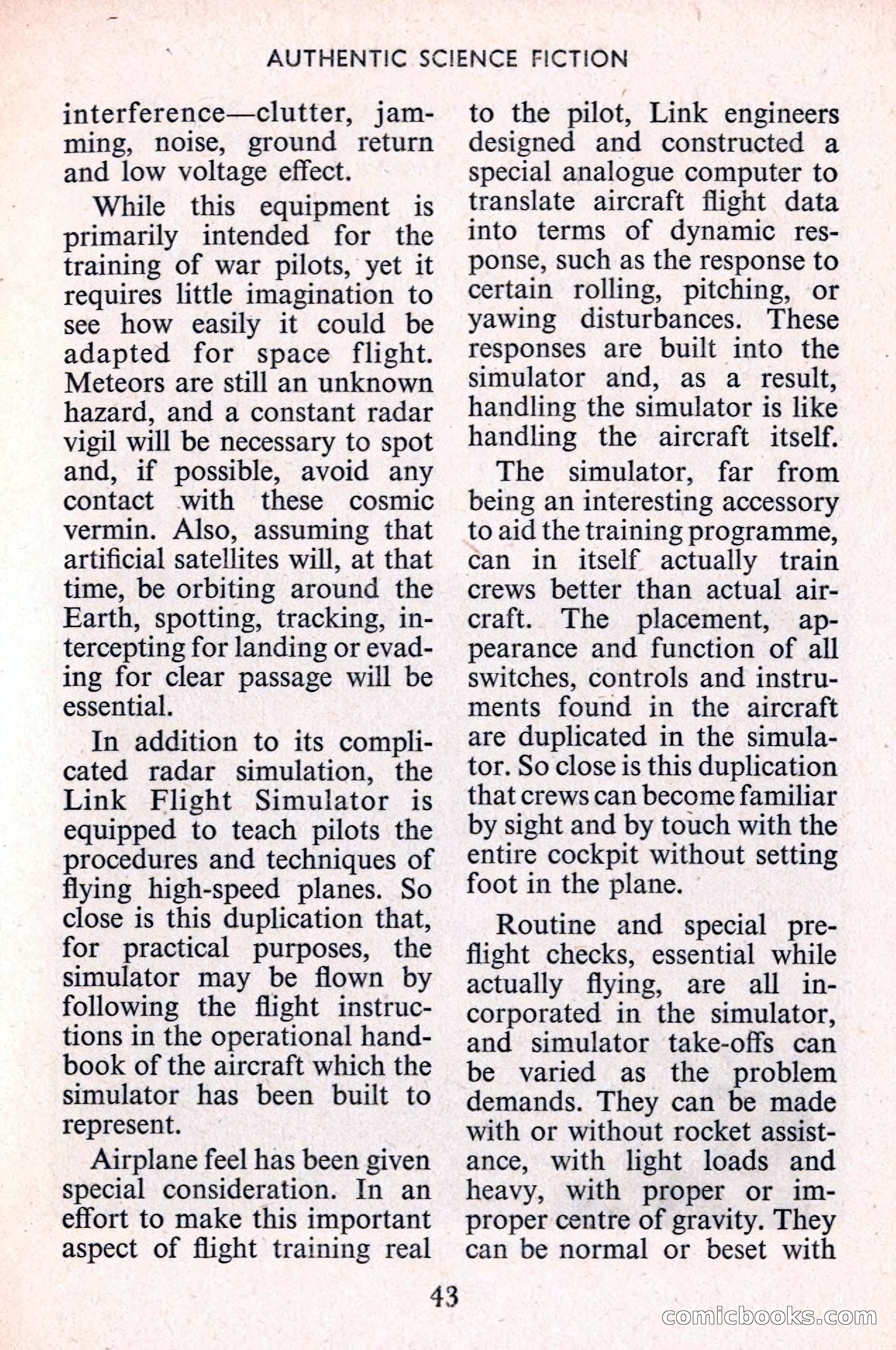
AUTHENTIC SCIENCE FICTION interference—clutter, jam- ming, noise, ground return and low voltage effect. While this equipment is primarily intended for the training of war pilots, yet it requires little imagination to see how easily it could be adapted for space flight. Meteors are still an unknown hazard, and a constant radar vigil will be necessary to spot and, if possible, avoid any contact with these cosmic vermin. Also, assuming that artificial satellites will, at that time, be orbiting around the Earth, spotting, tracking, in- tercepting for landing or evad- ing for clear passage will be essential. In addition to its compli- cated radar simulation, the Link Flight Simulator is equipped to teach pilots the procedures and techniques of flying high-speed planes. So close is this duplication that, for practical purposes, the simulator may be flown by following the flight instruc- tions in the operational hand- book of the aircraft which the simulator has been built to represent. Airplane feel has been given special consideration. In an effort to make this important aspect of flight training real 43 to the pilot, Link engineers designed and constructed a special analogue computer to translate aircraft flight data into terms of dynamic res- ponse, such as the response to certain rolling, pitching, or yawing disturbances. These responses are built into the simulator and, as a result, handling the simulator is like handling the aircraft itself. The simulator, far from being an interesting accessory to aid the training programme, can in itself actually train crews better than actual air- craft. The placement, ap- pearance and function of all switches, controls and instru- ments found in the aircraft are duplicated in the simula- tor. So close is this duplication that crews can become familiar by sight and by touch with the entire cockpit without setting foot in the plane. Routine and special pre- flight checks, essential while actually flying, are all in- corporated in the simulator, and simulator take-offs can be varied as the problem demands. They can be made with or without rocket assist- ance, with light loads and heavy, with proper or im- proper centre of gravity. They can be normal or beset with comiclooks.cormn